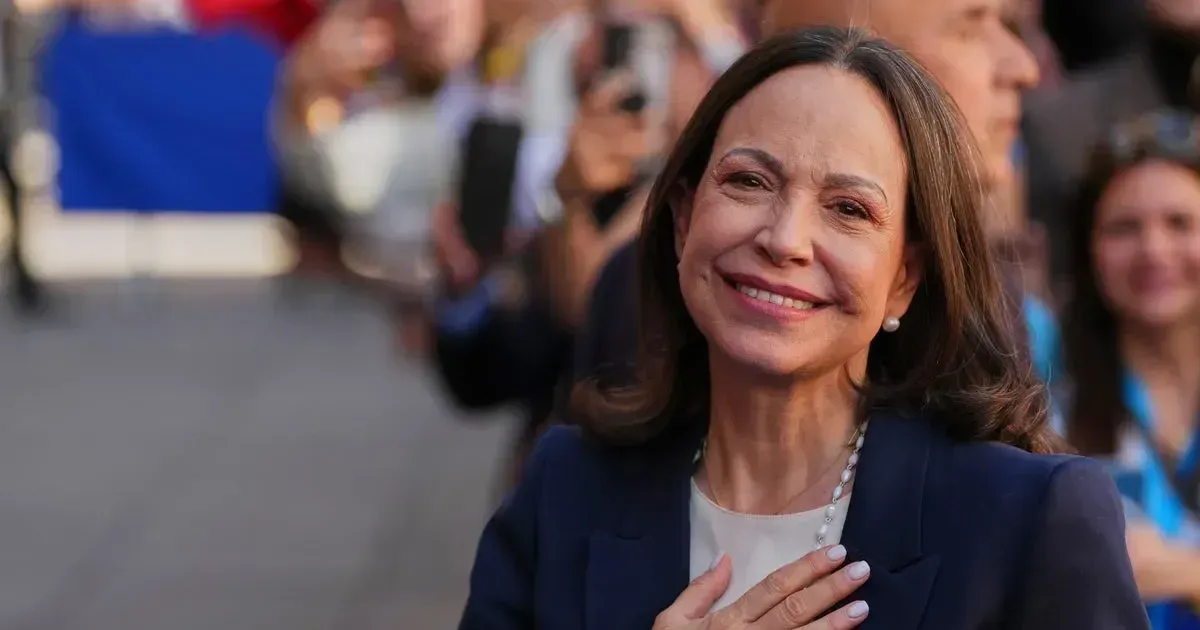
María Corina Machado turned a Madrid rally into a test of whether Venezuela's opposition can still project political force from exile.
The crowd had been building for hours, with flags, handmade signs and families who described the event as both political and personal. Many had followed Machado from afar through years of bans, threats and disputed votes. Thousands of Venezuelans filled Puerta del Sol on April 18, 2026, to hear Machado speak after leaving Caracas and rebuilding her campaign around diaspora pressure. The square mattered as much as the speech: Spain has become one of the most visible stages for Venezuelan opposition politics.
María Corina Machado framed the gathering as proof that distance from Venezuela does not mean distance from the country's political future.
Madrid Becomes Opposition Stage
The rally drew families carrying flags, older exiles who left years ago and newer arrivals still connected to relatives inside Venezuela. That mix gave the event a political charge beyond normal expatriate organizing.
Puerta del Sol has hosted many public causes, but this gathering carried a specific message: the opposition wants European governments to treat Venezuelan democracy as an active issue, not a frozen crisis.
Machado's decision to prioritize the crowd over official meetings also sent a signal to Spain's political class. The diaspora is more than a humanitarian constituency; it is a pressure network.
Pressure on Spain
Prime Minister Pedro Sánchez faces a delicate balance between diplomatic channels, domestic politics and the demands of Venezuelans who expect stronger language toward Nicolás Maduro.
Machado used the Madrid platform to argue that reconstruction will require accountability, investment and a return of professional talent now scattered across Europe and the Americas.
The rally did not change power in Caracas by itself. It did show that the opposition's public energy has not disappeared, even as repression and exile have forced it to move across borders.
Diaspora Leverage
For Machado, the strategic question is whether emotional solidarity can become organized diplomatic leverage. Madrid gave her a crowd; the harder task is turning that crowd into sustained pressure on institutions.
Machado's strength in Madrid came from speaking to people who have lived the consequences of Venezuela's collapse in practical terms. Many left behind property, careers, relatives or professional credentials that did not transfer easily. Their politics is shaped by memory, but also by the daily work of rebuilding lives abroad.
That makes the diaspora a complicated asset. It can raise money, lobby officials and keep international media attention alive, but it cannot vote freely inside Venezuela or organize neighborhoods under the same conditions as activists at home. Machado has to use exile energy without letting the movement look detached from domestic risk.
Spain's role is equally delicate. Madrid has humanitarian, linguistic and family ties to Venezuelans, while Spanish parties often use Venezuela as a symbol in their own ideological fights. Machado benefits from that visibility, but she also has to avoid becoming a prop in Spain's internal politics.
The rally's strongest message was continuity. Authoritarian governments often bet that exile will scatter opponents and exhaust their networks. The Madrid crowd suggested that dispersal has instead created new channels for pressure across Europe and Latin America. Still, crowds cannot substitute for strategy. Machado's next test is converting public emotion into coordinated diplomatic demands, legal advocacy and support for those who remain inside Venezuela under far greater personal risk. For Venezuelans in Spain, the rally also carried a practical demand: do not let normalization happen quietly. European governments can grow tired of prolonged crises, especially when trade, migration management and diplomatic channels become more convenient than confrontation. Machado's appearance pushed against that fatigue. The opposition leader also has to manage expectations. Exile speeches can lift morale, but they cannot promise an immediate return or a simple transition. Venezuela's institutions, economy and security apparatus would need a long reconstruction even if political change arrived suddenly. That is why the Madrid event worked best as a signal rather than a solution. It showed that the opposition still has an audience, a network and a story that resonates outside Venezuela. The next measure is whether that visibility produces sustained pressure from governments with real leverage. For Machado, Madrid also offered a safer place to say what many supporters inside Venezuela cannot say openly. That safety is useful, but it comes with responsibility. Exile leaders have to keep faith with people who still face surveillance, job loss and detention for the same slogans that can be shouted freely in a European square. Machado's Madrid rally therefore worked on two levels. It gave exiles a place to be seen together, and it reminded foreign governments that Venezuela's crisis still has organized witnesses abroad. The question is whether those witnesses can keep attention fixed after the square empties. That is the leverage Machado must now protect: a movement visible enough to matter abroad, but still disciplined enough to serve people inside Venezuela rather than only the emotions of exile.