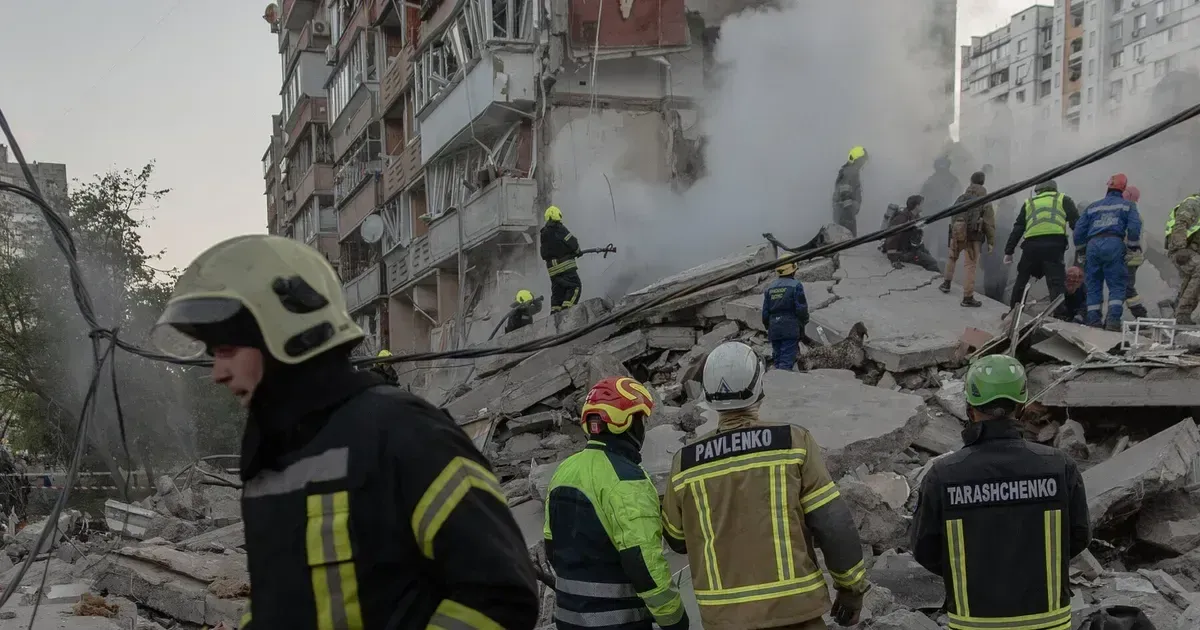
Moscow intensified its aerial bombardment across several Ukrainian provinces, hitting targets far from the active front lines in a sudden escalation of the air war. The attack also tested whether Ukraine could preserve air-defense coverage after the brief ceasefire ended. The scale of the barrage made the post-truce period look more dangerous, not less. The renewed offensive began on May 14, 2026, marking a violent shift in tactics since a brief three-day truce expired earlier in the week. Russian forces deployed enormous swarms of loitering munitions to overwhelm air defense networks in cities previously considered relatively safe from daily attrition.
President Volodymyr Zelenskyy confirmed that the scale of the onslaught reached record-setting levels over a forty-eight-hour period. Russian military units launched 1,560 drones at various infrastructure and residential targets starting on Wednesday. These attacks continued through Thursday morning, forcing citizens into shelters during daylight hours and disrupting commerce in the capital and surrounding regions.
One specific wave involved 800 drones launched in a single twenty-four-hour window. Moscow targeted energy facilities and logistical hubs, though reports from the ground indicate substantial damage to residential neighborhoods. At least six people were killed in the latest strikes, while dozens more sustained injuries as debris from intercepted projectiles fell on crowded urban areas.
Drone Swarms Target Civilian Infrastructure
Ukrainian air defense crews worked throughout the night and into the afternoon to intercept the incoming waves of Shahed-style munitions and missiles. Russia, however, adjusted its flight paths to approach targets from multiple directions simultaneously, echoing the pressure seen in a recent strike on Kyiv residential blocks. Cities far from the eastern trenches, including those in western and central Ukraine, faced multiple sirens as the swarms bypassed traditional border defenses.
President Volodymyr Zelenskyy stated that Russia fired more than 1,560 drones at Ukraine since Wednesday, describing the scale of the daytime barrage as a deliberate attempt to maximize civilian distress while international leaders met abroad.
Casualty figures rose steadily as emergency services reached sites in Kyiv and outlying districts. First responders confirmed that five people died during the initial strikes on Wednesday, with a sixth victim succumbing to wounds on Thursday morning. Hospitals in the capital reported a surge in patients suffering from shrapnel wounds and blast-related trauma following the daytime explosions.
Daytime attacks represent a psychological shift in the Kremlin's strategy. By striking during business hours, the Russian military increases the likelihood of civilian casualties and ensures that the visual impact of the strikes is captured by local media and residents. Many analysts suggest this timing is intended to prove that no region of the country is immune to the reach of the Russian aerospace forces.
Truce Collapse and Geopolitical Timing
Vladimir Putin previously hinted that the conflict could reach a conclusion soon, but the current volume of fire contradicts any immediate move toward de-escalation. The three-day truce that ended on Monday appears to have been followed by a large surge in Russian firepower, though officials have not established precisely how Moscow staged the munitions in advance. While the Kremlin maintains a public posture of being open to talks, the physical reality on the ground remains one of total mobilization for air superiority.
Reports from Kyiv suggest the intensity of the drone swarms is designed to deplete the stock of expensive interceptor missiles used by Ukrainian defense teams. If Ukraine exhausts its supply of Western-provided munitions, the Russian air force could potentially operate with greater freedom over the interior of the country. This resource-drain strategy is a primary concern for military planners in the Ministry of Defense.
Wednesday's escalation coincided with the arrival of Donald Trump in China for high-level diplomatic meetings. Ukrainian officials pointed to this timing as evidence that Moscow seeks to project strength and territorial dominance while the United States is occupied with Pacific diplomacy. The synchronization of the 800 drones on Wednesday suggests a calculated move to distract from or influence the outcomes of the Beijing summit.
Tactical Shift to Daytime Striking
Russian commanders seem to have abandoned the cover of night for these specific operations. Daytime visibility allows Russian reconnaissance units to film the impact of their strikes in real-time, providing immediate feedback for subsequent waves. That visibility can also serve Russian domestic messaging by showcasing the scale of the country's drone production lines.
Ukrainian military spokespersons noted that the drones are being launched from several sites, including the Crimean Peninsula and the Kursk region. If the current rate of fire persists, the demand on mobile fire groups and electronic warfare units will reach a critical point. Local commanders have requested additional man-portable air-defense systems to counter the low-flying threats that often evade radar detection by hugging the terrain.
Infrastructure repairs have become a race against time. Power crews are attempting to stabilize the grid between waves of attacks, but the sheer volume of 1,560 drones makes sustained restoration difficult. Residents in affected areas have been advised to remain near hardened structures, as the frequency of daytime sirens has increased fourfold since the start of the week.
Air Defense Pressure
How does a sovereign nation maintain its industrial and social cohesion when its entire territory becomes a live firing range? The current Russian strategy is not limited to pressure along trench lines in the Donbas; it also tests whether Ukraine can keep cities, utilities and transport corridors functioning under repeated aerial attack. By flooding the skies with cheap, mass-produced drones, Moscow is testing the limits of Western industrial capacity to provide defensive counters that cost ten times more than the targets they destroy.
Beijing and Washington are likely watching this development with varying degrees of alarm. If Moscow can sustain this level of pressure, it creates a template for future attrition-based conflicts where the quantity of autonomous systems outweighs the quality of traditional air platforms. The drone-led siege is a physical rebuttal to any diplomatic overtures made during the Beijing summit, signaling that the Kremlin is not yet ready to trade its kinetic leverage for a seat at the negotiating table.
The immediate future depends on the arrival of more sophisticated electronic warfare systems. Without the ability to jam these swarms at scale, Ukraine faces a summer of prolonged blackouts and a shrinking window for civilian normalcy. For many civilians, the practical boundary of the war now reaches far beyond the mapped front line and into city streets, substations and transport routes.