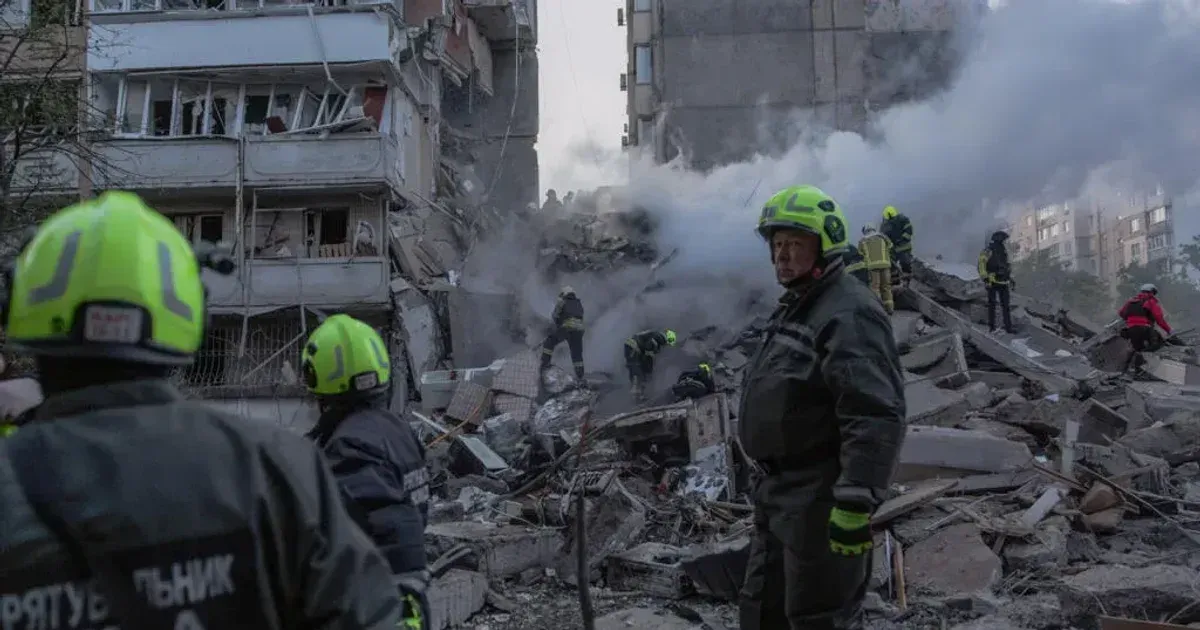
Russian forces launched a coordinated barrage of drones and ballistic missiles against multiple Ukrainian cities overnight. The primary focus of the assault appeared to be Kyiv, where several residential structures sustained direct hits. These strikes occurred during the early morning hours of May 14, 2026, forcing thousands of residents into subterranean shelters across the capital. Preliminary reports from local officials indicate that the density of the aerial attack was among the highest observed in recent months. Emergency crews moved quickly to address fires at multiple impact sites while air defense sirens continued to sound throughout the morning.
First responders arrived at the scene of a collapsed residential building in the capital shortly after the initial explosions. Residents in the vicinity reported hearing at least five distinct blasts before the structure partially pancaked. Search teams began sifting through mounds of concrete and twisted metal to locate individuals feared missing. BBC World confirmed that rescuers are searching for survivors in the rubble of the residential building hit overnight. Volunteers joined professional rescue teams to clear debris by hand as heavy machinery was brought in to lift larger slabs. Sunlight revealed the extent of the damage to the upper floors of the apartment block.
Casualty figures continue to rise as specialized teams access deeper sections of the ruins. Officials have confirmed that the attack resulted in at least one death and left dozens of others wounded. Many of the injuries involved lacerations from flying glass and blunt force trauma from falling masonry. According to France 24, the large aerial attack involved a combination of drones and ballistic missiles. Medical facilities in the capital remain on high alert to process the influx of civilians transported from various impact zones. At least twelve people were hospitalized in serious condition during the first few hours of the recovery effort.
"Rescuers are searching for survivors in the rubble of a residential building hit overnight in Kyiv," according to a statement from the BBC World service on the ground.
Air defense units across Ukraine struggled to intercept every incoming projectile due to the mixed nature of the weaponry. Russia deployed suicide drones alongside high-speed ballistic missiles to complicate the detection and interception process. These drones often act as decoys to exhaust air defense batteries before the faster missiles arrive at their targets. Al Jazeera reported that several buildings were damaged across the capital during the height of the engagement. Impact sites were not limited to the city center, with reports of damage surfacing from suburban districts and peripheral infrastructure hubs as well.
Rescue Operations and Residential Damage
Fires broke out in at least three separate neighborhoods following the strikes, requiring an extensive mobilization of the State Emergency Service. Wind conditions in the capital pushed smoke across the central districts, complicating visibility for drone pilots trying to assess the damage from above. One specific impact site saw a fire spread from a hit vehicle to an adjacent storefront, requiring a four-hour containment effort. Engineers began assessing the structural integrity of neighboring buildings to determine if they are safe for continued habitation. These assessments are critical because secondary collapses can occur hours after the initial kinetic impact.
Logistical challenges hampered the initial rescue response as debris blocked several key arterial roads leading to the hardest-hit apartment complex. Utility companies moved to shut off gas and electricity in the affected blocks to prevent secondary explosions or fires. This move left hundreds of families without power as temperatures dropped during the night. Local residents established makeshift aid stations to provide water and blankets to those displaced by the destruction. Many survivors stood wrapped in thermal foil as they watched the search for their neighbors continue into the afternoon. Psychological support teams were also dispatched to help witnesses and victims deal with the immediate trauma of the event.
The geographical scope of the mission extended beyond the capital to several other regions. Russia pummeled targets in southern and eastern provinces, suggesting a broad strategic intent behind the timing of the strikes. While the damage in Kyiv was the most visible, infrastructure in regional hubs also faced intense pressure. Authorities in those areas are currently tallying the destruction to power grids and water treatment facilities. One regional governor noted that the repair window for damaged substations would likely take several days. The persistent threat of follow-up strikes has made these repair efforts dangerous for technical crews on the ground.
Regional Escalation and Air Defense Challenges
Ukrainian military spokespersons noted that the variety of flight paths used by the drones suggests a sophisticated planning phase. Some projectiles entered the airspace from the north while others looped around from the east to bypass known defense clusters. This tactical shift forces defenders to spread their assets thin across a wider perimeter. Records show that the majority of the drones were successfully neutralized, yet the remaining ballistic missiles caused the bulk of the structural damage. Every successful strike on a residential area highlights the ongoing difficulty of protecting a sprawling urban environment against multi-axis attacks. Defense analysts observe that the saturation of the airspace remains a primary goal for the attacking forces.
Diplomatic reactions to the overnight violence were swift, with several Western allies condemning the targeting of civilian infrastructure. Statements from international monitors emphasized the humanitarian cost of the strikes on residential neighborhoods. These organizations are documenting the damage for inclusion in future reports on the conflict's impact on non-combatants. There is a mounting concern that the frequency of these large-scale aerial attacks will continue to strain the civilian population's access to basic services. The destruction of housing units adds to a growing internal displacement crisis that has persisted for years. Officials in the capital have begun looking for temporary housing solutions for the residents of the collapsed building.
The resilience of the emergency services has been tested by the sheer number of simultaneous incidents across the country. Teams that had just completed shifts in the east were rerouted to assist with the recovery in the capital. The constant rotation of personnel is necessary to manage the physical and mental fatigue of the first responders. Despite the exhaustion, the search for the missing remains the top priority for the government. Families of those believed to be in the rubble have gathered at a safe distance, waiting for any news from the search teams. The recovery effort is expected to continue for several more days as the basement levels are cleared of debris.
Civilian Protection Risk
The intensity of this latest aerial campaign indicates a shift in the operational rhythm of the conflict. By launching a mass of drones and ballistic missiles simultaneously, the attacking forces are attempting to identify gaps in the evolving air defense network. The tactic places immense pressure on the inventory of interceptor missiles, which are both expensive and limited in supply. The focus on residential zones in the capital also serves to distract military resources from front-line positions, forcing a redistribution of mobile defense units to protect urban centers. Such a move leaves other critical infrastructure more vulnerable to subsequent waves of attack.
Regional stability is further complicated by the damage to civilian logistics and power distribution hubs. When a capital city faces this level of disruption, the wider economic effects are felt in neighboring provinces. The ability of the national government to maintain essential services becomes a primary metric of resilience in the eyes of the public and international observers. The air strike is a blunt instrument of psychological pressure, aimed at degrading the domestic morale of the population. Whether the current defense posture can adapt to these saturation tactics will determine the level of protection afforded to other major cities in the coming weeks.