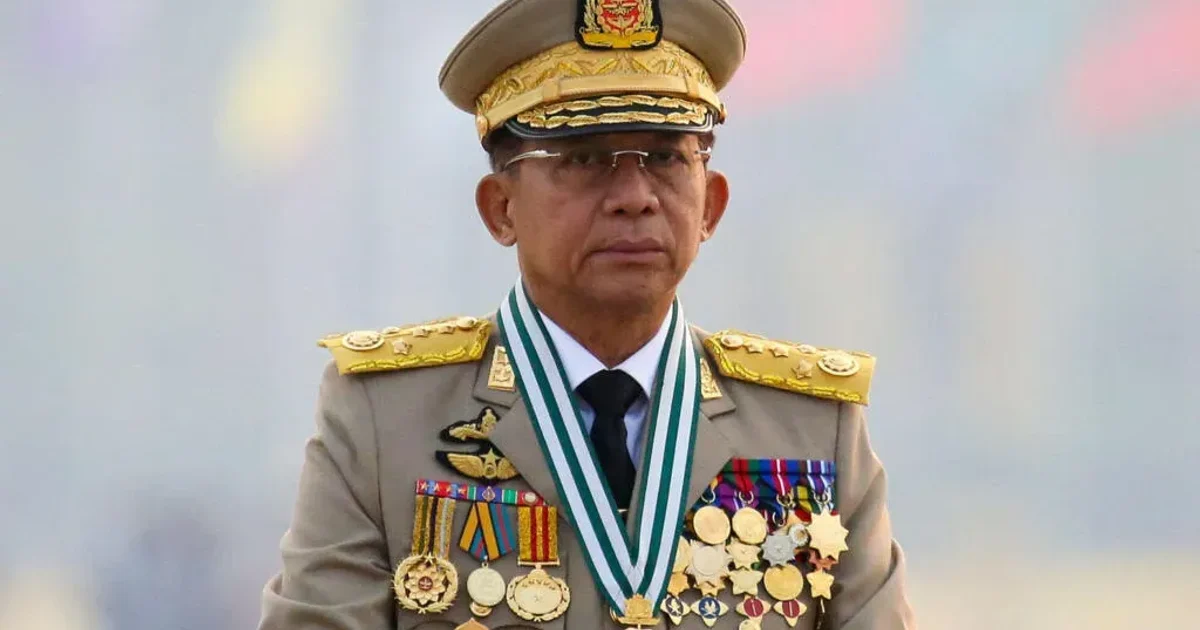
Min Aung Hlaing secured the presidency of Myanmar during a parliamentary session in the fortified capital of Naypyidaw. Legislative members gathered in the assembly hall to confirm the transition of the former Senior General from military commander to civilian head of state. The change occurred five years after the military intervention that removed the elected government from power in early 2021.
Official tallies from the session confirmed a decisive margin for the military leader. The April 3, 2026, session formalized a transition that opponents view as military rule in civilian clothing. According to legislative records, Min Aung Hlaing received 429 votes out of 584 ballots cast by the seated members of parliament. Support within the chamber mirrored the composition of the body, which consists largely of military appointees and representatives from pro-army political organizations. The outcome was widely anticipated by observers who have tracked the reorganization of the administrative structure since the ousting of Aung San Suu Kyi.
Min Aung Hlaing and Constitutional Requirements
Legal protocols mandated a specific set of transitions before the general could assume the presidency. Constitutional requirements forced the general to relinquish his top military post to maintain the facade of a civilian administration. Responsibility for the armed forces passed to the former spymaster of the country. This internal shift allowed the junta leader to claim compliance with the 2008 Constitution, a document drafted by the military to ensure its continued influence over the political sphere.
Relinquishing the role of Commander-in-Chief did not diminish the personal power of the new president. Analysts suggest the move is a rebranding exercise designed to seek regional legitimacy. Military leaders believe a formal civilian title will enable smoother diplomatic interactions with the Association of Southeast Asian Nations. A civilian title allows the ruling council to present a narrative of returning to constitutional normalcy while maintaining the same personnel at the top of the hierarchy.
Opponents of the regime dismissed the proceedings as a scripted performance. Monitoring groups noted that the electoral process excluded any meaningful opposition participation. Many potential candidates remain in detention or live in exile. Those who attempted to organize alternative political movements faced arrest or legal disqualification under the current restrictive laws.
Parliamentary Process and Security Measures
Security around the capital reached peak levels during the voting period. Armored vehicles patrolled the outskirts of Naypyidaw while checkpoints restricted movement into the government district. Authorities deployed thousands of soldiers to prevent disruptions from resistance forces active in other regions of the country. Government officials reported no security breaches during the parliamentary session. The session followed the earlier nomination of Min Aung Hlaing for the Myanmar presidency.
Legislators who voted for the general spoke of a need for stability and strong leadership. They emphasized that the military remains the only institution capable of preventing national fragmentation. Supporters in the chamber argued that the president possesses the necessary experience to handle both domestic security challenges and economic pressure from Western sanctions. Voting occurred rapidly without serious debate or dissenting voices from the floor.
Records indicate that the 584 members present represented the minimum quorum required for a valid vote. Many seats originally belonging to the National League for Democracy remain vacant following the 2021 crackdown. Military officials filled these gaps with loyalists or left them empty to ensure the voting bloc remained under central control. The resulting parliament functions as an extension of the State Administration Council. Appointment of the former spymaster as the new military chief indicates a consolidation of internal intelligence networks. The former spymaster previously managed the surveillance apparatus used to monitor both civilian activists and potential defectors within the ranks. Placing a loyalty-tested intelligence specialist at the helm of the army ensures the new president retains invisible threads of control over the soldiers. Military hierarchy remains rigid despite the change in titles.
Intelligence gathering has become the primary tool for the regime in its fight against the People’s Defense Forces. Resistance groups continue to challenge government authority in the borderlands and central plains. By elevating a spymaster, the president signaled that counter-insurgency and domestic surveillance will remain the top priorities for the foreseeable future. Direct military operations frequently rely on the data provided by these intelligence wings.
Commanders across the various regional districts reportedly pledged their allegiance to the new nominally civilian leader. The unified front aims to dispel rumors of internal fracturing among the officer corps. Disagreements over the progress of the civil war have occasionally surfaced in leaked reports, but the public display in the capital emphasized total cohesion. Power remains concentrated in a small circle of individuals who have led the country since the 2021 coup.
International response to the election remained cold across Western capitals. The United States and the European Union issued statements refusing to recognize the legitimacy of the parliamentary vote. Diplomatic representatives argued that an election held under military occupation could not be considered free or fair. Sanctions against the military leadership continue to restrict the flow of foreign currency and aviation fuel into the country.
Regional neighbors provided a more varied reaction to the news. Some members of the Association of Southeast Asian Nations expressed hope that a civilian-titled leader might be more amenable to the Five-Point Consensus peace plan. Others maintained a policy of non-interference, treating the election as an internal matter of the Myanmar state. China and Russia continue to maintain formal ties with the administration, providing essential military hardware and economic support.
Economic conditions in the country persist in a state of volatility. Inflation has eroded the purchasing power of the local currency, while energy shortages frequently disrupt industrial production. The new president faces the task of stabilizing a domestic market that has contracted sharply since 2021. Investors from neighboring countries remain cautious because of the ongoing armed conflict in the countryside.
Military Rule Takes a Civilian Title
Does a change of title offer a path to international recognition for a pariah state? History suggests that lipstick on a bayonet rarely convinces a skeptical global audience. Min Aung Hlaing is attempting to replicate the 2011 transition of Thein Sein, hoping that a suit and a civilian office will serve as a gateway to the removal of sanctions. The calculation ignores the reality that the current resistance is far more widespread and better armed than any opposition the military faced in previous decades. The international community is not in the mood for another decade of managed democracy that ends in a massacre.
The presidency is a hollow shell designed for a domestic audience that no longer believes in the military’s myth of national unity. By appointing a spymaster to his old military post, the president has effectively created a shadow command structure. He is the head of state on paper and the supreme warlord in practice. The tactical resignation is a transparent fraud. If the junta believes this performance will unlock foreign investment or dampen the fire of the People’s Defense Forces, they have fundamentally misread the temperature of the nation.
Expect the conflict to intensify as the opposition sees this election as the final burial of any negotiated settlement. Generals have closed the door on compromise. Total victory or total collapse is now the only remaining outcome.