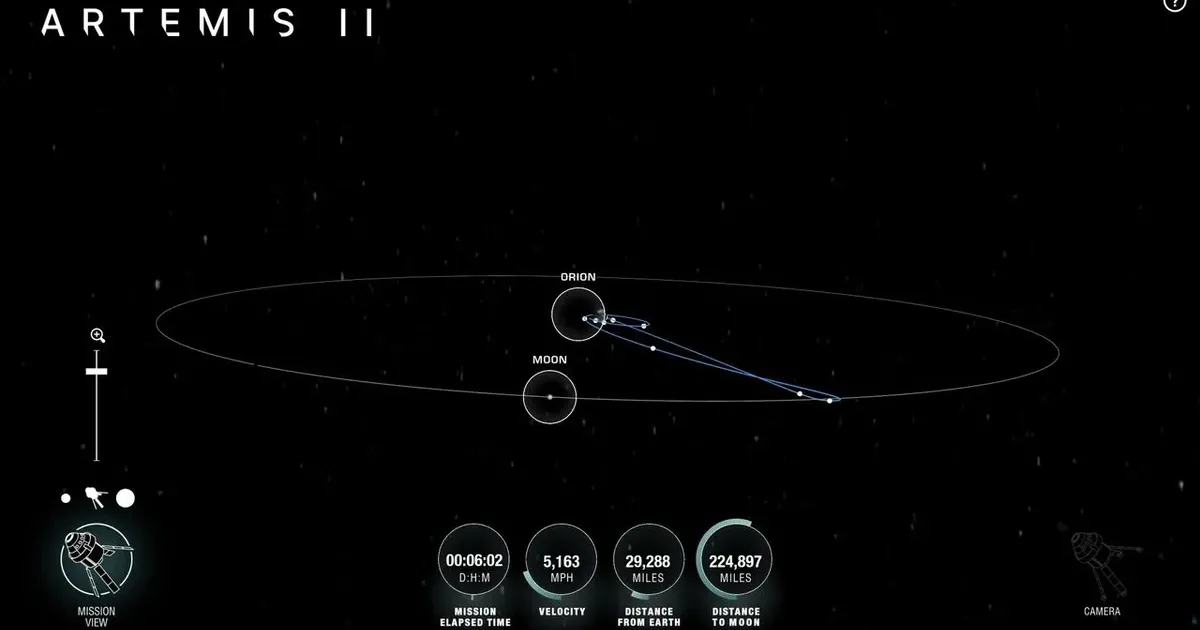
NASA astronauts Reid Wiseman, Victor Glover, Christina Koch, and Jeremy Hansen entered their second day in space on April 2, 2026, while preparing for a critical engine burn to depart Earth orbit. Mission controllers at the Johnson Space Center confirmed that the Orion spacecraft systems are performing within expected parameters. These four individuals are the first humans to venture toward the moon since the final Apollo mission in 1972. Success for this 10-day voyage hinges on a series of precise maneuvers designed to test the resilience of deep-space life support systems. NASA officials currently monitor every telemetry point from the high Earth orbit phase.

Flight dynamics officers scheduled a high-stakes engine burn to transition the crew from their current elliptical path into a translunar trajectory. This maneuver uses the European Service Module to provide the necessary thrust for a lunar slingshot. Previous data from the uncrewed Artemis I mission in 2022 provided a baseline for these maneuvers, yet the presence of a human crew introduces complex variables in mass and life-support consumption. Engineers designed the Orion capsule to sustain four astronauts for 21 days in the event of mission delays. Current propellant levels exceed the safety margins required for the return leg.

Artemis II Engine Burns and Orbital Mechanics

Primary mission objectives for the second day include the proximity operations demonstration and the critical Trans-Lunar Injection. Crew members practiced manual piloting earlier in the flight by using the spent upper stage of the Space Launch System rocket as a proximity target. Victor Glover, the mission pilot, executed a series of small thruster firings to maintain a fixed distance from the hardware. These tests verify that the spacecraft can perform docking maneuvers during future landings on the lunar surface. Precise alignment during these operations prevents fuel wastage and structural stress on the docking ring.

Mission control centers in Houston and Huntsville coordinate the timing of the next propulsion sequence. Every second of engine firing adds roughly 3,000 feet per second to the velocity of the spacecraft. If the burn duration varies by more than 1 percent, the crew could miss the lunar gravity well entirely. Navigational computers use star trackers and GPS signals from Earth to verify the trajectory before ignition. The $4 billion Space Launch System rocket placed the capsule in an initial orbit with a high point of approximately 46,000 miles. Ground stations in Spain and Australia maintain continuous contact through the Deep Space Network.

Environmental control systems inside the cabin maintain a steady pressure of 14.7 pounds per square inch. Christina Koch and Jeremy Hansen spent the morning monitoring the water recycling systems and CO2 scrubbers. These technologies differ sharply from those used on the International Space Station because they must operate without regular resupply from Earth. Radiation sensors located throughout the hull track the exposure levels as the ship passes through the Van Allen belts. Lead flight director Zebulon Scoville noted that the radiation readings fell within the lower end of the predicted range. For a deeper look into potential complications, our reporting on the European Service Module outlines the technical flaws observed during the mission.

Lunar Trajectory and Crew Operations

While the crew prepares for the lunar slingshot, they must also manage the physiological demands of microgravity. Space adaptation syndrome affects roughly half of all astronauts during the first 48 hours of flight. Medical officers on the ground monitor heart rates and sleep cycles via biometric sensors embedded in the flight suits. Despite the cramped quarters of the Orion capsule, the crew maintains a rigorous schedule of maintenance and exercise. Reid Wiseman is the commander and oversees the integration of automated systems with manual overrides. The cabin volume provides approximately 330 cubic feet of livable space for the team.

The hardware is performing flawlessly, and the crew is focused on the transition from Earth orbit to the lunar environment, according to a spokesperson for NASA.

Calculations for the free-return trajectory ensure that the moon's gravity will naturally pull the spacecraft back toward Earth. This safety feature eliminates the need for a secondary engine burn to leave lunar orbit. If the main engine fails after the slingshot, the Orion capsule will still splash down in the Pacific Ocean on schedule. Experts at the European Space Agency manufactured the service module that houses the primary engines and solar arrays. Four solar wings provide enough electricity to power two average suburban homes simultaneously. The arrays also serve as the primary communication antenna mounting points.

Digital Tracking and Public Engagement

NASA launched a dedicated web portal to allow the public to track the mission progress in real time. The Artemis Real-time Orbit Website, or AROW, provides live data on distance, speed, and elapsed mission time. Users can toggle between views showing the spacecraft relative to the Earth and the Moon. Thousands of students and researchers use this data to calculate orbital decay and fuel consumption rates. Internal cameras inside the Orion capsule transmit high-definition video of the lunar approach when bandwidth permits. Ground controllers prioritize telemetry over video during critical burns.

Data from the tracking site shows the Orion traveling at over 20,000 miles per hour during its departure from high Earth orbit. This speed will decrease as Earth's gravity pulls on the spacecraft during its outbound trek. Once the ship enters the lunar sphere of influence, the gravity of the moon will accelerate the capsule again. The distance between the Earth and the Moon on this date is roughly 238,000 miles. Amateur astronomers equipped with high-powered telescopes can occasionally spot the reflection of the Orion solar panels against the dark background of space. High-resolution imagery from the spacecraft will reach Earth with a latency of approximately 1.3 seconds.

Public interest in the mission remains high across North America and Europe. Educational programs in the United Kingdom and Canada focus on the contributions of Jeremy Hansen, the first non-American to leave Earth orbit. Canadian Space Agency officials confirmed that Hansen is responsible for the health monitoring systems during the lunar transit. His participation highlights the international nature of the Artemis program. Future missions plan to include astronauts from Japan and the European Union. The 50 years of waiting for a return to lunar proximity ended the moment the Orion crossed the 2,000-mile altitude mark.

The Elite Tribune Strategic Analysis

Lunar exploration is the ultimate geopolitical scoreboard, and the Artemis II mission is less about scientific discovery than it is about re-establishing American hegemony in the cis-lunar economy. While NASA promotes a narrative of international cooperation, the underlying reality is a frantic race to claim strategic territory at the lunar south pole. China's rapid advancement in heavy-lift rocketry has forced Washington to accelerate a timeline that is straining both the federal budget and the technical capacity of traditional aerospace contractors. The reliance on the Space Launch System, a vehicle built with decades-old shuttle technology, exposes a lack of innovation that private competitors like SpaceX have already surpassed.

Voters should not be fooled by the high-definition streams of smiling astronauts. The mission carries a price tag that rivals the GDP of small nations, yet it offers no immediate return on investment beyond national prestige. If the Orion capsule suffers a catastrophic failure during the lunar slingshot, the entire American space program could face a decade of stagnation. The stakes are not merely the lives of four pilots, but the credibility of a superpower that has tied its identity to the final frontier. We are paying for a repeat of the 1960s at 21st-century prices. It is a gamble.