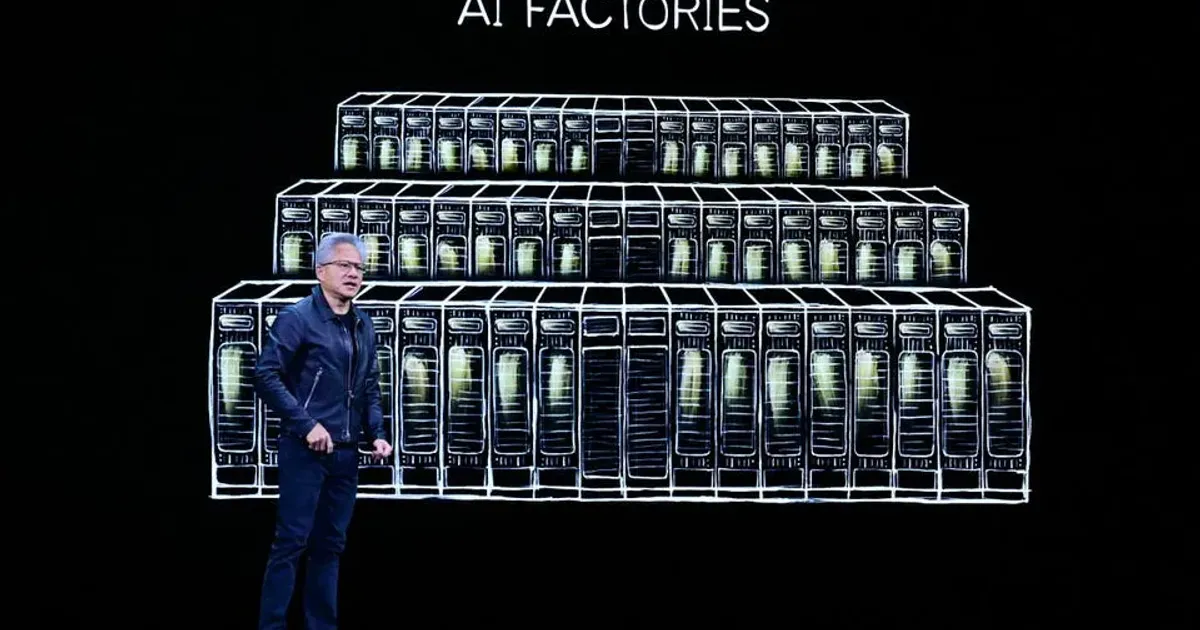
Nvidia's $2 billion investment in Marvell Technology was not a side bet on a smaller chip name. It was a signal that the AI infrastructure fight has moved beyond raw accelerator supply. The next constraint is how data moves across racks, switches, memory, custom processors and optical links inside the largest AI data centers.
The March 31 partnership connected Marvell to Nvidia's NVLink Fusion platform, a rack-scale system meant to let customers build semi-custom AI infrastructure around Nvidia components. Marvell brings custom silicon, scale-up networking and optical-connectivity experience. Nvidia brings the GPU platform, networking hardware, software stack and customer pull that can turn a technical design into a buying standard.
The companies will also collaborate on silicon photonics technology.
The Bottleneck Moved Into the Links
AI clusters do not work like isolated servers. Training and inference workloads depend on thousands of processors exchanging data quickly enough that expensive accelerators do not sit idle. The larger the cluster, the more performance is lost in movement: chip to chip, rack to rack, accelerator to memory, compute to storage.
Networking therefore and interconnects are no longer background plumbing. They are part of the product. If GPUs double in value but the links around them waste power, add latency or fail at scale, the customer pays for compute it cannot fully use. Nvidia's Marvell deal is aimed at that gap.
Silicon Photonics Targets a Physical Limit
Copper still carries a large share of data-center traffic, but it becomes harder to stretch as speeds rise and rack density increases. Distance, heat, signal loss and power use all become more expensive. Silicon photonics tries to move more of that traffic with light, closer to where data is created and consumed.
The promise is not magic speed for its own sake. It is bandwidth per watt, cleaner signal integrity and fewer compromises in dense AI systems. Optical links can help reduce the energy lost in moving data, and those savings matter when data centers are already constrained by electricity, cooling equipment, transformers and physical space.
Marvell Gives Nvidia a Semi-Custom Door
Marvell's value is not that it can replace Nvidia's accelerators. Its value is that cloud builders and telecom operators increasingly want hardware shaped around their own workloads. Custom XPUs, AI-RAN infrastructure, optical interconnects and scale-up networking give Nvidia a way to serve those customers without making every layer entirely in-house.
The semi-custom door is strategically useful. Nvidia can keep its platform at the center while offering more paths for customers that want semi-custom systems. Marvell gets validation, demand and a closer position near the most important buyer conversations in AI infrastructure. Both sides gain leverage, but not the same kind of leverage.
The Deal Also Tightens Nvidia's Grip
There is a customer benefit in integration. One coordinated architecture can be easier to deploy than a pile of disconnected parts. But the same integration raises dependency questions. If Nvidia influences accelerators, switches, interconnects, software, reference designs and partner silicon, buyers may find it harder to negotiate price or switch direction later.
Integration creates the tension behind the deal. Cloud operators want speed and reliability, but they also fear being trapped inside one supplier's roadmap. Marvell can help create flexibility inside Nvidia's architecture, yet the architecture still strengthens Nvidia's role as the company setting the terms of the buildout.
Power Efficiency Is Becoming a Financial Metric
The AI boom has made electricity and cooling part of the income statement. A faster interconnect is valuable only if it improves total system economics. If silicon photonics lowers the cost of moving data, it can reduce wasted accelerator time and improve the return on expensive racks. If it adds complexity without enough energy savings, the promised gains shrink quickly.
The Marvell relationship therefore belongs beside discussions of data-center power contracts, utility delays and transformer shortages. The winning AI system is not just the one with the fastest chip. It is the one that can train and serve models at scale without turning every watt, cable and cooling loop into a bottleneck.
Marvell's Opportunity Comes With Concentration Risk
For Marvell, Nvidia's money and technical partnership can pull demand forward. It can also concentrate attention around one dominant platform. A deeper Nvidia relationship may lift Marvell's profile with cloud customers, but it can make investors more sensitive to any change in Nvidia's architecture, procurement pace or public endorsement.
The strategic reading is that Nvidia is no longer only selling the engine of the AI data center. It is shaping the roads, signals and power lines around that engine. Marvell now has a valuable place in that system, but the value comes from proximity to Nvidia's control point. The same proximity creates opportunity and risk in the same package.