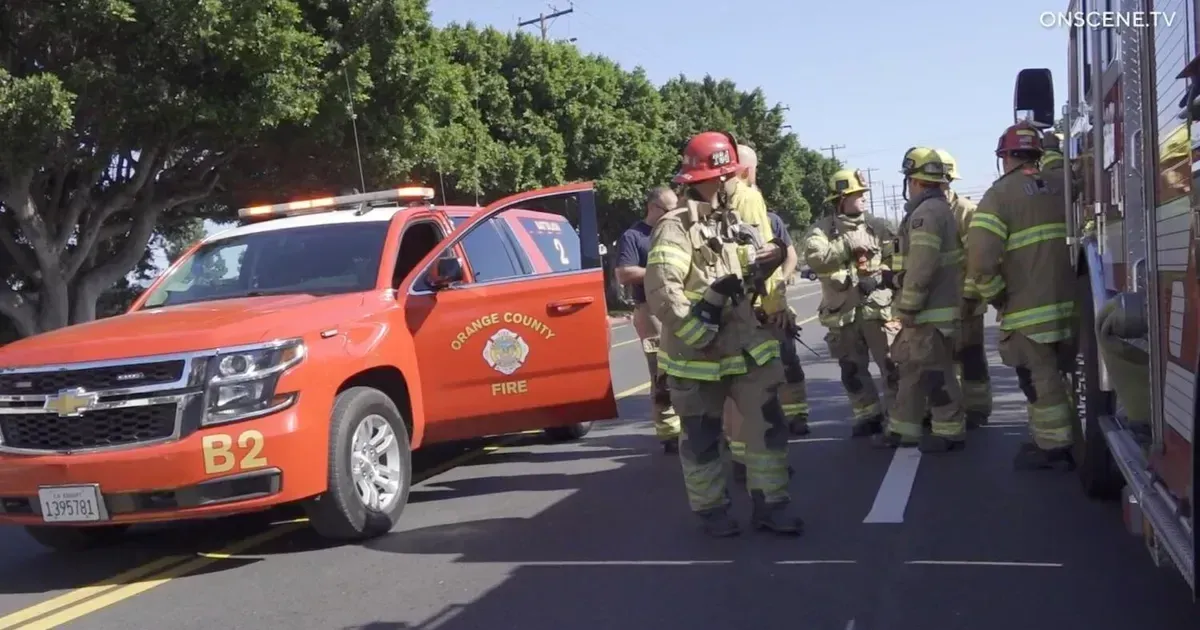
Orange County emergency personnel ordered 40,000 residents to evacuate Friday to avoid a potential chemical explosion. The evacuation order turned an industrial hazard into a countywide public-safety operation. Officials first had to move residents before they could explain how unstable the tank had become. The mandatory evacuation, announced on May 22, 2026, follows a failure to stabilize a high-capacity storage tank located at a local manufacturing facility. Local authorities identified the site as GKN Aerospace, a plant in Garden Grove that produces engine structures for both commercial and military aircraft. Emergency crews determined that a tank containing a volatile chemical is currently in a state of crisis and could fail or explode at any moment.
GKN Aerospace serves a critical role in the aviation supply-chain by manufacturing specialized plastic epoxy parts and engine components. Workers first noticed a problem Thursday night when toxic fumes began off-gassing from a 34,000-gallon storage tank. Cooling operations were initially deployed to lower the internal temperature of the container, but those measures failed to prevent an escalation. Failure to contain the heat levels led fire officials to conclude that the tank is no longer safe to secure or cool through direct intervention.
Environmental protection records describe methyl methacrylate (MMA) as a flammable and volatile plastic epoxy used widely in the aerospace sector. Exposure to the chemical carries serious health risks including acute skin irritation and eye damage. Short-term contact often leads to severe respiratory issues according to the Environmental Protection Agency. Because the substance is highly reactive, it requires precise temperature controls to remain stable in large quantities.
"We are setting up these evacuations in preparation for these two options: It fails, or it blows up," Covey said.
Incident Commander and Orange County Fire Division Chief Craig Covey confirmed that the crisis has surpassed the point of standard containment.
Chemical Volatility and Thermal Runaway Threats
Hazardous materials experts warn that the tank is currently entering a state of thermal runaway. This chemical process occurs when an exothermic reaction goes out of control, causing internal temperatures and pressure to rise rapidly. If the pressure exceeds the structural integrity of the vessel, a violent rupture will occur. Such an event would likely spark the flammable MMA and potentially trigger a chain reaction with neighboring tanks containing fuel and other manufacturing chemicals.
Risk assessments provided during an emergency news conference highlighted two specific catastrophic outcomes. The first involves a structural failure of the tank walls, which would result in the spill of approximately 6,000 to 7,000 gallons of toxic chemicals. While a spill would create a serious environmental hazard, fire crews are more concerned about the second option of a total explosion. An uncontrolled blast could send shrapnel and toxic debris through the surrounding industrial park and residential neighborhoods.
Firefighters have abandoned direct cooling efforts because the risk of a sudden explosion has made proximity to the tank too dangerous for ground personnel. Safety teams have established a wide perimeter to protect first responders from a possible pressure vessel failure. Remote monitoring equipment is now the primary method for tracking the internal conditions of the deteriorating tank.
Containment Failures at GKN Aerospace
Orange County Fire Authority Interim Chief TJ McGovern stated that crews worked around the clock at the Garden Grove site after discovering the leak. Initial reports on Thursday suggested that firefighters had stabilized the situation, briefly allowing some residents to return home. However, the internal reaction within the tank restarted Friday morning, leading to the large 40,000-person evacuation order. The sudden shift in stability suggests that the chemical inhibitors meant to prevent the MMA from hardening or reacting have been exhausted.
Commanders have prioritized life safety by clearing a large radius around the Knott Street facility. Residents in the path of a potential toxic plume have been directed to emergency shelters established at local community centers. Police departments from neighboring jurisdictions are assisting with traffic control to ensure the rapid movement of people out of the hazard zone. The evacuation remains in effect until hazardous materials teams can confirm the tank has either completely reacted or has been safely drained.
Public health officials have warned anyone within the evacuation zone to keep windows closed and avoid using air conditioning units that pull in outside air. Methyl methacrylate vapors are heavier than air and can settle in low-lying areas or basements. Local hospitals have been placed on high alert to treat potential cases of chemical inhalation or skin burns.
Garden Grove Safety Perimeter
Managing high-capacity storage of volatile monomers like methyl methacrylate presents a persistent challenge for industrial safety and regional security. When large-scale tanks enter thermal runaway, the traditional tools of firefighting often prove insufficient to stop the kinetic energy of the reaction. The situation in Garden Grove highlights the vulnerability of residential zones located in close proximity to specialized aerospace manufacturing hubs. A single tank failure can displace tens of thousands of citizens and disrupt critical infrastructure for days.
High-density urban areas rely on the strict adherence to chemical cooling and storage protocols to prevent such events from occurring. It is clear that when these systems fail, the resulting crisis requires a total mobilization of regional resources. This event will likely prompt an investigation into the specific maintenance and monitoring logs of the 34,000-gallon unit. Future safety standards may require more robust secondary containment or automated emergency venting systems to reduce the risk of thermal runaway. Until the pressure inside the GKN Aerospace tank subsides, the threat of a catastrophic blast dictates every aspect of the local emergency response zone. Safety protocols dictate that the perimeter must remain cleared until all reactive energy has dissipated from the containment unit.