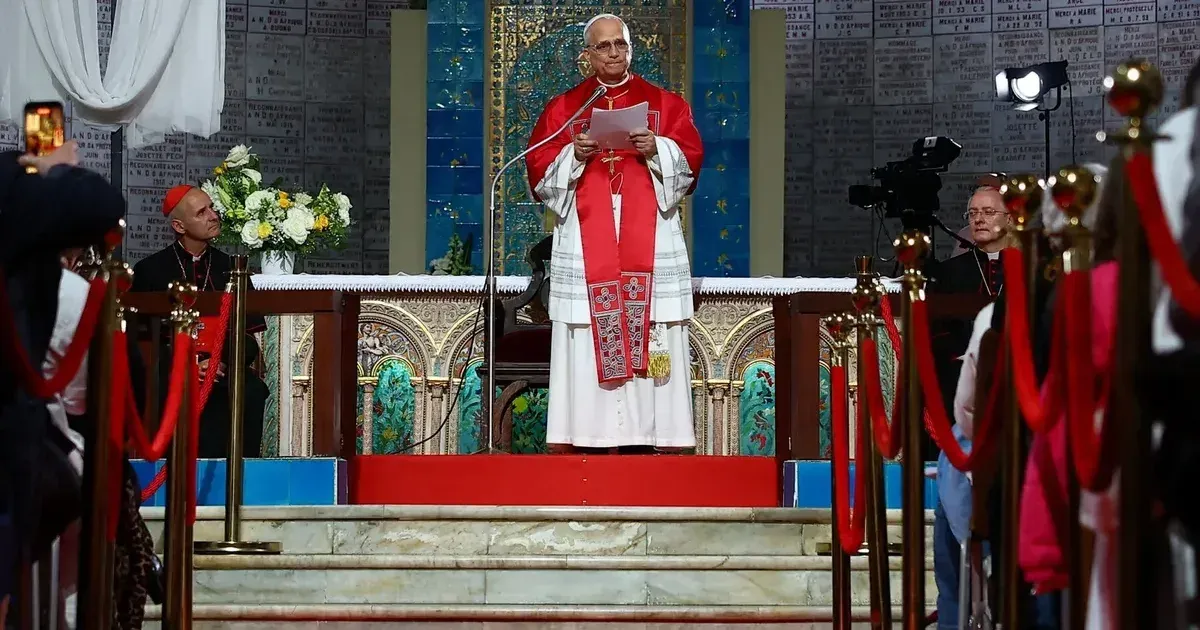
Pope Leo and JD Vance turned an old Catholic doctrine into a live Washington argument. The clash quickly moved from theology into campaign language and foreign policy. On April 16, 2026, their public theological dispute centered on the traditional Just War Doctrine. Donald Trump recently criticized the pontiff, which triggered a renewed examination of when a nation is morally permitted to engage in armed conflict. Such disagreements between the White House and the Holy See create serious friction within the American electorate. National security advisers now find themselves debating fourth-century philosophy alongside 21st-century combat tactics.
Theological standards for legitimate defense are becoming central to the 2026 political calendar.
Ancient principles established by Saint Augustine of Hippo serve as the foundation for this debate. Augustine argued that war must be a last resort and aimed at restoring peace rather than achieving conquest. Pope Leo maintains that current global military expenditures, which exceed $2.4 trillion annually, violate the spirit of these foundational teachings. Vatican officials suggest that modern preemptive strikes rarely meet the strict criteria for a just cause. Conflict between religious authority and state power has historically defined Western political development.
Just War Doctrine Framework and Origins
St. Augustine formulated the early concepts of justifiable violence to reconcile Christian pacifism with the necessity of protecting the innocent. He proposed that war is only acceptable if it is declared by a legitimate authority and motivated by a desire for justice. Later, Thomas Aquinas expanded these criteria in the 13th century, adding requirements for a right intention. Aquinas emphasized that the promotion of good or the avoidance of evil must be the primary goal. These scholastic thinkers sought to limit the horrors of medieval warfare by imposing moral constraints on kings and emperors.
Vatican scholars frequently cite the principle of proportionality when assessing modern conflicts. Proportionality requires that the anticipated good resulting from military action must outweigh the inevitable suffering and destruction. Pope Leo has argued that the destructive capacity of modern weaponry makes meeting this standard increasingly difficult. High-tech munitions and autonomous systems change the moral calculus of engagement. Military leaders often prioritize technical success over these centuries-old ethical benchmarks.
Church doctrine also mandates the principle of last resort, which requires that all diplomatic and non-violent avenues be exhausted. Many theologians believe that modern states move toward kinetic solutions too quickly. Negotiated settlements are frequently discarded in favor of rapid military intervention. Catholic thinkers emphasize that the probability of success must be high enough to justify the risks taken. Senseless bloodshed in a losing cause is considered a grave moral failure.
Pope Leo Challenges National Interest Logic
Diplomatic relations between Washington and the Vatican cooled sharply after the pope released a statement questioning the morality of recent border security operations. Pope Leo asserted that national sovereignty does not grant an absolute right to disregard human dignity. He criticized the use of lethal force in scenarios where non-violent containment is possible. Religious leaders in Europe and South America supported his stance, creating a global coalition against the current American administration. State Department officials responded by defending the right of a nation to protect its territory. This ideological rift follows reports that Donald Trump has demanded the pope refrain from catering to the political left.
A Holy See spokesperson said the church recognizes governments’ right to defend their citizens but does not view that right as an absolute license for aggression.
Vatican critiques often target the concept of preemptive war. While some legal scholars argue that striking first is necessary to prevent an imminent threat, Pope Leo remains skeptical of this logic. He suggests that claims of imminent danger are frequently used to mask expansionist or economic goals. Moral clarity is lost when intelligence assessments replace clear acts of aggression as the trigger for war. Proving a negative becomes impossible once the missiles are launched.
Global leaders find themselves divided along religious and nationalist lines. Some Catholic majority nations have shifted their foreign policies to align more closely with the Vatican. This shift complicates alliance structures that have been in place for decades. International law often conflicts with theological mandates, leaving diplomats in an uncomfortable position. Every decision made in the Situation Room now carries an implicit religious weight.
JD Vance Responds With Realist Theology
JD Vance, who joined the Catholic Church in 2019, has become the primary defender of the administration’s military posture. He argues that the first duty of a Christian statesman is to protect the people under his care. Vance identifies as a realist, suggesting that the Just War Doctrine must adapt to the realities of a multipolar world. He contends that the Vatican’s current interpretation is too restrictive for a global superpower. Protecting the national interest is, in his view, a moral imperative that fulfills the requirement of legitimate authority.
Realism in foreign policy emphasizes power dynamics and security over abstract ethical frameworks. Vance often cites the need for a strong defense as a deterrent that ultimately prevents larger wars. He believes that American strength is the only force capable of maintaining global order. Critics within the Church argue that this approach prioritizes Caesar over God. Supporters of the administration see it as a necessary evolution of ancient thought. The tension between these two perspectives defines the current internal debate within the American Catholic community.
Political analysts suggest that Vance is attempting to build a bridge between traditionalist Catholics and populist voters. This strategy relies on emphasizing the protection of the family and the local community. He frames border security as a form of self-defense that falls within the Just War category. Opponents argue that his logic stretches the doctrine beyond its breaking point. They point to the historical emphasis on universal human rights that goes beyond national borders.
Moral Authority and Election Politics
Weaponizing the Just War Doctrine for partisan gain is a dangerous move that risks hollowed-out theology and broken alliances. JD Vance is attempting to perform a delicate surgery, trying to transplant the heart of Catholic tradition into the body of an America First agenda. The operation is likely to fail because the Just War framework was never intended to serve as a rubber stamp for nationalist ambitions. It was designed as a hurdle, a series of moral roadblocks intended to make the path to violence as difficult as possible. By trying to lower those hurdles, Vance is not just arguing politics; he is rewriting centuries of moral philosophy to fit a campaign slogan.
Pope Leo understands that the moral authority of the Church depends on its independence from any single global power. If the Vatican allows its core teachings on violence to be co-opted by Washington, it loses its ability to speak to the rest of the world. The dispute extends beyond theology into a broader argument over Western moral authority. The administration’s attempt to redefine self-defense as whatever the state deems necessary is a direct challenge to the idea of a higher moral law.
A secular state focused on its own survival will face persistent difficulty satisfying every requirement of a just war. The dispute turns on whether realism can remain bounded by the moral constraints described in the original texts.