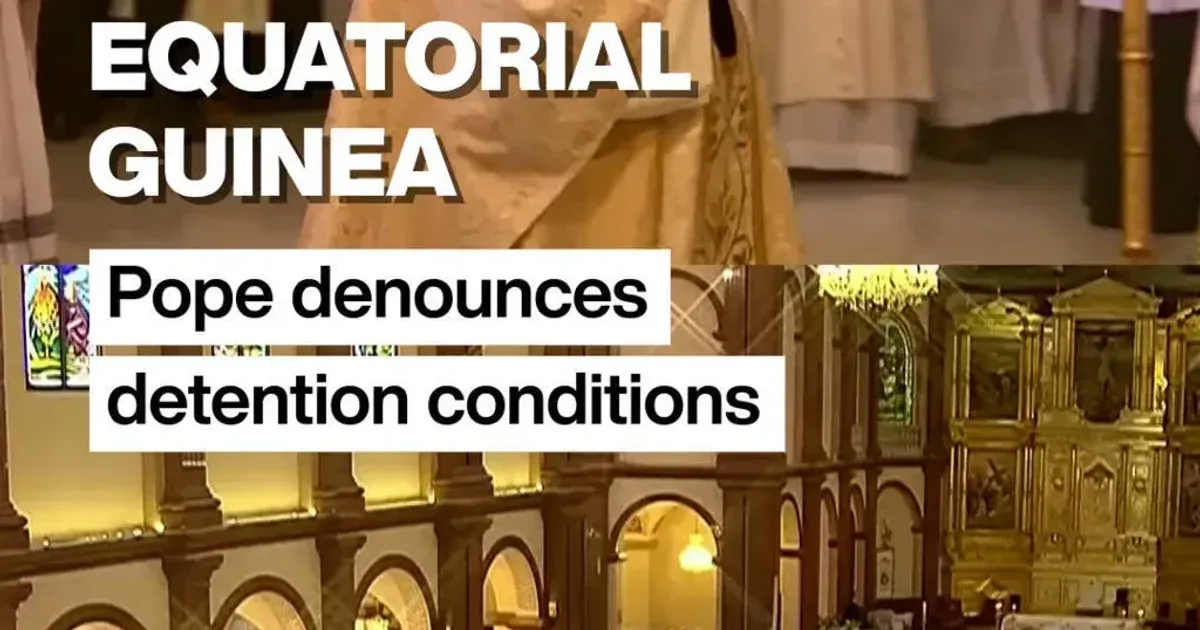
Pope Leo XIV’s address to 100,000 worshippers in Malabo directly challenged Equatorial Guinea’s prison conditions, political repression and extreme inequality. Pope Leo XIV arrived in Malabo on April 22, 2026, to deliver a scathing critique of the country's judicial system and the widening chasm between its elite and the impoverished majority. Standing before 100,000 worshippers gathered for an open-air Mass, the pontiff abandoned typical diplomatic niceties to address the systemic rot within the Central African nation. His words carried weight because the president and his family sat in the front row, forced to listen to a direct denunciation of the very structures that maintain their control.
Worshippers from across the country converged on the capital, some traveling for days to witness what they hoped would be a transformative religious event. These citizens stood in sweltering heat while the leader of the Catholic Church focused his sermon on the lack of justice and the suffering of the poor.
Equatorial Guinea Prison System Under Scrutiny
Prison conditions across Equatorial Guinea became a primary focal point during the final leg of the pontiff's tour of the continent. Pope Leo XIV used his platform to describe detention facilities as places of deep human suffering rather than rehabilitation. He demanded that the government respect the dignity of every individual, regardless of their legal status or political affiliation. Religious leaders rarely challenge the Malabo administration so openly, particularly on the sensitive topic of how it treats its detainees. Reports of overcrowding, lack of medical care, and arbitrary detention have long circulated among international observers. Pope Leo XIV insisted that a nation is judged by how it treats those at the bottom of its social hierarchy.
Detention centers in the country remain largely closed to independent oversight, making the papal remarks particularly important for local human rights advocates. These activists have documented cases where prisoners are held without trial for years, often in facilities that lack basic sanitation. Voices within the church have privately expressed concern about the safety of those who might be emboldened by the pontiff's rhetoric. Pope Leo XIV signaled that the global Catholic community is watching how the government manages its legal institutions. He argued that no amount of economic growth could compensate for the loss of fundamental human rights. The speech, characterized by its frankness, targeted the conscience of those holding power in the executive and judicial branches.
Mass Attendance and Demands for Freedom
Large crowds totaling nearly 100,000 people transformed the urban landscape of Malabo into a sea of colorful textiles and religious iconography. This vast turnout provided a physical manifestation of the influence the Catholic Church holds over the population. Pope Leo XIV took advantage of the size of the gathering to call for greater freedoms, including the right of citizens to express their grievances without fear of retribution. He emphasized that true peace could not exist where people are silenced or marginalized by the state. The administration often restricts public gatherings, but the papal Mass proved too large and too internationally visible to suppress. Many attendees held up crosses and placards, viewing the event as a rare moment of collective empowerment.
"The Pope gives a frank and passionate speech, the likes of which have characterised his tour of Africa," reported BBC World.
Freedom of association and speech is frequently curtailed in the country, leading to a climate of self-censorship. Pope Leo XIV addressed this directly, stating that a society flourishes only when every voice is heard. Wealthy oil interests have historically shielded the ruling class from the consequences of their domestic policies, yet the pontiff suggested that spiritual poverty is a greater threat to the nation than economic lack. He called for a redistribution of moral focus, urging the government to prioritize the welfare of the citizenry over the accumulation of personal assets. Every sentence seemed designed to strip away the veneer of stability the government attempts to project to the outside world.
Opposition Fears of Political Image Laundering
Exiled dissidents and human rights organizations expressed deep reservations about the timing and nature of the visit. These groups worry that the presence of the Pope could be used by Teodoro Obiang Nguema Mbasogo to legitimize his decades-long rule. They argued that the administration often uses international visits to distract from internal abuses and present a facade of international acceptance. Critics pointed out that images of the Pope standing alongside the president would be broadcast by state media for years to come.
Such propaganda can be used to convince the populace that the regime has the blessing of the highest religious authority in the world. Despite the harshness of the papal critique, the visual evidence of the meeting remains a potent tool for the government.
Silence from the palace suggests a calculated indifference.
Refugees who fled the country to escape political persecution watched the proceedings with a mix of hope and cynicism. While they appreciated the Pope's words on justice, they questioned whether anything would change once the Vatican delegation returned to Rome. These individuals have seen various international bodies attempt to reform the regime with little success. The visit might provide a temporary reprieve for the government, allowing it to claim it is engaging in a dialogue about human rights. Pope Leo XIV appeared aware of these concerns, framing his visit as a mission of solidarity with the oppressed instead of an endorsement of the state. He insisted that his presence was a pastoral necessity in a region suffering from deep corruption.
Wealth Disparity and Resource Management Analysis
Economic inequality is the foundation for the social tensions that Pope Leo XIV highlighted during his Mass. Equatorial Guinea possesses abundant natural resources, yet the majority of its inhabitants live on less than two dollars a day. The ruling family controls the flow of oil wealth, leading to a visible disparity in the streets of Malabo. Modern skyscrapers and luxury villas stand in contrast to the shantytowns where many worshippers reside. Pope Leo XIV called this disparity a sin against the divine order, demanding a more equitable distribution of the nation's riches. He noted that the abundance of natural resources should be a blessing for all, not a private bank account for a select few.
International oil companies continue to operate within the country, often ignoring the social conditions for the sake of profit. Pope Leo XIV implicitly criticized this corporate complicity, suggesting that justice is a collective responsibility. He urged the government to invest in education and healthcare instead of building monuments to its own glory. The administration's focus on large-scale infrastructure projects has often come at the expense of social services. Pope Leo XIV concluded his tour by reminding the faithful that they deserve a government that serves their needs. His departure leaves a country struggling with the echoes of his demands for a more just and free society.
Papal Visit Tests Moral Authority Against Regime Optics
Religious diplomacy rarely functions as a scalpel, acting instead as a blunt instrument that regimes often repurpose for their own longevity. While Pope Leo XIV delivered rhetorically sharp blows to the Obiang administration, the optics of the visit provided the very legitimacy the regime craves. Critics who claim this visit laundered the image of a dictator are doing more than expressing cynicism; they are acknowledging the reality of political theater in Central Africa. The Vatican must recognize that a 1,000-word sermon, no matter how biting, cannot undo fifty years of consolidated autocracy. It is a naive calculation to believe that words alone will loosen the grip of a family that has successfully navigated decades of international pressure.
The Pope effectively traded a moment of moral clarity for a permanent propaganda victory for Malabo. By appearing in the capital, the Catholic Church signal-boosted a regime that thrives on the appearance of international normalcy. Even as the pontiff decried the state of the prisons, the palace was likely calculating the PR value of the footage. This visit was a strategic error if the goal was true reform. It served only to provide a temporary emotional release for a suffering populace while granting the ruling elite a divine photo opportunity. Real change requires more than sermons.