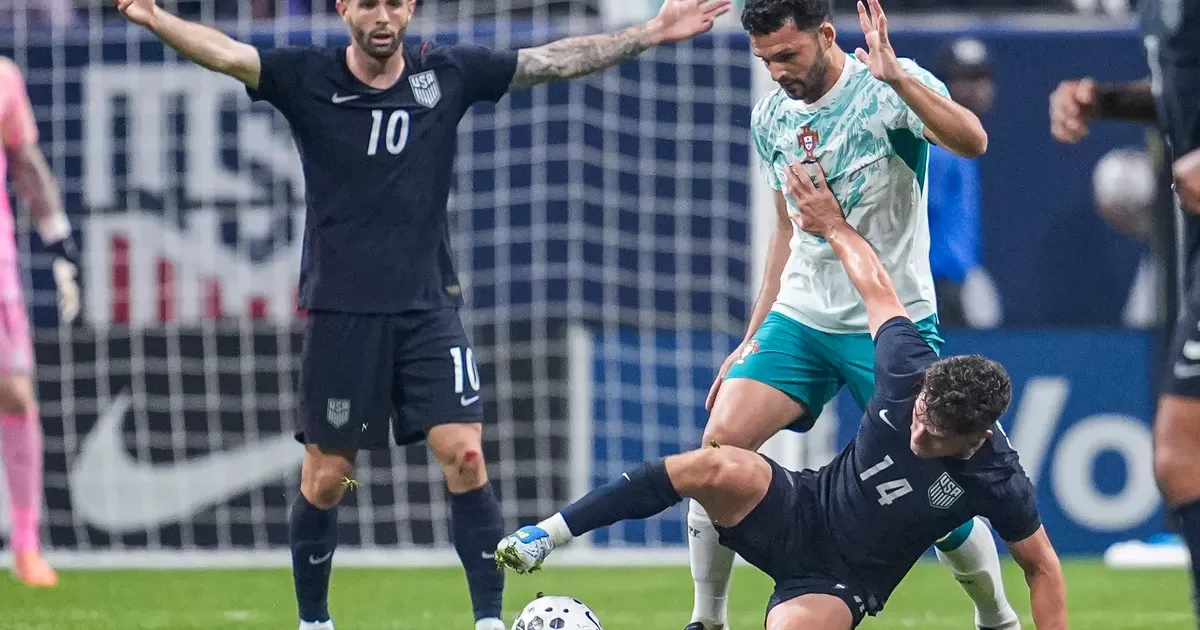
The United States' 2-0 loss to Portugal at Mercedes-Benz Stadium on March 31 was written at the time as a final warning before Mauricio Pochettino named his World Cup roster. After the USMNT's home World Cup ended with a 4-1 round-of-16 defeat to Belgium, that friendly reads more clearly. Portugal did not create the American problems. It exposed them early enough for everyone to see.
The March result followed a heavy defeat to Belgium in the same window and raised familiar concerns: loose buildup, thin midfield control, missed chances and too much dependence on Christian Pulisic to supply both danger and finish. The World Cup later showed a more complicated picture. The U.S. produced strong moments, even dominant stretches, but when the opponent reached Belgium-level quality, the same stress points returned.
Pulisic Was Asked to Carry Too Much
Against Portugal, Pulisic was used through central attacking zones and had chances that made the frustration visible. The experiment showed the risk of asking one player to solve several jobs at once: progress the ball, draw defenders, create the final action and finish. When service arrived late or narrow, he received the ball with too many bodies already around him.
The burden on Pulisic did not disappear during the World Cup. Pulisic finished the tournament without a goal, added only one assist and had his campaign disrupted by injuries, including the leg issue confirmed after the Belgium loss. He remains one of the best players the United States has ever produced. The tournament showed that being the face of the team is not the same as being able to carry its whole attacking design.
Portugal Found the Midfield Gaps First
Portugal's goals through Francisco Trincao and Joao Felix came from the areas that should have worried the staff in March. The U.S. lost control around the edge of midfield, recovery runs arrived late and the back line had to absorb pressure before the team could reset. Portugal moved through pressure with more patience and punished the spaces that opened when American energy turned into chase work.
Belgium later made the same lesson harsher. Tournament opponents with elite timing do not need many invitations. If the press is bypassed and the midfield cannot delay the next pass, American athleticism becomes reactive. That was the ceiling Portugal pointed toward before the tournament began.
The World Cup Did Show Progress
The postmortem cannot be only negative. The U.S. delivered some of its best modern World Cup football in the group stage, including a forceful win over Paraguay and useful performances from a broader attacking group. Folarin Balogun and Ricardo Pepi gave Pochettino more forward options than the March friendlies suggested. The team did not collapse at the first challenge.
The group-stage progress makes the ending sharper rather than softer. The U.S. was good enough to raise expectations and then not good enough to meet the first truly punishing knockout test. Progress and disappointment are not opposites here. They are the same story.
The Roster Question Became a System Question
Before the tournament, the Portugal loss made roster selection look like the main problem. Who should start in goal? Who could protect the midfield? Who could run beyond Pulisic? Which striker could punish chances? Those were real decisions, but the World Cup revealed something deeper: the issue was not only names. It was connection.
The U.S. still too often separated into parts. Attackers waited for service, midfielders chased rhythm, defenders handled transitions and Pulisic tried to bend the game back toward danger. Strong teams make those parts feel connected under pressure. The U.S. managed that in stretches, not reliably enough.
Pochettino's Case Is Continuity With Evidence
Pochettino inherited a team with talent, commercial pressure and a home-World-Cup burden that left little room for quiet development. He deserves credit for moments when the team looked more aggressive and for getting more from the forward pool than the March window implied. He also owns the Belgium ending and the patterns that Portugal had already revealed.
If U.S. Soccer keeps him into the next cycle, the argument cannot be sentiment. It has to be continuity with evidence: clearer midfield spacing, less Pulisic dependency, better game-state control and a plan for the next generation before the current one ages out of its peak.
The March Warning Was Not Harsh Enough
The reaction to the Portugal friendly was not an overreaction. It was a mild version of the later problem. The U.S. could look energetic, could create early pressure and could still be pulled apart by an opponent with cleaner timing. The same pattern returned when the World Cup became unforgiving.
Portugal made the weaknesses visible in March. Belgium made them terminal in July. The next U.S. cycle has to start there, not with marketing slogans about a golden generation. Pulisic can still matter. Balogun and Pepi can still grow. Pochettino may still build something better. But the team has to stop confusing promise with control. The World Cup made the gap between promise and control painful enough to remember.