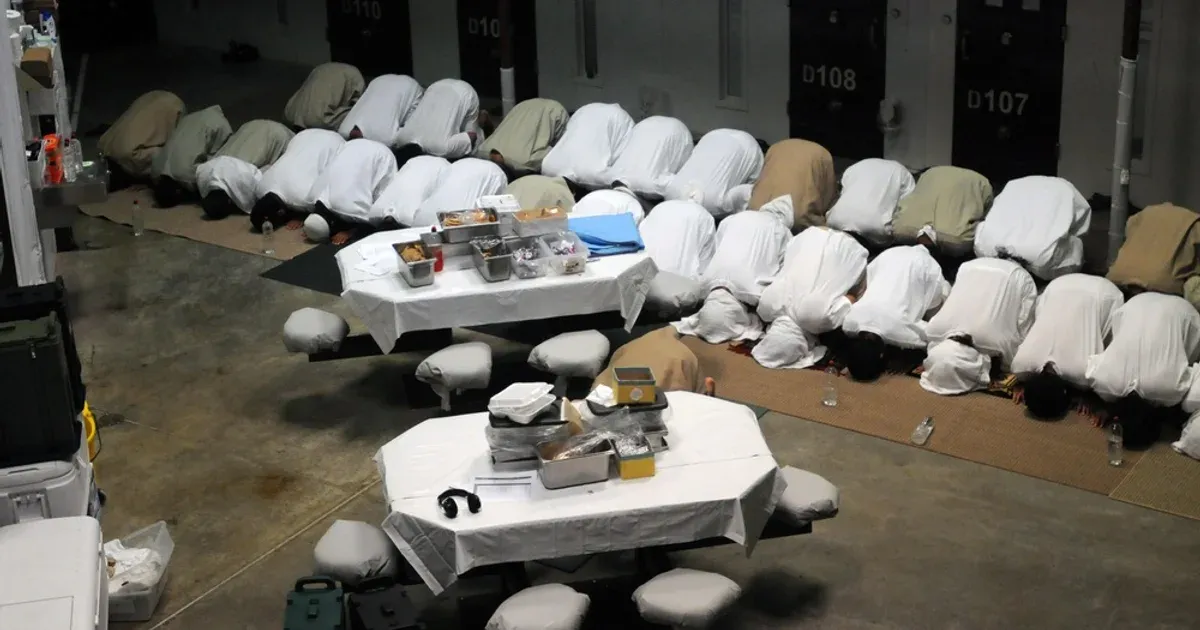
Human rights organizations launched a formal protest against a Trump administration proposal to use the naval base at Guantánamo Bay as a holding facility for Cuban migrants. Eighty-five advocacy groups delivered a joint letter to U.S. senators and representatives today to express their opposition to the re-establishment of migrant camps on the military installation. Their communication arrived shortly after a high-ranking Department of Defense commander detailed contingency plans to manage a potential exodus from the island nation. The detention plan drew renewed protests on April 10, 2026, as rights groups challenged the Guantánamo proposal.
Advocacy groups described the prospect of renewed migrant detention at the site as a violation of basic humanitarian standards. They focused their criticism on comments made last month by a top military leader regarding the maritime interdiction of individuals fleeing political and economic instability. Eighty-five organizations signed the document to ensure their collective voice reached key oversight committees in Washington. Military planners are currently preparing for various scenarios in the Caribbean Sea. General Laura Richardson, commander of U.S. Southern Command, recently discussed the need for a scalable migrant camp at the base if conditions on the island deteriorate. Documents shared with congressional offices indicate the facility would be designed to house thousands of people intercepted at sea by the Coast Guard. Planners view the base as a secure location to process individuals without triggering the automatic legal protections afforded to those who reach American soil.
General Richardson Outlines Detention Contingency Plans
Department of Defense officials argue that the Migrant Operations Center is a necessary logistical tool for national security. Operations at the base involve the 45-square-mile territory that the United States has leased from Cuba since 1903. While the base is primarily known for holding high-value detainees from the war on terror, its history as a processing point for Caribbean migrants is extensive. Military leaders have maintained the infrastructure for temporary housing for decades to ensure readiness for sudden spikes in maritime traffic.
Specific details within the proposed plan suggest a rapid expansion of current capacity. Engineers would likely use tent cities and repurposed hangars to accommodate large groups of people. Estimates suggest the base could eventually hold more than 10,000 individuals if a full-scale crisis occurs. Logistics experts within the Department of Defense prioritize containment and security over long-term integration or asylum processing. Opponents of the plan insist that the base is unsuitable for civilian housing. The proposed Guantánamo plans coincide with the broader foreign policy shifts directed by the Trump administration regarding Cuba.
Legal scholars point to the lack of independent oversight and the difficulty for migrants to access legal counsel while held at the remote military post. This strategy relies on the unique legal status of the base to bypass certain judicial requirements. Past operations at the facility resulted in lengthy detentions where individuals had limited ability to challenge their status. Critics argue that the military is not equipped to manage the specific needs of families and children who may be part of a migrant surge.
Human Rights Groups Challenge Congressional Authority
Congressional representatives received the letter today following a period of increased tension regarding U.S. policy toward the Caribbean. The 85 groups, which include the American Civil Liberties Union and several international human rights monitors, are demanding that lawmakers withhold funding for any expansion of detention facilities at the base. They argue that the Department of Defense should focus on regional cooperation instead of isolationist detention strategies. Joint efforts between human rights monitors and legal activists seek to prevent the military from becoming the primary arbiter of asylum claim.
Advocacy groups described further migrant detention at the base as deeply troubling and unacceptable. Legislators in both the House and Senate are divided on the issue of funding maritime interdiction operations. Some members of the Armed Services Committee view the migrant camp as a pragmatic solution to prevent a mass arrival of boats on Florida shores. Others contend that the moral cost of using a military prison for economic refugees is too high. Budgetary debates for the upcoming fiscal year now include specific provisions that could either authorize or prohibit the construction of temporary housing at the base.
Historical Precedents for Maritime Migrant Interdiction
History provides a grim blueprint for the current proposal. In 1994, the Clinton administration used Guantánamo Bay to house roughly 32,000 Cubans and 20,000 Haitians during a period of enormous civil unrest. Migrants lived in rows of tents on the base runways under intense tropical heat. Reports from that era documented poor sanitation and a lack of medical resources for the thousands of people confined behind barbed wire. Those camps eventually became the site of riots and hunger strikes as the detention period stretched into months.
Current advocates reference those 1994 conditions to illustrate why the military base is an inappropriate solution. They believe that a return to such tactics would undermine the reputation of the United States as a protector of human rights. Previous crises showed that once a camp is established, it is difficult to dismantle quickly. The transition from a temporary processing center to a permanent detention site occurred multiple times in the late 20th century. Military records indicate that some migrants remained at the base for years while their cases wound through a complicated legal system.
Legal Ambiguity Surrounding Migrant Operations at Guantánamo
Federal courts have historically struggled with the jurisdiction of the base. Because the land is under the control of the United States but technically belongs to Cuba, the application of the Constitution is inconsistent. Supreme Court rulings like Boumediene v. Bush established certain rights for enemy combatants, but the legal status of a civilian migrant is different. The government often argues that people held at the base have not entered the country and therefore lack the right to an attorney or a hearing. This legal fiction allows for the indefinite holding of individuals without the standard protections of the American court system.
International law experts suggest that the plan may violate treaties regarding the treatment of refugees. The principle of non-refoulement prohibits a country from returning a person to a place where they face persecution. By holding migrants at a military base, the government can claim they were never legally processed for entry. Such a policy creates a second-class tier of asylum seekers who are denied the due process available to those who cross the border by land. Records show that the Department of Defense prefers this ambiguity to simplify logistical operations.
Military Detention Cannot Replace Asylum Policy
American foreign policy creates vacuums that the military is then asked to fill with barbed wire and canvas tents. Using the naval base as a relief valve for migration crises is a recurring failure of statecraft that prioritizes optics over law. The Trump administration is attempting to revive a 1990s-era solution for a 2026-era problem, ignoring the large legal evolution that has occurred since the 1994 Balsero crisis. Relying on a military installation to handle civilians is a confession that the civilian asylum system is broken beyond repair.
The Department of Defense should not be the lead agency for humanitarian crises. When generals start planning for tent cities, the goal is containment, not justice. This approach treats desperate families like a tactical problem rather than people with rights under international treaties. Washington appears to believe that out of sight is out of mind, yet the history of the base suggests that these problems always find a way back to the headlines. A migrant camp at the base is a legal black hole designed to circumvent the scrutiny of the American public and the oversight of federal judges. Legislators who support this move are abdicating their responsibility to create a functional immigration policy. It is easier to fund a military camp than to negotiate a sustainable regional agreement. The result is a cycle of detention that solves nothing while costing the taxpayer billions. Security is not found in a tent city.