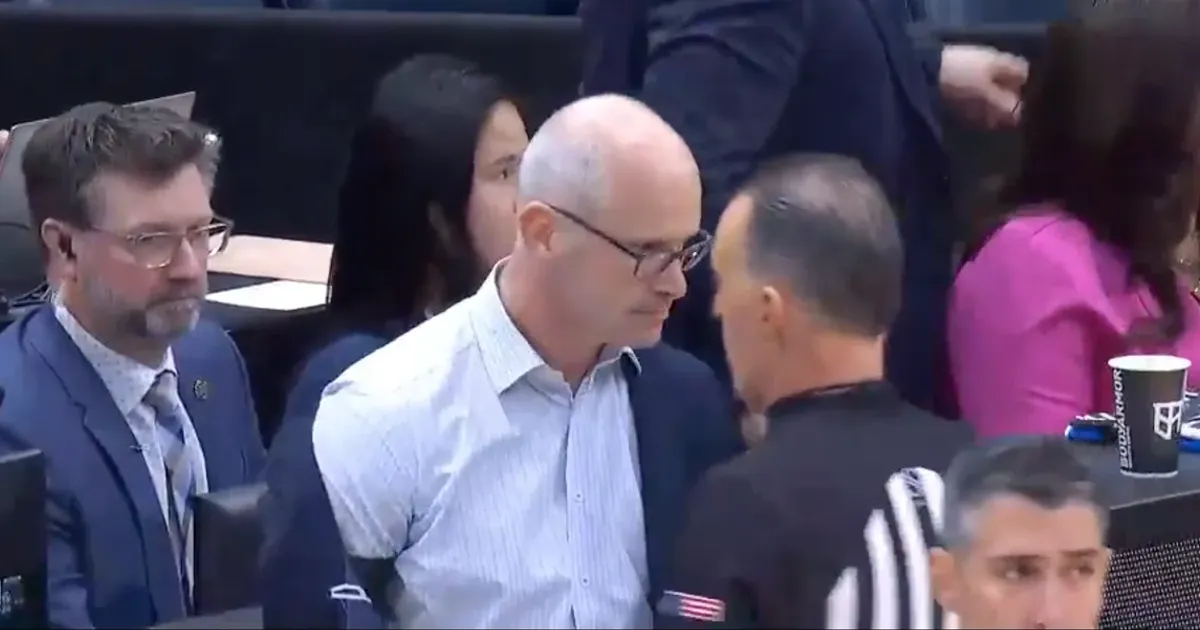
Roger Ayers' absence from the 2026 men's Final Four officiating roster kept the Dan Hurley sideline incident alive because the NCAA never clearly explained what standard it applied. Ayers was not publicly suspended. The NCAA did not say he was punished. It simply announced 11 Final Four officials, and a veteran referee with seven Final Four appearances was not on the list.
The timing made that silence hard to ignore. One day earlier, UConn had beaten Duke 73-72 in a chaotic Elite Eight finish after Braylon Mullins hit a 35-footer with 0.4 seconds left. In the celebration, video showed Hurley moving into close head-to-head contact with Ayers near the sideline. No technical foul was assessed. Within 24 hours, Ayers was absent from the Final Four pool.
The Assignment List Became the Message
Final Four work is the highest-profile officiating assignment in college basketball. Only 11 officials make the final-weekend list, with three assigned to each game and alternates available. For a referee with Ayers' resume to miss it after a viral controversy, the omission naturally read like a response.
Quiet assignment discipline creates the problem with quiet discipline through assignments. It may protect the institution from a detailed public fight, but it also lets everyone invent motive. If Ayers was left off because the crew failed to control the moment, the NCAA could say so. If the decision was unrelated, the NCAA could say that too. Silence left the public to connect dots without knowing whether the dots belonged together.
Hurley's Explanation Solved Only Intent
Hurley said he thought the exchange was friendly and emotional in the rush after the game. Ayers later downplayed the incident as well, describing it as a loud, chaotic moment rather than something that stuck with him as hostile. Those explanations matter because they push back against the simplest version of the clip.
They do not answer the rules question. A coach does not have to intend harm for a sideline interaction with an official to become inappropriate. Physical proximity, especially in a tournament game, creates ambiguity the sport should not want. If that is not a technical foul, coaches and officials need to know where the line actually sits.
Hurley's Reputation Shaped the Reaction
The clip did not land in a vacuum. Hurley is one of the best coaches in the country and one of the most combustible sideline figures in the sport. His success gives him attention. His behavior gives every interaction with an official a longer public tail.
Hurley's reputation does not change the rulebook, but it changes reception. Viewers who already see Hurley as crossing lines were ready to call the moment a headbutt. Supporters saw noise, celebration and a coach who had just survived a wild ending. The NCAA's silence gave both camps room to stay exactly where they were.
Officials Are Being Judged in a Clip Economy
College basketball still behaves as if officiating controversies can be handled mainly through internal review. The broadcast and social-media environment no longer allows that. Every close exchange becomes a replay angle, a screenshot and an argument before the crew has left the building.
The clip economy does not mean every viral clip tells the full truth. It means the NCAA needs better public process. Officials deserve protection from mob reaction, but protection cannot mean secrecy about basic standards. Coaches deserve fair treatment, but fair treatment cannot mean that their celebrity makes contact with officials easier to explain away.
The Standard Has to Cover Both Sides
Ayers' role also matters. Officials are trained to leave heated spaces, avoid performative exchanges and keep coaches from turning the crew into part of the show. In the final seconds of an Elite Eight game, that is hard. It is also exactly why the best officials are trusted with these assignments.
Hurley had a responsibility not to create the appearance of contact. Ayers had a responsibility to keep the interaction from becoming part of the game story. The NCAA had a responsibility to explain whether the later assignment decision reflected performance review, optics, normal rotation or something else.
Quiet Accountability Is Not Enough
The unanswered issue is that the NCAA tried to move past the issue by moving past Ayers. That may have lowered the temperature for the Final Four, but it did not clarify anything. A sport that asks officials to be invisible cannot then leave them alone to absorb public blame when a viral moment becomes inconvenient.
The right answer was not necessarily a public shaming of Ayers or Hurley. It was a clear standard: what conduct crossed the line, what officials are expected to do, and how tournament assignments respond to high-profile misses. Without that, every future clip will restart the same argument. The system will look disciplined internally and evasive everywhere else.