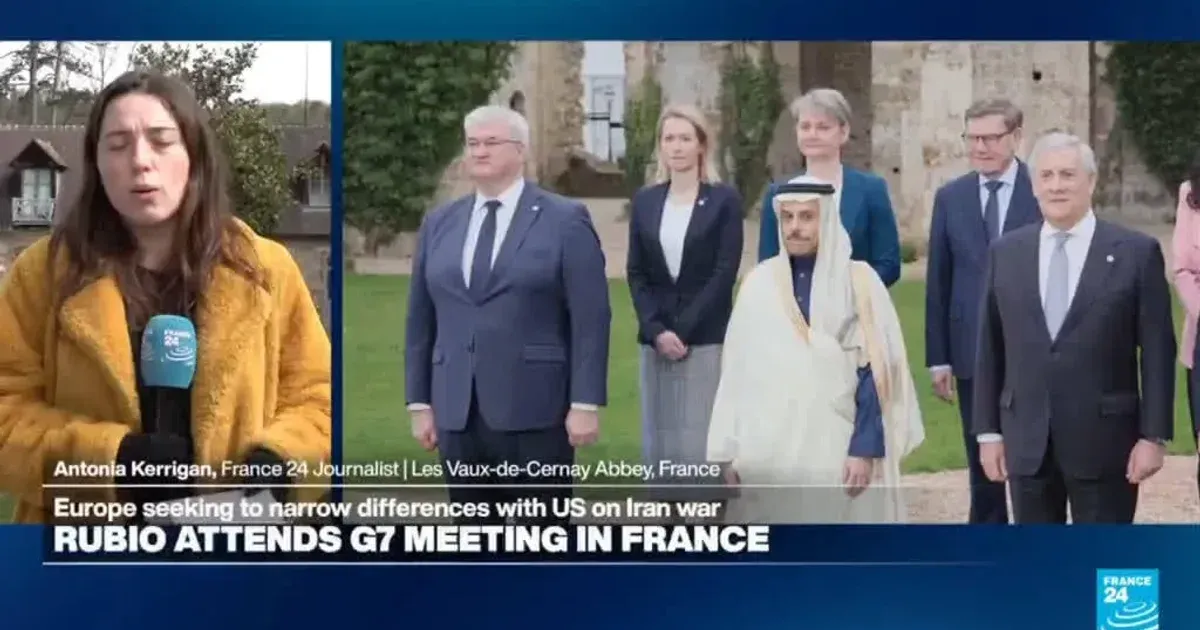
Secretary of State Marco Rubio arrived in France for G7 talks with the Iran war now testing both US strategy and allied patience. The diplomatic test is coordination, not only messaging. The meetings began against the backdrop of a conflict that started on February 28, 2026, and has already pushed energy security back to the center of Western diplomacy.
Rubio is making his first international trip since the outbreak of the war. Security was heavy at the French summit site as ministers prepared for closed-door sessions on Western strategy. European officials are looking for a clearer account of objectives, timelines, and escalation risks. That skepticism has made coalition-building harder, especially for allies facing domestic pressure over energy prices and the possibility of a wider regional conflict.
President Donald Trump complicated the diplomatic landscape on March 26, 2026, during a televised Cabinet meeting. His criticism of NATO members reached European capitals just before Rubio arrived in France. The remarks gave ministers another reason to question whether Washington is asking for partnership or obedience. Rubio now has to defend the policy while containing the political damage created by the White House tone.
Rubio Navigates Growing European Skepticism Over Iran
France 24 reported that European ministers intend to use the G7 forum to demand specific answers about the duration of the American commitment. Germany and Italy remain concerned about regional stability and the economic cost of prolonged hostilities. Some delegations are expected to press for clearer humanitarian arrangements and a defined diplomatic exit lane. Rubio has argued that a premature pause would strengthen Tehran and weaken deterrence.
The resistance Rubio faces is more than rhetorical. Access to bases, airspace, and logistics remains the practical test of allied support. Negotiators in Paris spent the morning debating the legal and operational framework of any broader coalition, while the American side insisted that the current course remains necessary for regional security. The early sessions produced pressure rather than consensus.
"Rubio is expected to be pressed by European and other allies over American strategy for the further conduct of the conflict," reported Antonia Kerrigan for France 24.
Relations with the United Kingdom have also shown signs of strain. London usually aligns with Washington on security matters, but British officials are watching the risk of a wider regional fire. French President Emmanuel Macron has tried to leave room for mediation, a move that sits uneasily with Washington’s push for a unified front. That diplomatic strain follows Trump’s NATO comments on burden-sharing and alliance responsibility.
Trump Criticisms Complicate Diplomatic Mission in France
Trump used his public appearance to cast European hesitation as a failure of alliance solidarity. Such rhetoric can harden positions in European capitals, where leaders have to defend security policy to voters already worried about prices and escalation. Rubio has focused his messaging on shared interests, energy security, and the need to confront Iranian military pressure without opening a permanent rift inside NATO.
The shadow of the Cabinet meeting still hung over bilateral discussions. Rubio avoided extended public argument over the president’s NATO comments and instead emphasized the threat posed by Iranian drone and missile capabilities. The European response has been polite but cautious. Many ministers want clearer evidence of progress on the ground before they ask their own governments to accept a larger role.
Hostilities have settled into a difficult pattern in several sectors. Iranian forces have leaned on asymmetric tactics that are hard to counter with air power alone, while the US military continues to prioritize command-and-control targets. That mismatch makes Rubio’s diplomatic case harder: allies want to know what success looks like if Washington has ruled out a ground deployment.
Global Energy Prices Surge During Middle East Hostilities
Global markets have reacted sharply to uncertainty in the Persian Gulf. Oil prices remain a central source of pressure for European ministers, who are trying to limit the cost-of-living impact while keeping sanctions and security commitments intact. G7 energy officials held separate talks on emergency reserves and alternative supply routes, underscoring how quickly the military crisis has become an economic one.
Price volatility is still a central theme of the negotiations. Rubio has argued that the long-term benefit of weakening Iran outweighs short-term economic pain, but his counterparts in France, Germany, and Italy face a different political calculation at home. Any request for sanctions flexibility would test the maximum-pressure strategy and expose the gap between strategic discipline and domestic tolerance.
Efforts to secure alternative supply chains have produced only limited relief. Washington is pushing regional partners to raise output where possible, while the Treasury Department monitors attempts to move Iranian oil through indirect channels. Rubio has little immediate relief to offer allies beyond coordination and resolve. The Strait of Hormuz remains the hard geographic fact beneath every diplomatic phrase in France.