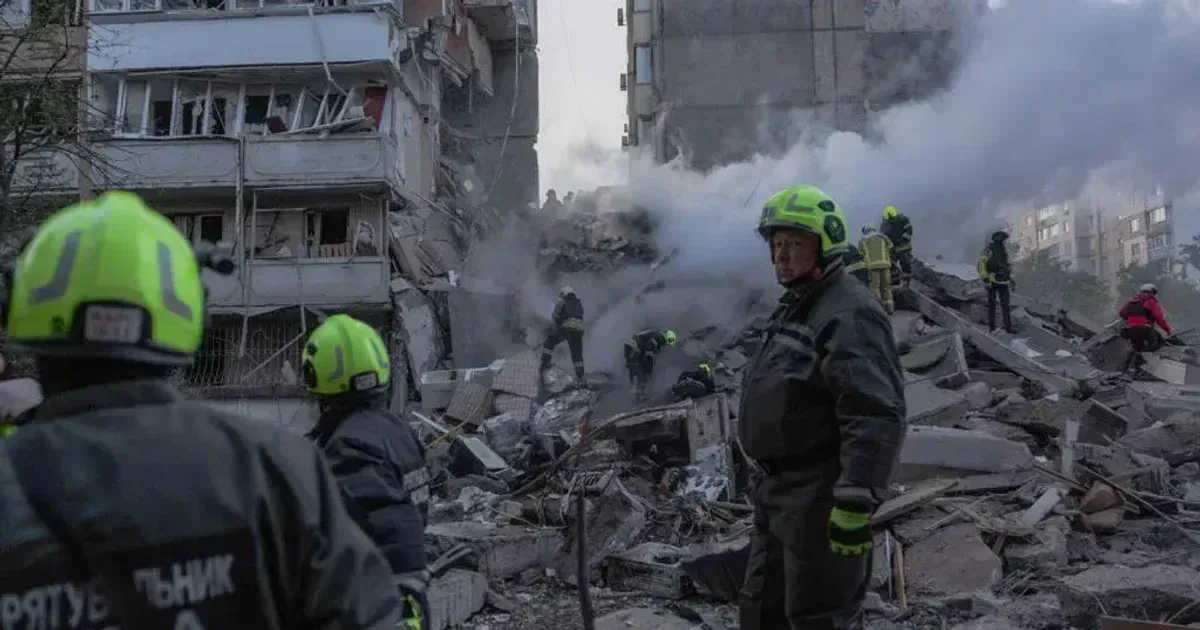
Kyiv residents scrambled for cover early Sunday as a multi-wave missile attack tore through several residential districts and neighboring communities. The attack brought retaliation threats into the daily life of Kyiv residents before dawn. It also showed how quickly a public vow from Moscow can become a civil-defense emergency. Russian military forces launched a concentrated barrage of ballistic missiles against the capital on May 24, 2026, after recent threats of retaliation from the Kremlin. Air raid sirens pierced the pre-dawn silence across the city, giving civilians only minutes to reach underground shelters before the first detonations shook the metropolitan area.
Casualty reports from municipal authorities indicate at least four people were killed during the morning strikes. Medical facilities across the city received more than 50 injured civilians, with doctors treating blast-related trauma and shrapnel wounds. Emergency services confirmed that three children were among those transported to hospitals for urgent care. Most victims were at home when the projectiles struck residential blocks and secondary infrastructure.
First responders focused their initial efforts on a residential complex where a direct hit caused a partial structural collapse. Firefighters battled secondary blazes in multiple locations as thick black smoke drifted over the Dnieper River and darkened the morning sky. Heavy machinery arrived on the scene by midday to clear tons of concrete and twisted metal from blocked thoroughfares. Rescue teams used thermal imaging and acoustic sensors to search for survivors trapped beneath the smoldering ruins of apartment buildings.
Subway stations transformed into makeshift shelters for thousands of families fleeing the surface explosions. Many remained underground for hours as additional alerts warned of secondary missile launches from Russian territory. Local volunteers distributed water and emergency blankets to those huddled on the station platforms, while mobile charging stations allowed residents to contact relatives and check for safety updates.
Ballistic Barrage Targets Kyiv Districts
Moscow officials had recently vowed to retaliate for previous operations, and the morning bombardment appeared to match that public posture. Ballistic missiles formed the core of the Russian offensive, using high-velocity paths that sharply reduce the reaction time for civil defense systems. Unlike slower cruise missiles, these weapons descend at extreme speeds, creating wide impact zones when they reach ground targets.
Ukrainian air defense units engaged multiple incoming threats throughout the morning, though several projectiles bypassed the defensive screen to hit ground targets. Debris from intercepted missiles rained down on populated areas, causing secondary fires and shattering windows across several city blocks. Police cordoned off streets where unexploded components or engine fragments were discovered, warning the public to maintain a safe distance from any metallic remains. Forensic teams began documenting the fragments to identify the specific missile variants used in the operation.
Damage extended beyond the city center into the wider Kyiv region. Regional administrators reported destroyed private homes and severed utility lines in suburban neighborhoods where proximity to the capital often makes communities vulnerable. Thousands of households lost access to electricity and water as technical crews prioritized the restoration of essential services. Repair teams estimated that stabilizing the power grid would take several days because of the severity of the strikes on local substations.
Recovery operations entered their tenth hour as night fell over the city.
Government officials in Kyiv condemned the strikes as a deliberate attempt to terrorize the civilian population during a period of relative calm. Evidence from the impact sites suggests that several high-velocity projectiles hit non-military zones, including a public park and a retail area. Legal teams within the administration are preparing documentation for international monitors regarding the targeting of civilian infrastructure. The city remains under a heightened state of alert as authorities monitor for further launches from the north and east.
Retaliation Threats and Infrastructure Damage
International observers noted that the scale of the ballistic attack represented a sharp increase in intensity compared with previous months. Security analysts suggest that the use of specialized missile systems points to a shift in tactical priorities by Russian commanders seeking to overwhelm local defenses. Strategic planners are now evaluating the effectiveness of the current air defense umbrella against these high-velocity strikes. Additional resources are being diverted to reinforce critical nodes within the capital's defense perimeter.
Fatalities could rise as engineers stabilize several high-rise structures.
Hospitals in the city have transitioned to emergency protocols to manage the influx of surgical cases. Surgeons worked in rotating shifts to stabilize patients with complex fractures and internal injuries caused by pressure waves from the impacts. Blood donation centers saw a surge in arrivals as residents lined up to support fellow civilians. Social services also established mental health support units at the impact sites to assist families dealing with sudden displacement and loss.
Public transit resumed limited operations by late afternoon, though several bus routes remained diverted around active crime scenes and debris fields. Local businesses near the impact sites began boarding up broken storefronts and assessing inventory damage. Despite the destruction, municipal workers were seen cleaning glass and soot from the sidewalks in a show of resilience that has become common in the capital. Heavy machinery and emergency sirens provided a constant background to the recovery efforts.
What the Escalation Signals
Does the return to large-scale ballistic strikes on the capital signal a durable shift in the Kremlin's strategic appetite? The use of high-end munitions suggests a willingness to spend expensive stockpiles for psychological and political impact rather than purely military gains. By targeting the capital after a period of relative stability, Moscow is testing the durability of international support and the patience of the Ukrainian public. This escalation also forces the administration to reconsider how it allocates resources between frontline positions and the protection of civilian hubs.
Pressure will now mount on Western allies to provide more sophisticated air defense technology capable of handling high-speed ballistic profiles. Regional stability depends on whether the defense can adapt faster than the offense can refine its targeting. If these strikes become a regular feature of the conflict again, the humanitarian burden on the Kyiv metropolitan area could quickly reach a breaking point. The strategic warning is clear: the air war has entered a more volatile phase in which civilian life remains exposed far from the front.