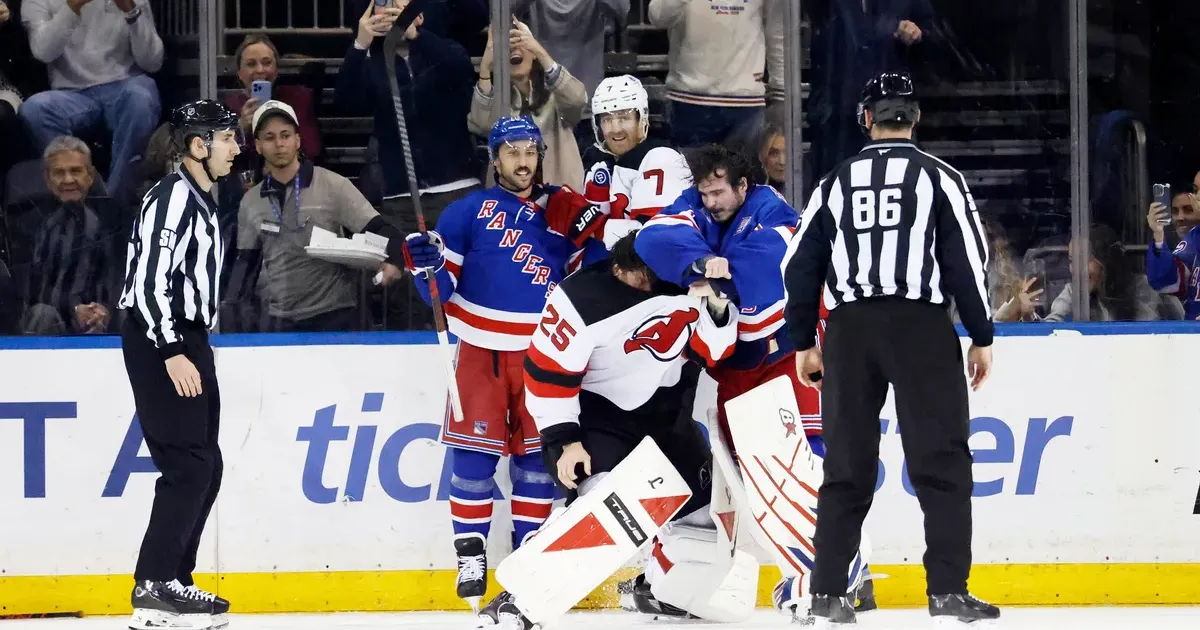
Igor Shesterkin and Jacob Markstrom gave Rangers-Devils the kind of clip that survives long after the standings stop mattering. Midway through the third period at Madison Square Garden on March 31, Markstrom skated down the ice, Shesterkin met him near the Rangers' end, and a rare goaltender fight turned New York's 4-1 win into a rivalry image rather than just another late-season result.
The moment was loud because goalie fights are scarce, theatrical and instantly shareable. It was also misleading. The Rangers had already been eliminated from playoff contention. The Devils were sliding toward the same fate. New York avoided a season-series sweep and won a third straight home game, but the fight did not change the deeper reading of either club. It gave a bad season a pulse for one night.
The Fight Hijacked the Box Score
The game had ordinary hockey details before the gloves came off. Conor Sheary scored for a second straight game. J.T. Miller, Jaroslav Chmelar and Mika Zibanejad added the other Rangers goals. Adam Fox had two assists. Shesterkin made 22 saves, while Markstrom stopped 18 shots and Connor Brown supplied New Jersey's only goal.
Those details should have been the structure of the recap. Instead, the night became Shesterkin and Markstrom. ESPN and NHL coverage both centered the third-period fight because the image was impossible to resist: two starting goaltenders leaving the usual rules of their position and turning a regional rivalry into a spectacle. Hockey culture will always replay that before it studies neutral-zone entries.
New York Needed the Noise
For the Rangers, the reaction made sense. Madison Square Garden had not had much to celebrate during a poor home season. A team already out of the playoff race still needs something to give its fans before April ends. Shesterkin's fight, followed by chants for him, became a release valve for months of frustration.
The emotional lift does not make it a solution. The Rangers' larger problems were roster shape, consistency, scoring droughts at home and a season that never found reliable altitude. A 4-1 rivalry win can lift the room for a night. It cannot rewrite why the team reached late March with only pride left to defend.
Markstrom's Challenge Had a Different Meaning
Markstrom's skate down the ice read less like celebration than irritation. New Jersey had beaten the Rangers twice earlier in the season by identical 6-3 scores, then arrived at the final meeting flat and disjointed. The Devils had talent, but the March loss showed how little of it had hardened into dependable structure.
From a Devils angle, the fight looked like a player trying to answer for teammates after a sequence around Shesterkin's crease. The response matters inside a dressing room. Still, Markstrom also allowed four goals on 22 shots, and the broader performance gave New Jersey little to claim beyond emotion. A goalie can show fire and still leave behind a bad stat line.
Goalie Fights Are Expensive Theater
The NHL sells speed, skill and star goaltending, then watches a rare goalie fight become the night's most replayed event. The contradiction is not new, but it is sharper when the players involved are franchise assets. Hands, shoulders, knees and heads are exposed when goaltenders fight. A short emotional burst can threaten a position where tiny physical changes can alter performance.
The league can hand out fighting and leaving-the-crease penalties, and it did here. It can talk about safety. But the market response is obvious: fans remember the fight. The highlight will outlive the standings note that both teams were effectively playing out failed seasons. Violence remains one of hockey's easiest shortcuts to attention.
The Rivalry Got a Clip, Not a Direction
Rangers-Devils still has old heat, geography and playoff memory behind it. The rivalry history is why a late-March game with limited stakes could still detonate once the goalies met. Rivalries do not need perfect standings to produce anger. They only need history and one push too many near the crease.
Both organizations should be wary of treating the clip as more than a clip. The Rangers need a team worthy of Shesterkin's peak years. The Devils need structure around their talent and goaltending that settles games instead of becoming the story. One wild fight gave the rivalry another chapter. It did not give either team a plan.