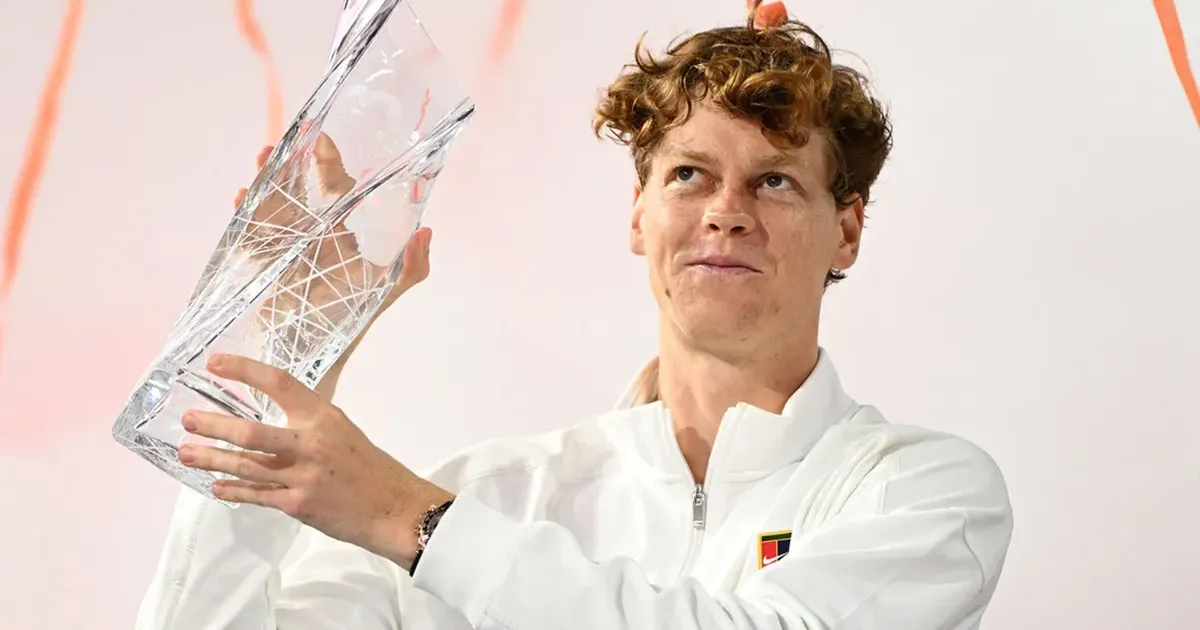
Jannik Sinner's Miami Open title was more than another Masters trophy. It completed one of the most demanding achievements in men's tennis: winning Indian Wells and Miami in the same spring. He did it without dropping a set across either event, turning the Sunshine Double from a milestone into a statement of control.
Sinner beat Jiří Lehečka 6-4, 6-4 in the Miami final on March 29, 2026. The win made him the first man since Roger Federer in 2017 to take Indian Wells and Miami in the same season, and the first man to complete that double without losing a set across the two tournaments. The scoreline looked straightforward because the month had been controlled.
Miami Confirmed The Indian Wells Message
Indian Wells and Miami test different versions of hard-court tennis. Indian Wells is slower and higher, with desert conditions that reward patience and heavy shot tolerance. Miami brings humidity, wind, rain interruptions and a different bounce. Winning both requires more than a hot serve or one inspired week. It requires adaptation before fatigue catches up.
Sinner handled that transition better than anyone else in the field. His backhand stayed flat and deep, his forehand did damage without becoming reckless, and his movement let him defend without surrendering the baseline. That combination is what separates a strong run from a structural advantage.
Lehecka Could Not Turn The Final Loose
Lehecka gave the final a fresh tactical problem. He had enough first-strike power to make Sinner respect the opening shot of every rally, and he arrived in Miami with the confidence of a player who had earned his place rather than drifted into the final. Sinner still kept the match from becoming chaotic.
That was the most telling part. There was no dramatic escape, no collapse avoided, no mythology built on surviving a crisis. Sinner held the center of the court, protected his serve and made every loose service game feel expensive. He won as if control were the point, not the byproduct.
The Record Was About Repetition
The set-perfect double mattered because it measured repetition under changing conditions. Many players can deliver one clean tournament. Fewer can carry the same pressure through two Masters events, two climates, different opponents and the expectation that grows with each straight-sets win. By the end of Miami, the streak had become its own opponent.
The achievement therefore landed beyond the trophy count. Sinner was no longer asking the tour to believe in his ceiling. He was showing a floor that had become punishingly high. Opponents had to hold serve under pressure, survive his depth and find enough offense to keep him from settling into rhythm. Few managed even two of those tasks at once.
The Season Made The Miami Signal Louder
The clay and grass months asked different questions, and the season did not become one uninterrupted hard-court story. But by July, Sinner's broader form had made the spring look less like a surface-specific spike and more like a foundation. His later Wimbledon run showed that the same habits - first-strike discipline, low-error aggression and calm scoreboard management - could travel beyond the North American hard courts.
The Sunshine Double was therefore not flashy chaos. It was pressure with almost no wasted motion. That is what made it so difficult to solve. Opponents can survive a highlight reel. Surviving four weeks of depth, accuracy and scoreboard discipline is a different assignment. Miami did not crown Sinner as unbeatable. It showed how narrow the path had become for anyone trying to interrupt him.