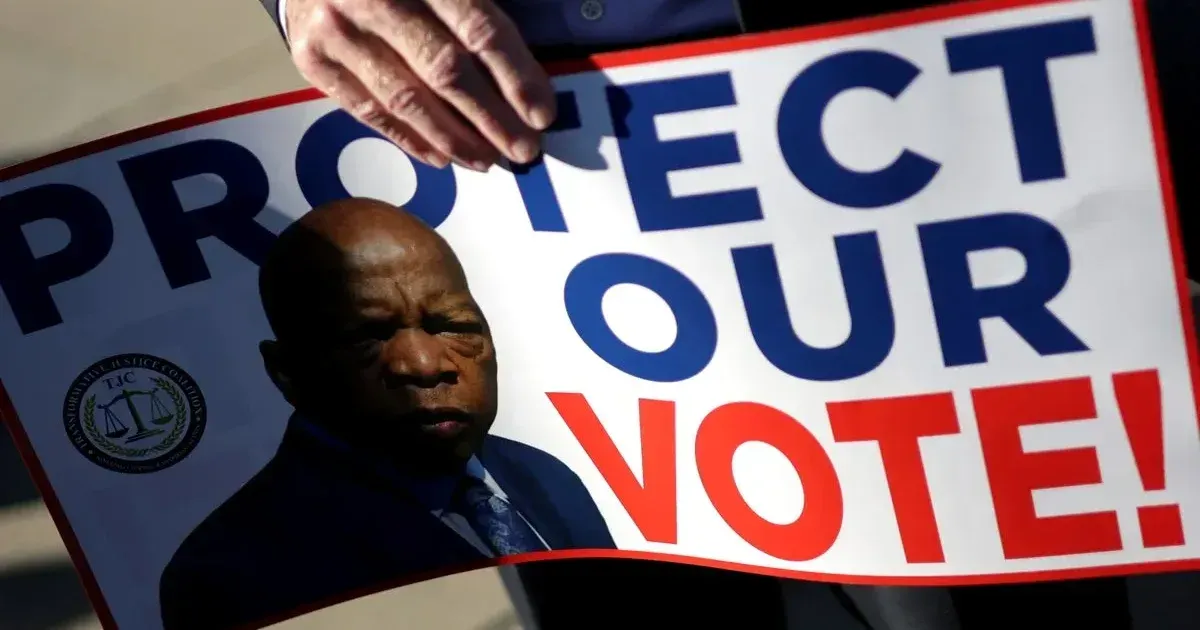
The redistricting ruling narrowed a major voting-rights tool without ending the fight over race and mapmaking. States now have a clearer path to defend some maps that civil-rights groups say dilute minority power. Federal justices narrowed a major Voting Rights Act rule for race-conscious redistricting, reshaping how courts will review congressional maps. The decision was issued on April 29, 2026, in a Louisiana case over a second Black-majority congressional district. The Supreme Court majority said the state relied too heavily on race when it created the district, even though the map had been defended as a response to earlier vote-dilution claims. The ruling raises the burden for plaintiffs who argue that a map denies minority voters an equal opportunity to elect candidates of their choice.
The case centered on the tension between Section 2 of the Voting Rights Act and the Constitution's limits on racial classifications. Civil rights groups have long used Section 2 to challenge maps that dilute minority voting strength. The majority held that compliance with the statute did not justify Louisiana's specific use of race in the challenged district. That reasoning does not erase Section 2, but it makes future race-based remedies harder to defend unless states can show a close fit between the remedy and a proven legal violation.
Higher Bar for Voting Rights Claims
Attorneys challenging district lines now face a more demanding path. Earlier cases allowed courts to consider whether a minority group was large and compact enough to form a district, whether voting was racially polarized, and whether the political process gave minority voters a fair opportunity. The new decision leaves those factors in place but gives states more room to argue that a proposed remedy would itself become an unconstitutional racial gerrymander. That shift will matter most in states where race and party preference overlap closely.
State lawmakers are likely to read the ruling as permission to emphasize compactness, county lines, incumbency protection, and partisan goals over demographic targets. The decision also intersects with ongoing mid-decade redistricting fights, because legislatures can now point to the ruling when defending maps that reduce minority-opportunity districts. Supporters of the decision say it keeps government from sorting voters primarily by race. Critics say it weakens one of the few remaining federal tools for policing discriminatory election rules.
Dissent Warns of Reduced Representation
Liberal justices warned that the ruling could make Section 2 far less effective in practice. Their concern is that plaintiffs may prove minority vote dilution but still lose if the remedy requires a district that pays substantial attention to race. That creates a legal loop in which the statute recognizes a problem but the Constitution, as interpreted by the majority, restricts the available cure. The dissent framed the decision as a retreat from decades of precedent designed to balance equal protection doctrine with the realities of racially polarized voting.
Outside the court, voting rights advocates said the immediate impact could fall across the South, where many congressional maps have been litigated under Section 2. Republican officials and conservative legal groups welcomed the decision as a check on what they view as racial sorting in election law. The practical result is likely to be more litigation, not less, as lower courts test how much race can still be considered when states try to avoid diluting minority votes.
Impact on Upcoming Legislative Cycles
Future maps may include fewer districts drawn specifically to protect minority voters' electoral opportunity. Without a clear mandate to use race-conscious remedies, mapmakers may lean more heavily on partisan advantage, geographic boundaries, and incumbent protection. That does not mean every majority-minority district is unlawful. It does mean that states defending such districts will need a stronger record showing why the district is necessary and why less race-conscious alternatives would not satisfy the law.
Lower courts must now apply the decision to active and future redistricting disputes. Some cases involve maps drawn after the 2020 census, while others are tied to fresh attempts to redraw lines before the 2026 midterms. Election officials may face compressed timelines if judges order changes, and voters may confront new district boundaries close to campaign season. The ruling therefore affects both legal doctrine and the practical calendar for candidates, parties, and local administrators.
The Court Has Made Voting-Rights Remedies Easier to Attack
The decision pushes Section 2 toward a narrower role. It remains a tool for challenging discriminatory election systems, but plaintiffs will need to connect their proposed remedies to concrete evidence without making race the dominant feature of the map. That is a difficult balance in places where racially polarized voting is well documented. The more a plaintiff relies on race to show a remedy works, the easier it may be for a state to argue that the remedy violates equal protection principles.
The long-term effect will depend on how aggressively lower courts read the new standard. A restrained reading could preserve some Section 2 claims while blocking only the most race-driven maps. A broader reading could make many vote-dilution cases much harder to win. Either way, the ruling gives state legislatures stronger defensive language and forces civil rights lawyers to build more detailed records before asking courts to redraw electoral boundaries.