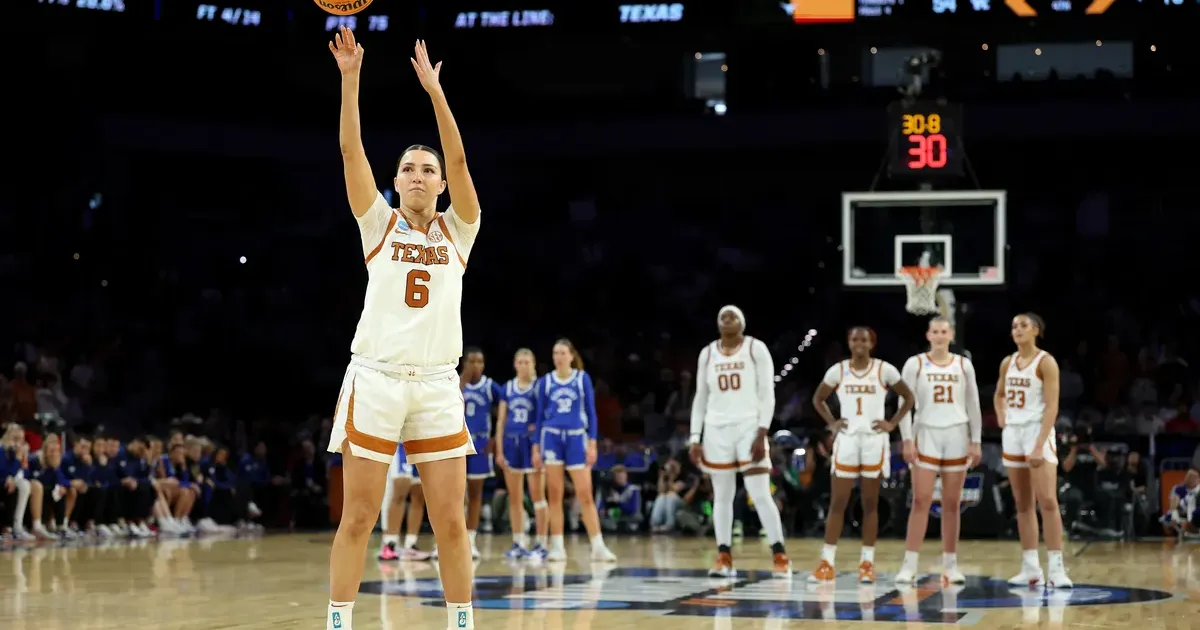
Texas and South Carolina closed the 2026 women's Elite Eight with the kind of wins that made the Final Four feel like a power bracket. Texas beat Michigan 77-41 in Fort Worth, and South Carolina beat TCU 78-52, completing a field with UConn and UCLA already waiting in Phoenix.
With the tournament now complete, those March 30 blowouts read differently. They were proof of depth and control, but not a guarantee of a title path. Texas later lost to UCLA in the national semifinal, while South Carolina beat UConn before being routed by UCLA in the championship game.
Texas Turned Michigan Into A Measuring Stick
Texas' 36-point win over Michigan was a defensive statement as much as a scoring margin. The Longhorns started fast, controlled the paint and made Michigan's guards work through pressure all night. A regional final is not supposed to feel settled early, but Texas made it feel that way.
The win showed why Vic Schaefer's team had the roster to reach a second straight Final Four. Madison Booker gave Texas star power, while the frontcourt and guard pressure made the game feel bigger and faster than Michigan could handle. The Wolverines' run still mattered, but the night exposed the gap between a breakthrough season and a top seed playing near its ceiling.
South Carolina Stopped TCU's Story
TCU entered its Elite Eight game with momentum and a real national story. South Carolina did not let the story become leverage. Dawn Staley's team controlled the game through size, defense and depth, turning a potential underdog moment into another example of Gamecocks tournament authority.
The 78-52 result fit South Carolina's broader identity. The Gamecocks were not trying to prove they belonged on the stage. They were trying to prove they could win another title-level sequence after a season that had tested them. Against TCU, the answer looked convincing.
The Field Rewarded No. 1-Seed Strength
With UConn, UCLA, Texas and South Carolina in Phoenix, the Final Four had very little Cinderella cover. The bracket rewarded teams that could survive multiple styles, absorb physical games and win without depending on one perfect shooting night.
A field this strong changes the stakes. A blowout in the Elite Eight raises expectations immediately. Texas and South Carolina did not arrive as happy participants. They arrived carrying evidence that they could overwhelm good opponents when their defense and depth traveled.
Phoenix Changed The Meaning
The semifinal round added the missing context. UCLA beat Texas 51-44 in a grinding game that exposed how difficult it is to carry offensive rhythm from one weekend to the next. Texas had looked explosive against Michigan, then had to fight through a much slower, tighter matchup against the Bruins.
South Carolina's path went further. The Gamecocks beat UConn 62-48, ending the Huskies' long winning streak and earning a title shot. But UCLA's 79-51 championship win over South Carolina showed that even a dominant semifinal team can be overwhelmed two days later.
The Lesson Was Depth And Adaptability
March 30 showed that Texas and South Carolina had the depth to end regional runs with authority. The rest of the tournament showed that depth alone is not enough. Teams also need half-court answers, late-game shot creation and the ability to handle a matchup that refuses to resemble the previous round.
Michigan and TCU reached meaningful thresholds, but Texas and South Carolina showed the gap between arrival and authority in the Elite Eight. UCLA then showed the next gap: authority in one round does not protect a team from a colder, more physical, more precise opponent in Phoenix. The completed tournament makes the March 30 blowouts look impressive, but not final.