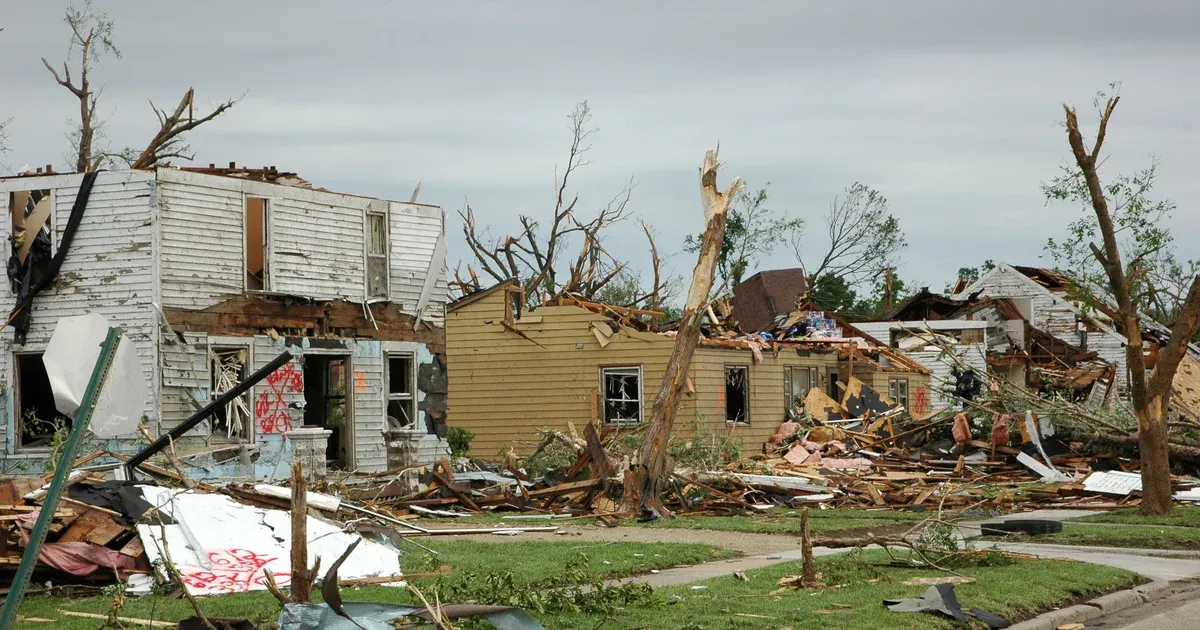
A tornado outbreak across five states has left neighborhoods damaged, emergency crews stretched and residents facing a long recovery.
Tornadoes Tear Across Five States
Midnight destruction carved a path of atmospheric violence across the American heartland that many residents will not soon forget. Emergency responders in five states spent the early morning hours searching through splintered timber and twisted metal. The scale of damage became clearer on March 11, 2026, as crews moved through neighborhoods torn apart overnight. Survivors describe a terrifying sequence of events where the night sky turned a bruised purple before the sound of a freight train leveled their homes. CBS News correspondent Lana Zak, reporting from the ground, characterized the destruction as a complete annihilation of entire residential blocks.
Search and rescue teams focused their efforts on small towns where the infrastructure proved no match for the tornadic winds. Families who retreated to basements emerged to find the upper stories of their houses completely gone. In many cases, the only remaining evidence of a home was a concrete slab and a set of stairs leading to nowhere. Local authorities confirmed that the storm system crossed state lines with relentless speed, catching some residents before they could reach adequate shelter. Nature rarely displays such concentrated fury across so many jurisdictions simultaneously.
Reports indicate that the storm system moved through Illinois, Indiana, Ohio, Kentucky, and Tennessee. This multi-state cluster developed when a high-pressure system from the Gulf of Mexico collided with a cold front sweeping down from the Rockies. The resulting instability created a breeding ground for supercell thunderstorms capable of producing long-track tornadoes. Meteorologists noted that the rotation in these storms was exceptionally tight, leading to the narrow but devastating paths of destruction seen on the ground. Ice fell from the sky with enough force to penetrate roofing materials and shatter automotive glass.
While the tornadoes caused the most visible structural damage, the accompanying hail caused its own brand of chaos. Residents reported stones the size of softballs falling in a rhythmic barrage that lasted for several minutes. Such large hail requires intense updrafts to keep the ice suspended in the atmosphere long enough to reach those dimensions.
Recovery Begins Block by Block
These updrafts were measured at speeds exceeding 100 miles per hour within the core of the storm cells. Damage from the hail will likely complicate the insurance recovery process for months. Entire car dealerships in the path of the storm saw their inventory totaled in a matter of seconds. Greenhouse operations and agricultural facilities also suffered significant losses, with glass structures shattered and early-season crops pulverized. This secondary element of the storm added a layer of economic hardship to a region already reeling from the loss of housing.
Lana Zak noted that the sheer scale of the debris fields makes it difficult for emergency vehicles to reach certain rural pockets. Local police departments have requested assistance from the National Guard to help clear roads and establish security perimeters. Looting remains a concern in areas where homes no longer have walls or doors to protect personal property. Still, the primary focus remains the accountability of every resident listed in the census for these hard-hit neighborhoods. Communication towers fell early in the night, leaving many without the ability to receive emergency alerts on their mobile devices.
Traditional sirens provided the only warning for some communities, though the high winds often drowned out the sound until the funnels were nearly on top of the structures. Power grids across the five states suffered massive failures as high-voltage lines were snapped like kite string. Utility companies warn that restoring electricity to the most remote areas could take weeks due to the volume of downed trees. Recovery costs are expected to soar well beyond previous disaster records. Insurance adjusters are already moving into the region, but the complexity of the damage presents a unique challenge.
Some properties were hit by both the tornadoes and the softball-sized hail, leading to disputes over which weather event caused specific types of failure. However, for those who lost everything, the technicalities of insurance policy language offer little comfort in the face of total displacement.
Why Warnings Still Meet Fragile Infrastructure
Why do we continue to build stick-frame houses in the bullseye of nature's firing range? The outbreak showed again that timber and drywall cannot carry the burden of a changing risk map. We continue to subsidize rebuilding in high-risk zones, effectively paying for the privilege of watching the same houses fly apart every few years. Insurance companies are already pulling out of coastal regions, and it is only a matter of time before the Midwest faces a similar exodus of capital. If a structure cannot withstand 200-mile-per-hour winds, it should not be built in a region where such winds are a seasonal certainty.
The March 11 disaster proves that timber and drywall are no match for a climate that has grown increasingly hostile to human habitation.
Our refusal to mandate storm-resistant construction reflects a broader cultural denial regarding the fragility of our infrastructure. This recurring tragedy is not a matter of fate, but a consequence of policy failure and aesthetic stubbornness. If the sight of leveled neighborhoods across five states does not force a change in building codes, nothing will. We are financing our own destruction through a cycle of cheap construction and taxpayer-funded recovery. The era of the disposable American home must end before the next supercell arrives.