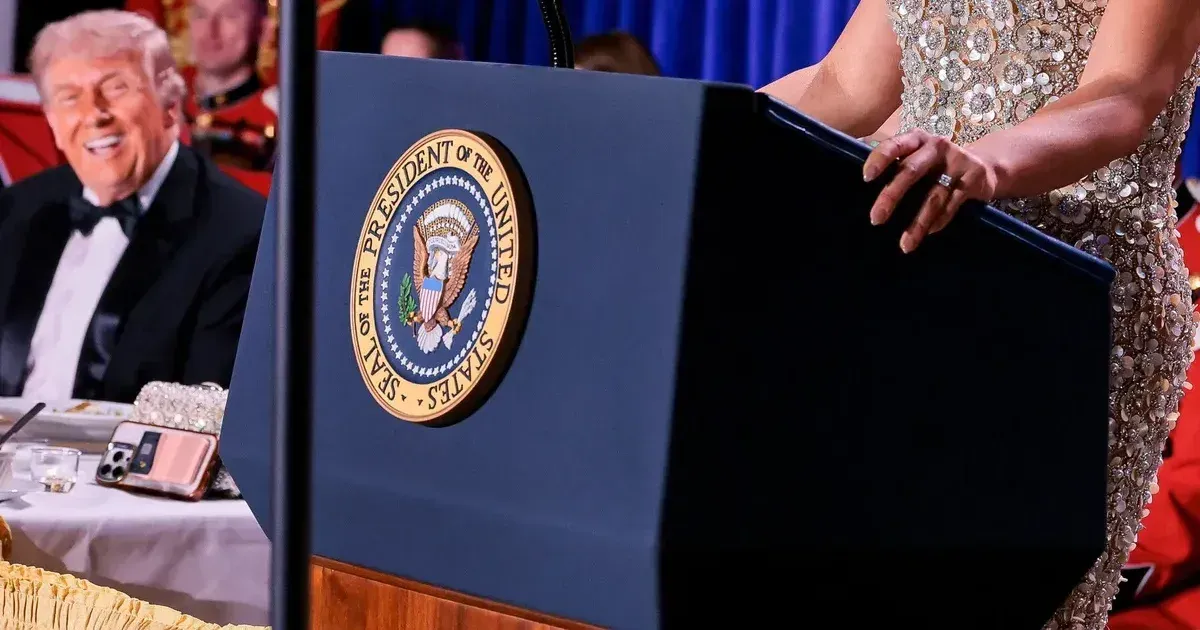
Gunfire at the White House Correspondents' Association dinner pushed Donald Trump into the center of another presidential security crisis. On April 26, 2026, the attack unfolded at the Washington Hilton as Secret Service agents rushed the president from the podium and neutralized a suspect on the balcony. That breach of the innermost ring of presidential security occurred while Donald Trump sat beside Weijia Jiang, the CBS News correspondent and current president of the association. Witnesses reported at least four rounds were discharged before agents tackled the assailant near a television camera riser. Jiang remained at the head table to report on the incident immediately after the evacuation of the room.
Donald Trump expressed public gratitude toward the reporter for her composure during the immediate aftermath. He described her actions as professional and noted her commitment to reporting the facts as they unfolded in the ballroom. Presidential security protocols failed to detect the weapon despite multiple layers of magnetometers and background checks for all attendees. Law enforcement officials initially withheld the shooter's identity and motive, but federal records later described formal assassination charges tied to the breach. Recovery efforts at the scene began within minutes of the area being secured by federal authorities.
Weijia Jiang and the Washington Hilton Attack
Gunfire transformed a night of political levity into a crime scene that spanned the entire basement level of the Washington Hilton. Weijia Jiang was providing opening remarks when the first pop of a small-caliber weapon echoed through the hall. She stayed at the scene even as other guests crawled beneath tables or fled toward the emergency exits. Her reporting provided the first window into the chaos for the outside world. Trump later acknowledged her presence of mind during a chaotic transition to a secure location.
‘She handled herself with total professionalism while the bullets were still flying,’ Trump stated during a press briefing following the evacuation of the Washington Hilton.
Security failures at the dinner are now the subject of an intense federal inquiry led by the Department of Justice. Investigators are looking into how an armed individual bypassed the Secret Service security perimeter that typically defines this high-profile event. Shooter proximity to the head table suggests a total breakdown in the screening process for technical staff or venue employees. Evidence suggests the weapon was concealed in a piece of equipment used by the catering department.
Security Risks Fuel White House Ballroom Expansion
Trump renewed his demand for the construction of a dedicated ballroom within the White House grounds on April 26, 2026. He argued that the current practice of using public hotels for large-scale presidential events presents an unacceptable level of risk. Administration officials have treated the proposed White House Ballroom project as a priority for months, but it encountered major delays. Environmental groups and historical preservationists have filed multiple lawsuits to block the construction of the facility. These legal challenges focus on the impact the new structure would have on the historic South Lawn.
Litigation involving the ballroom project has moved slowly through the federal court system for nearly a year. Opponents of the plan claim the building would mar the aesthetic of the executive mansion. Trump maintains that the safety of the commander-in-chief outweighs architectural concerns. He signaled that he would use executive authority to speed up the project to prevent future exposure at vulnerable public sites. Estimated costs for the proposed facility run into several hundred million dollars.
Fetterman Joins Bipartisan Support for Presidential Safety
Pennsylvania Senator John Fetterman broke with his party on April 26, 2026, to endorse the immediate construction of the secure ballroom. He noted that the frequency of attempts on the life of the president makes the current security posture unsustainable. Fetterman stated that regardless of political affiliation, the safety of the office is a matter of national security. His support provides the project with a degree of bipartisan cover it previously lacked in the Senate. His shift came after he reviewed initial security reports from the Hilton scene.
Concerns about the safety of the president have intensified across the political spectrum. Federal officials now count the incident as the third attempt on the life of Donald Trump within the last two years. Congressional leaders are now considering emergency funding to accelerate the ballroom construction. Fetterman argues that the Secret Service cannot guarantee safety in open, commercial venues like the Hilton. Pennsylvania's senator has requested an immediate hearing on the failure of the security screening process at the correspondents' dinner.
Global Response to Third Assassination Attempt
World leaders issued statements of condemnation within hours of the reports emerging from Washington. Leaders in London, Paris, and Berlin expressed concern over the escalation of political violence in the United States. Foreign governments have watched with increasing alarm as threats against American officials translate into kinetic action. Diplomatic cables indicate that foreign governments are reviewing their own security protocols for high-level summits. Several nations offered intelligence assistance to help determine if the shooter had international connections.
Political stability in the United States continues to be a primary concern for global markets and allies. Violence at the correspondents' dinner has already impacted overnight trading on the major stock exchanges. Investors typically react poorly to signs of domestic unrest or threats to the head of state. Repeated security breaches are testing the resilience of the American political system. Local police in Washington have increased patrols around all federal buildings following the evening's events.
A Secure Ballroom Confirms the Retreat of the Accessible Presidency
Architecture often functions as the final admission of state failure. A private White House ballroom goes beyond a request for luxury; it is a retreat into a bunker. When the Secret Service can no longer secure a hotel ballroom in the heart of the capital, the public square has been surrendered to the assassin. Trump is correct to demand a secure facility, but the necessity of such a building highlights a deeper rot in the American social fabric. A presidency that must be conducted behind ten-foot-thick reinforced concrete is a presidency in a state of siege.
Fetterman’s endorsement of the project reveals the desperation of the political class. Even the most vocal critics now recognize that a dead president is a catastrophic outcome for the republic. Bipartisanship born of fear is rarely a sign of health. Construction will likely scar the South Lawn if the ballroom is built. That may be a small price for executive security, yet it means the end of the accessible presidency. Washington is becoming a city of fortresses. America's open political society is closing.
A fortress will not solve the underlying pathology of 2026. Walls protect bodies but do not quiet minds. Protection is the state's most basic duty, and it is failing. Retreat is the only strategy left.