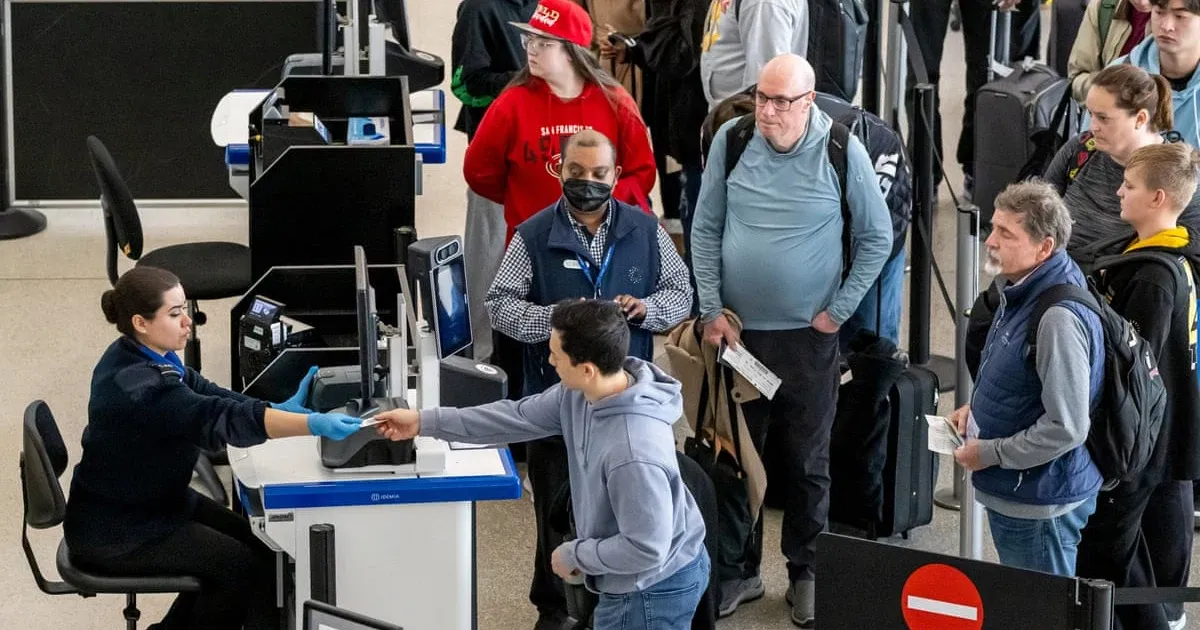
At the airports serving Tampa, Charleston and Des Moines, the Transportation Security Administration is preparing to place checkpoint operations and screening equipment under contractor management. The change goes beyond hiring a company to staff lanes under federal supervision: the new Gold+ model would give contractors control of the technology used at those checkpoints.
The Guardian reported the plan on August 5, 2026, after the agency notified the American Federation of Government Employees in July. AFGE, which represents TSA workers, is reviewing possible legal action. The takeover is expected to replace the employees' collective-bargaining agreement and current benefits. That makes the first rollout a test of both security management and federal labor protections.
Gold+ Moves Equipment Along With Screening Work
Private airport screening is not new. TSA's Screening Partnership Program already allows contractors to conduct searches at smaller and non-hub airports while the federal agency oversees their work. Gold+ changes that boundary by allowing the contractor to own and operate screening equipment. That creates a wider transfer of operational control than the existing program.
The distinction matters because the administration is expanding private screening on several tracks. TSA plans to remove about 4,500 positions as the partnership program reaches 220 U.S. airports. In May, deputy administrator Adam Stahl raised the prospect of automating work now performed by officers as Gold+ develops. For fiscal 2027, the administration has also proposed cutting 8,400 screener roles. That total represents roughly one in seven officers in the workforce described by The Guardian. The labor fight was already under way before Gold+: the administration tried in March and again in December to cancel collective bargaining agreements covering 47,000 TSA employees, but federal judges blocked both efforts. Those rulings preserved the agreements; they did not settle how workers will be treated when an airport moves to a contractor.
AFGE president Everett Kelley argued that a change of this scale should involve Congress, airport authorities, employees and the traveling public. His objection reaches back to the reason federal screening was created after the September 11 attacks: national standards replaced a system run by contractors. TSA itself began operations in November 2001 under the Bush administration. Kelley also pointed to the 1988 bombing of Pan Am Flight 103 as part of the security history that preceded federal control. The union's earlier privatization warning emerged from shutdown pressure; Gold+ now turns that policy argument into a named program at specific airports.
A Tampa officer, Chris Finlay, offered a labor example from another Florida airport where a contractor took over screening 12 years earlier. Workers were initially told their pay would hold steady, he said, before wages were reduced within weeks. He argued that payroll is an obvious place for a profit-seeking contractor to cut costs. He also recalled a 2015 case in which a contractor employee was dismissed after reporting that a steak knife had passed through a checkpoint near Orlando.
The First Test Is a Worker Transition, Not a Safety Verdict
Affected TSA officers will have the first opportunity to continue working under the new operator. Those who do not move are expected to receive severance or retirement according to their years of federal service. Those terms describe the transition, but they do not answer what pay, benefits or workplace protections will look like after a contractor assumes control. That is why the Gold+ worker transfer will be watched as closely as checkpoint performance.
TSA presented the initiative as a way for Tampa International Airport to improve service, security and efficiency while maintaining stable operations and supporting employees. The agency said it would work with the airport on improvements for travelers. The union sees the same transfer through a different lens: private ownership introduces a profit obligation into an operation whose central purpose is public safety.
The three-airport launch therefore cannot prove in advance that private screening will be safer or weaker. It will show which standards remain federal, which decisions move to contractors and whether experienced officers stay after their employment terms change. Passenger wait times may be the most visible measure, but retention, reporting channels and equipment accountability will determine whether private checkpoint control changes more than the name on a worker's badge.