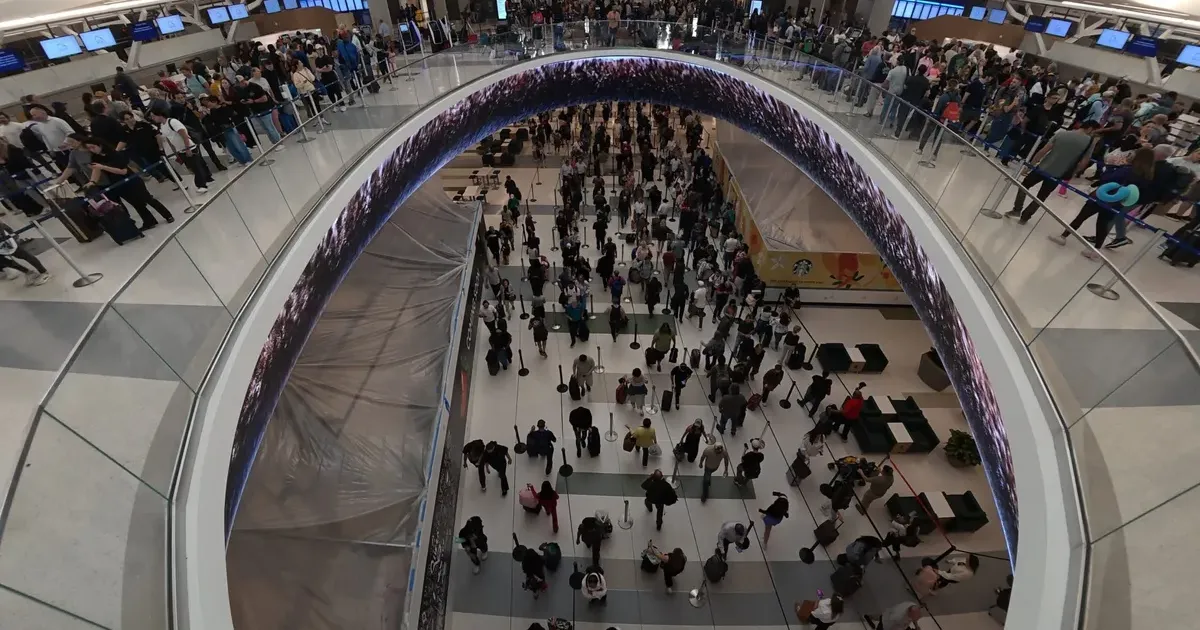
Airport security is not only a travel inconvenience when funding fights hit Washington. It becomes a labor test, a passenger-flow problem and a privatization argument at the same time. TSA union representative Jill DeJanovich warned that the partial government shutdown was putting screeners under financial and operational strain, while travelers were already seeing uneven checkpoint conditions across the country.
The warning matters because a long security line is easy to see and a damaged workforce is not. Passengers see a corridor filling up, a flight time getting closer and a checkpoint that appears to be failing. They do not see delayed pay, callouts, extra shifts, morale problems or managers moving officers between lanes to keep the system from breaking. That gap creates political space for a simple claim: if the federal model cannot keep lines moving, private screening should get a larger role.
That was the risk behind DeJanovich's argument. The concern was not that every airport would be privatized overnight. The United States already has the Screener Partnership Program, which allows airports to use private contractors under TSA oversight. The sharper issue is whether a shutdown crisis can make that limited option look like a broad cure for a problem created by unstable federal funding.
Shutdown Pressure Makes A Labor Problem Look Like A Market Solution
When a government funding standoff reaches airport checkpoints, it changes the public reading of the system. A traveler delayed at security may blame TSA as an institution. A lawmaker may point to that frustration as evidence that contractors would be more flexible. A union official sees a different sequence: Congress delays pay, screeners absorb the damage, staffing becomes harder, lines get worse, and the visible failure is then used against the workforce.
That sequence is why the privatization question cannot be separated from labor stability. Screening is not only a set of machines and lanes. It depends on experienced officers making quick judgments, keeping passenger movement orderly and applying national rules with consistency. Federal screening expanded after the September 11 attacks because airport security was treated as a national responsibility, not a patchwork service bought airport by airport.
Private contractors can still operate under federal rules, but cost pressure and churn are not minor details in this work. A checkpoint that loses experienced people does not simply replace bodies on a schedule. It loses judgment, rhythm and institutional memory. In security, those are operational assets, not workplace luxuries.
Passengers Are Getting Conflicting Airport Messages
The traveler side of the story is messy because airports are not experiencing the same day. John Glenn International Airport in Columbus urged passengers not to arrive three or four hours early, saying 90 minutes was enough for many departures and that excessively early arrivals were creating bottlenecks. The message was practical: a terminal works best when passengers arrive in waves, not when anxiety pushes everyone into the building long before their flight.
Baltimore-Washington International showed the opposite risk. Reports from BWI described long TSA lines, staffing strain and passengers missing flights despite arriving early. In that setting, telling people to cut their arrival window can sound reckless. The result is a trust problem for airport communication. A generic instruction to ?arrive early? can create panic crowding at one airport. A generic promise that 90 minutes is enough can fail badly at another.
That is why airport-specific guidance matters more than old habits. Travelers need current checkpoint information, airline alerts and local airport notices rather than one national rule of thumb. Airports also need to be precise. If they want passengers to arrive closer to departure, they have to show that live wait times, signage, lane staffing and airline coordination can support that advice.
Airport Capacity Depends On Public Competence
The policy lesson is harder than the travel advice. A funding fight does not stay inside Congress. It arrives in paychecks, callout rates, checkpoint staffing and missed flights. If lawmakers let TSA workers become the buffer for repeated shutdown pressure, they should not be surprised when passengers start treating every long line as proof that the federal model itself is broken.
That is the opening privatization advocates need. They do not have to prove that private screening is safer, fairer or more resilient in every airport. They only have to point to visible dysfunction and promise smoother management. The union side has to defend public control while the public system is being weakened in real time.
The better answer is not to romanticize federal bureaucracy. It is to stop creating the conditions that make airport security look unreliable. A checkpoint can survive a bad travel day. It cannot be run indefinitely as a stress test for unpaid workers, anxious passengers and political actors waiting to turn a preventable failure into an ownership argument.