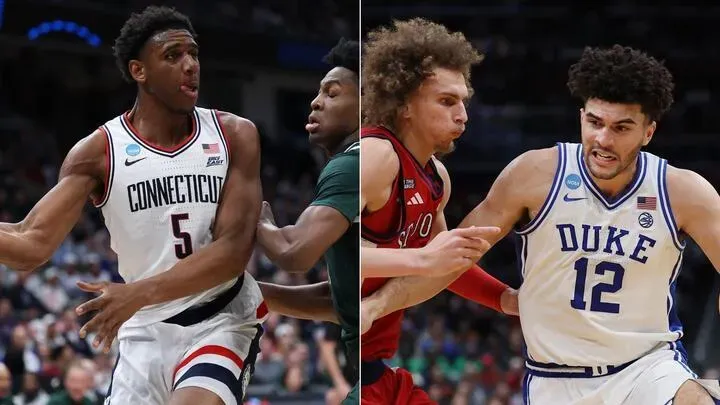
UConn and Duke gave the Elite Eight a frontcourt showcase before one desperate perimeter shot took over the whole night. The East Regional final was played on March 29, 2026, in Washington, where UConn rallied from 19 points down to beat top-seeded Duke 73-72 and reach the Final Four.
The game had been sold as a size test. Duke had Cameron Boozer, the freshman forward whose scoring and rebounding bent defenses all season. UConn had Tarris Reed Jr., whose work inside kept the Huskies alive while their offense stalled. By the end, the lesson was not that big men are back or that guards still rule March. It was that tournament teams need both, and they need them under pressure.
Braylon Mullins hit the shot everyone will remember, a 35-footer with 0.4 seconds left. Reed made that shot possible by keeping UConn close enough for a miracle to matter.
Interior Play Set the Terms
The paint mattered because it shaped the tempo. Duke looked most comfortable when Boozer touched the ball early and forced UConn to decide whether to send help. His gravity opened passing lanes, drew contact and let the Blue Devils control long stretches without needing a three-point avalanche.
UConn answered differently. Reed's value was not limited to scoring. He screened, fought for rebounding position and gave the Huskies a place to play through contact when the floor tightened. When Duke tried to turn control into separation, UConn's size kept the game from slipping completely out of reach.
The frontcourt did not decide the game by itself, but it decided whether the final shot could still matter.
That is the serious takeaway. Neither team looked like a small-ball experiment. Duke wanted the ball to pass through Boozer's decision-making. UConn needed its frontcourt to stabilize possessions long enough for its guards and wings to find a late answer.
Late Possessions Broke the Preview
The final sequence exposed the limit of the simple pregame read. Duke had the lead, the star forward and the cleaner statistical profile for much of the night. UConn still won because it defended one more action, survived one more scramble and trusted a freshman wing to take the shot that ended the regional.
That does not weaken the frontcourt theme. It makes it more honest. Modern college basketball still rewards spacing, ball pressure and shot creation. But deep tournament runs also require bodies that can rebound misses, absorb contact and protect the rim when the offense turns ugly.
Duke left with proof that Boozer can sit at the center of a title-level roster. UConn left with the win, which is the only proof March respects.
March Still Punishes One-Dimensional Teams
The broader lesson is not that the sport is returning to an older era. It is that the best teams are harder to categorize. UConn's comeback needed Reed's interior resistance, veteran patience, defensive pressure and one fearless shot from Mullins. Duke's loss still showed why a dominant forward can tilt an entire bracket.
For coaches, the lesson is practical. Recruiting size only matters if the guards can handle pressure and the wings punish help. Building around shooting only works if someone can finish through contact when the game slows down. The best tournament rosters need a frontcourt that can take punishment and a perimeter group calm enough to turn that pressure into one clean look.
The hard read is that Duke did plenty right and still lost because March compresses good work into one possession. UConn did not reject Duke's model. It survived it, then added the one answer Duke could not erase. That is why the game revived the size debate without settling it.