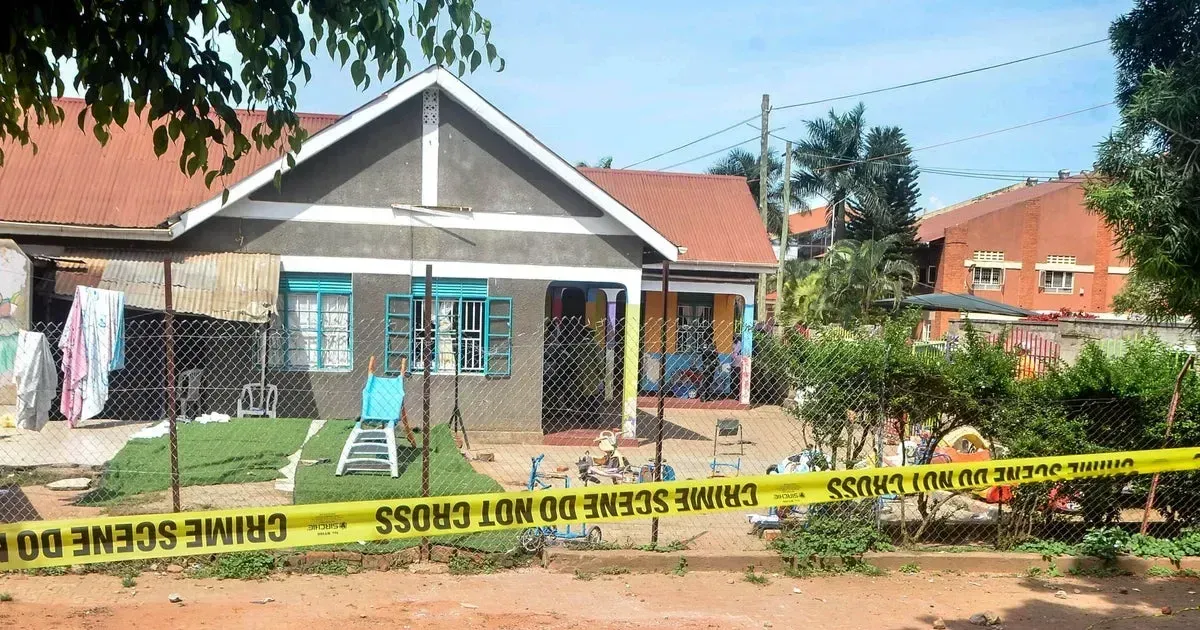
Uganda's mobile court experiment has moved a high-profile murder trial close to the community most affected by the crime. Christopher Okello Onyum is being tried over the machete killings of four children, with hearings held in a tented site under heavy security. The location has become a test of both public access and judicial restraint. Officials described the arrangement on April 13, 2026, as a test of local access to justice and transparency.
Mobile Court Trial Logistics
Holding a capital murder trial in a portable tent involves serious logistical hurdles. Power for the recording equipment comes from portable generators positioned several dozen yards away from the judicial bench. Clerks must manage physical case files in an environment exposed to high humidity and dust. Despite these challenges, the Uganda High Court maintains that the integrity of the record is preserved through digital backups. Judges wear traditional robes despite the rising temperatures inside the canvas structure. Local participation remained the primary driver for this specific venue choice. Officials noted that the distance to the nearest permanent courthouse often prevents victims' families from attending daily sessions. Bringing the court to the village removes the financial and physical barriers to entry for those most affected by the crime. Several villagers walked more than ten miles to reach the site by the 9:00 a.m. start time. Public attendance is seen as a way to demystify the legal process for rural populations. Public sentiment regarding the mobile court remains divided. Some residents expressed relief that they could see the accused man face the law in person. Others expressed concern that the proximity to the crime scene might inflame passions and threaten the safety of the defendant. Uniformed police officers carry rifles while patrolling the outer edges of the audience area. Their presence is a direct response to rumors of potential vigilante action surfacing in local markets.
Presidential Mandate for Local Justice
Presidential directives often bypass standard judicial scheduling to address cases of high public interest. Direct intervention by the head of state ensures that funding for these mobile sessions is fast-tracked through the Ministry of Justice. The year 2026 has seen an increase in these specialized sessions across various districts. Advocates for the system argue that such visibility deters future crimes by showing the speed of the state's response. Critics, by contrast, worry about the erosion of judicial independence when the executive branch dictates the timing and location of specific trials.
Mobile courts are not a new invention in the East African judicial landscape. Uganda has used them for decades to address land disputes and minor criminal offenses in remote areas. However, applying this model to a quadruple homicide is a meaningful expansion of the practice. Four children died in the attack, and the scale of the tragedy required a more resilient security detail than typical mobile sessions require. Additional funding was allocated specifically for the transportation of high-ranking judges from the capital city.
International observers have arrived to monitor the fairness of the proceedings. Representatives from human rights organizations sit in the front row of the public gallery, taking detailed notes on the treatment of the defendant. They are particularly focused on whether the mobile environment allows for a proper defense. Access to legal counsel is guaranteed under the constitution, but the physical constraints of a tent can limit private consultation time between a lawyer and their client. Judges have promised to allow as much time as necessary for the defense to prepare their rebuttals.
Community Trauma After the Attack
Machete violence, while localized, leaves deep scars on the social fabric of rural villages. Elders in the community have spoken about the loss of trust between neighbors following the discovery of the children. Traditional mourning rituals were held simultaneously with the start of the legal proceedings. Many parents in the area now keep their children home from school unless they can be escorted by an adult. The psychological toll on the survivors remains a major point of discussion in the village council.
Schools in the district have implemented new safety protocols. Teachers now conduct headcounts multiple times per day to ensure no student has wandered off. This climate of fear persists despite the arrest of the primary suspect. Prosecutors intend to call several minor witnesses to testify about what they saw on the day of the killings. Child psychologists are on standby to assist these young witnesses during their testimony. Special measures, such as screens to hide the defendant from the children's view, have been discussed by the court.
Medical examiners provided the court with detailed autopsy reports during the afternoon session. Documents describe the nature of the wounds inflicted on the victims. Each child suffered multiple injuries consistent with a heavy, sharp-edged weapon. Forensic experts took the stand to explain the angle of the strikes and the probable force used. Their testimony was met with a heavy silence from the spectators. One parent had to be led out of the tent after becoming overwhelmed by the technical descriptions of the injuries.
Trial proceedings are expected to continue for at least two weeks. More than thirty witnesses are scheduled to testify for the prosecution alone. Defense attorneys have indicated they will call character witnesses to speak on behalf of the accused. The judge has cautioned the public against making noise or gestures during the testimony. Violators of this rule face immediate removal and potential contempt charges. Every word spoken is being translated into the local dialect for the benefit of the observers.
Justice Access and Fair Trial Risk
The mobile court risks becoming a stage for state-sponsored theater. This deployment of the judicial apparatus into the heart of a grieving community smells of populist posturing rather than procedural rigor. By shifting the trial into a tent near the crime scene, the Ugandan government is prioritizing the optics of retribution over the sanctuary of a neutral courtroom. The inherent pressure of a local crowd, many of whom are likely related to the victims, creates an environment where a truly impartial verdict becomes a statistical improbability. A judge sitting in a hot tent surrounded by an angry village is not the same as a judge sitting in the High Court in Kampala.
The presidential mandate further complicates the ethical landscape. When a head of state orders a specific type of trial for a specific individual, the line between justice and politics vanishes. This maneuver serves to strengthen the administration's image as a protector of the people while simultaneously bypassing the standard, and often slower, rhythms of the law. If the state can move the court on a whim, it can move the goalposts of justice just as easily.
The arrangement signals a shift toward a more performative style of governance that uses the trauma of a community to justify the expansion of executive reach into the courtroom. Victims deserve justice, but a circus in a tent is a poor substitute for the cold, hard application of the law.
Justice must be done, and it must be seen to be done, but the latter should never compromise the former. The mobile court system in its current form risks becoming a tool for mob satisfaction instead of a mechanism for discovering the truth. If the defendant is found guilty in this environment, his legal team will have ample grounds for appeal based on the potentially coercive atmosphere of the trial site. The efficiency might actually lead to years of legal delays in the long run. Performance is not justice.