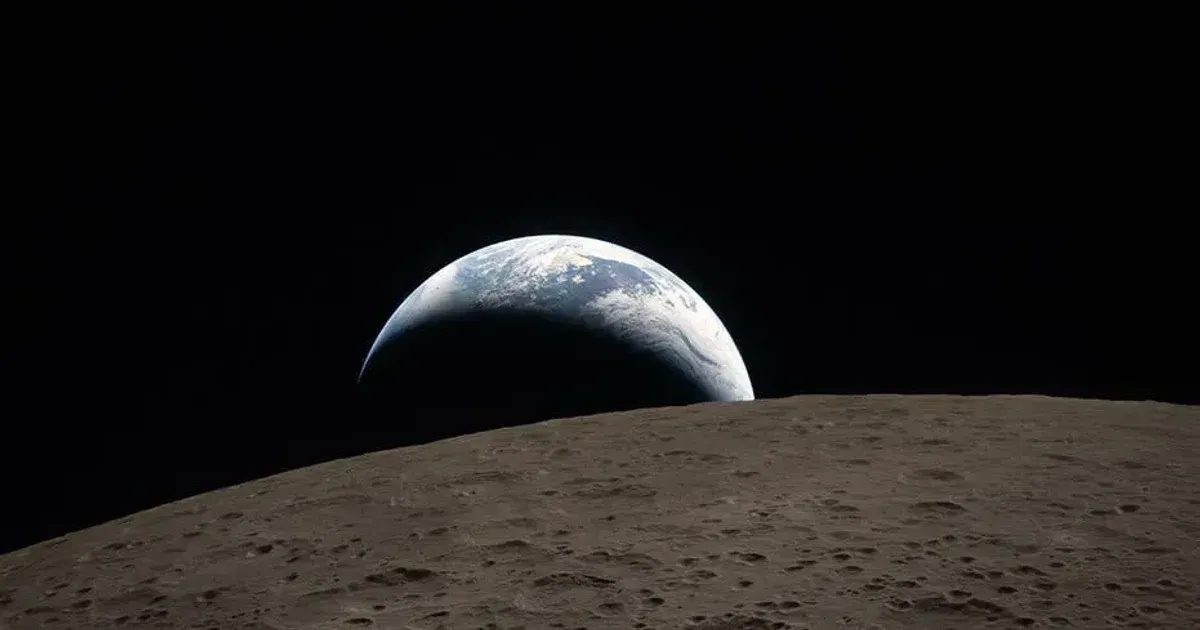
The Artemis II crew has begun the return leg from the lunar far side after Orion completed the burn that set it back toward Earth. The milestone matters because the mission now shifts from spectacular imagery to the harder engineering test of re-entry, recovery and post-flight data review.
NASA confirmed the trans-Earth injection phase on April 7, 2026, after the crew completed its far-side pass and captured the Earthset image. The next several days will determine how well Orion performed as a crewed deep-space vehicle rather than only as a public symbol.
Orion Crew Captures Historic Earthset Image
Images beamed back to mission control on Monday evening revealed a perspective of Earth never before captured by human eyes. NASA released the photograph, which shows a muted blue Earth with bright white clouds dipping behind the cratered lunar horizon. Mission planners dubbed the image Earthset as a direct tribute to the 1968 Earthrise photo taken during the Apollo 8 mission. Darkness covered the portions of Earth where nighttime prevailed, while swirling cloud patterns were visible over Australia and the Oceania region. High-resolution sensors captured the contrast between the desolate lunar terrain and the vibrant colors of the home planet.
Technical specifications for the Orion spacecraft include a suite of 32 cameras distributed across the interior and exterior. Fifteen cameras remain fixed to the frame of the vessel to monitor mechanical performance and external conditions. Seventeen handheld cameras allow the four crew members to document specific geological features or internal activities. NASA officials have not yet assigned specific credit to a single astronaut for the Earthset photograph. The image was captured through a window of the Orion capsule at approximately 7 p.m. ET. Digital files reached terrestrial servers through the Deep Space Network.
Lunar Far Side Provides Scientific Baselines
Former NASA scientist James Head, now a professor at Brown University, argues that this mission targets the missing chapters of Earth history. Earth's geological record has been largely erased by plate tectonics and constant erosion from weather systems. Lunar surfaces remain geologically stagnant, preserving a record of the early solar system that is no longer available on our own planet. Head noted that the far side contains a higher density of impact craters compared to the near side. These craters serve as a chronological map of the bombardment period that occurred billions of years ago.
Direct observation of these regions allows the crew to identify potential landing sites for future Artemis sorties. Humans can perceive depth and color variations that sensors occasionally flatten or misinterpret. Observations made during the flyby will provide a scientific baseline for the Artemis III mission, which aims to put boots on the ground. Data from the far side flyby suggests that the crustal thickness varies sharply between the two hemispheres. This geological asymmetry remains a primary focus for lunar researchers. The crew reported seeing textures and color gradients that were not apparent in previous satellite imagery.
President Donald Trump held a phone call with the astronauts late Monday to congratulate them on their progress. He characterized the crew as modern-day pioneers during the conversation. Trump emphasized that the mission makes the American people proud. White House officials shared the Earthset photo on social media platforms shortly after its release. The administration has frequently linked space exploration milestones to national prestige and technological leadership. Success in the Artemis II mission reinforces the current timeline for establishing a permanent lunar base.
NASA Administrator Jared Isaacman credited the current administration for the operational success of the mission. Isaacman stated that Artemis II would not have been possible without the consistent backing of the executive branch. Funding for the program was still a priority in recent budget cycles. Strategic partnerships with private aerospace companies have also accelerated the development of the Orion hardware. The administration views the moon as a testing ground for eventual Mars exploration. Policy experts suggest that the successful flyby strengthens the case for continued heavy investment in deep space infrastructure.
"Humans have really never seen anything quite like what you're doing in a manned spacecraft. It's really special," Trump added.
Previous missions relied on robotic probes to map the far side of the moon, but the presence of humans provides a different qualitative assessment. Bill Anders captured the original Earthrise nearly 60 years ago, yet his vantage point differed from the current Artemis II trajectory. The current mission represents the first time human beings have witnessed the Earth disappearing behind the lunar limb from this specific distance. Light reflecting off the lunar crust provided enough illumination to reveal deep craters and ridges in the foreground. Scientists at the Johnson Space Center began processing the telemetry associated with these images immediately.
Communication during the flyby required the crew to manage periods of total radio silence. While the spacecraft passed behind the moon, the lunar mass blocked all direct signals to Earth. Astronauts used this time to focus on manual photography and internal checks. Victor Glover described the experience of the blackout as a moment of quiet reflection. Crew members relied on pre-programmed flight sequences to maintain their heading during the loss of signal. Normal communications resumed once the Orion cleared the lunar limb and regained a line of sight with Earth.
Return Flight Turns Images Into Mission Data
The photograph will remain the public image of the mission, but the return flight is where the hardware has to prove itself. Navigation, radiation data, heat-shield performance and recovery operations are all part of the same test.
That is why the mission should be judged by more than one image. Artemis II becomes a foundation for future lunar work only if the visual success is matched by reliable flight data.