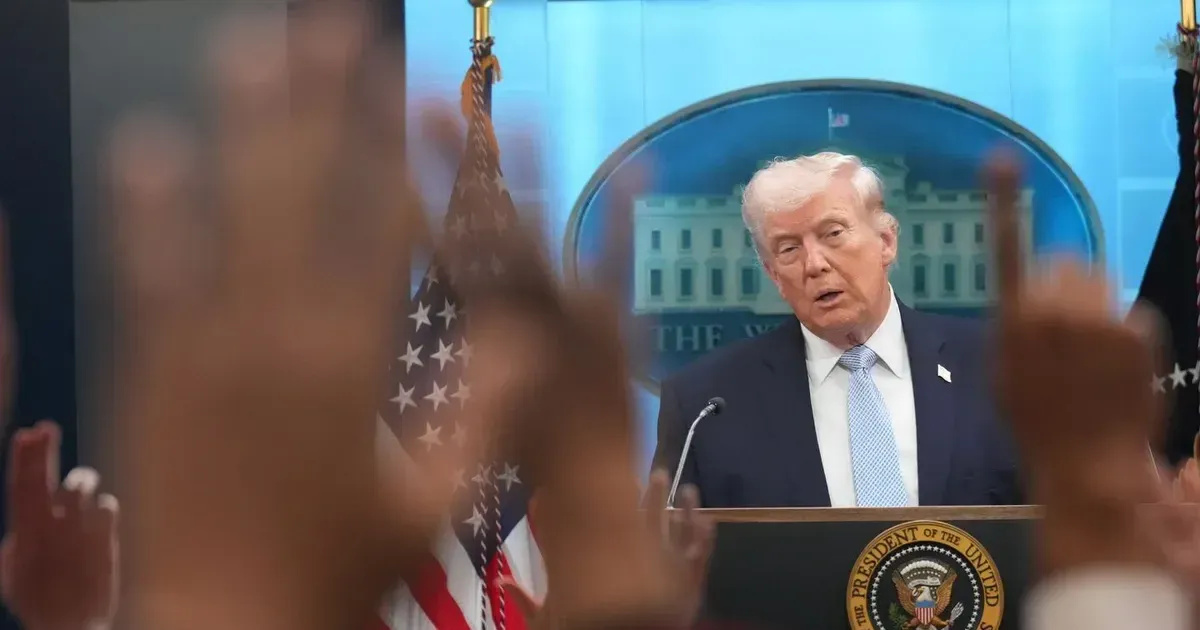
Donald Trump's ultimatum to Iran has drawn intense scrutiny because the language appeared to threaten more than military targets. The April 7, 2026, warning pushed an already active conflict into a debate over proportionality, civilian protection and whether U.S. rhetoric is closing off diplomacy.
U.S. forces had already moved against Iranian oil-related infrastructure as the deadline approached. Legal critics focused on whether threats against a civilization can be reconciled with the Geneva Conventions, while military analysts questioned what happens if Iran refuses to comply. The timing sharpened those concerns as markets, allies and lawmakers tried to assess whether the statement was coercive messaging or a preview of broader action.
U.S. Forces Destroy Iranian Oil Infrastructure
Naval assets in the region conducted a precision strike on a major offshore oil hub late in the evening. This facility is a primary artery for the Iranian energy-export market and is a significant part of the national revenue. Reports from the Pentagon indicate that the operation used long-range cruise missiles to minimize risks to American personnel. Destruction of the hub effectively severs the economic lifeline of the Iranian state. Satellite imagery confirms that several loading platforms and storage tanks are currently engulfed in flames.
Field reports indicate that Iran has scrambled interceptor jets in response to the naval activity. No direct ship-to-ship engagement has occurred, though the proximity of the two forces has created a hair-trigger environment. Commanders on the ground have been granted expanded authority to return fire if they perceive an imminent threat. The proximity of the oil hub to international shipping lanes has forced commercial tankers to divert their routes toward the coast of Oman.
Pentagon Officials Define Legal Bounds for Broad Attacks
Legal scholars and military attorneys are currently debating the legitimacy of targeting infrastructure heavily used by civilians. While the 1949 Geneva Conventions prohibit the direct targeting of non-combatants, the U.S. has historically sought broad definitions for what constitutes a military objective.
Military officials often categorize energy grids and transport hubs as dual-use facilities that support both civilian life and military operations. This classification allows for the destruction of essential services under the guise of neutralizing enemy logistics. Human rights organizations have criticized this interpretation as a loophole that endangers millions of innocent residents. Legal questions regarding these strikes have led to intense scrutiny as Senate Democrats demand justifications for the current strategy.
Critics of the administration argue that the current rhetoric suggests an intent to target cultural sites and civilian population centers directly. Donald Trump has repeatedly used language that implies the total erasure of the Iranian state. This approach departs from the traditional American doctrine of proportional response. Instead, it moves toward a policy of total war that many international legal experts classify as a war crime. The distinction between a military target and a civilian one has become increasingly blurred in the current operational theater.
Senate Democrats Challenge Legality of Total War
Democratic leaders on Capitol Hill launched a formal condemnation of the administration's military strategy on Tuesday. Top-ranking senators described the threat to wipe out a whole civilization as a betrayal of core American values. They argued that such rhetoric provides a recruitment tool for extremist groups and alienates essential allies in the European Union. Minority Leader Chuck Schumer called for an immediate briefing from the secretary of defense regarding the rules of engagement. Legislative efforts to curb the executive's war powers have gained renewed momentum among the opposition party.
Republicans in Congress have largely supported the president, asserting that a show of overwhelming force is the only way to prevent a larger regional conflict. They maintain that Trump's strategy of maximum pressure has successfully brought the Iranian regime to the brink of collapse. Senator Tom Cotton noted that the threat of total destruction is a necessary deterrent against Iranian aggression. Most members of the president's party believe that the ceasefire ultimatum will ultimately be accepted to avoid total annihilation.
“A whole civilization will die tonight if we do not get the deal we want for our country and for the world, and I mean that very sincerely because we have the power to do it and we have the will to do it,” Trump said.
International law requires that any attack must be necessary and proportional to the military advantage gained. Pentagon lawyers maintain that the destruction of the Iran oil infrastructure meets these criteria by degrading the ability of the Revolutionary Guard to fund its operations. By contrast, legal experts at the United Nations have warned that attacking an entire civilization constitutes a violation of the Genocide Convention. Official documents from the Department of Justice have not yet provided a legal memorandum justifying the specific language used in the President's latest ultimatum. Global markets continue to react with extreme volatility as the deadline approaches.
Protesters gathered outside the White House to demand a de-escalation of the situation. These groups expressed concern that a full-scale war would lead to a humanitarian catastrophe on a scale not seen in the 21st century. Reports from Tehran indicate that residents are fleeing major cities in anticipation of an aerial campaign. The lack of a clear exit strategy for the U.S. military has raised concerns among veteran diplomats who recall the prolonged conflicts in Iraq and Afghanistan. International NGOs have proposed $11 billion in emergency humanitarian aid, though access to the region is currently blocked by military cordons.
Rhetoric Can Close the Diplomatic Door
Threat language can be useful only if it leaves the other side a way to change course. When it sounds like total punishment, it can harden resistance and make a negotiated exit harder for both governments. That is the strategic risk. The administration may believe maximal pressure creates leverage, but rhetoric that alarms allies and legal observers can narrow the path back to a controlled outcome.