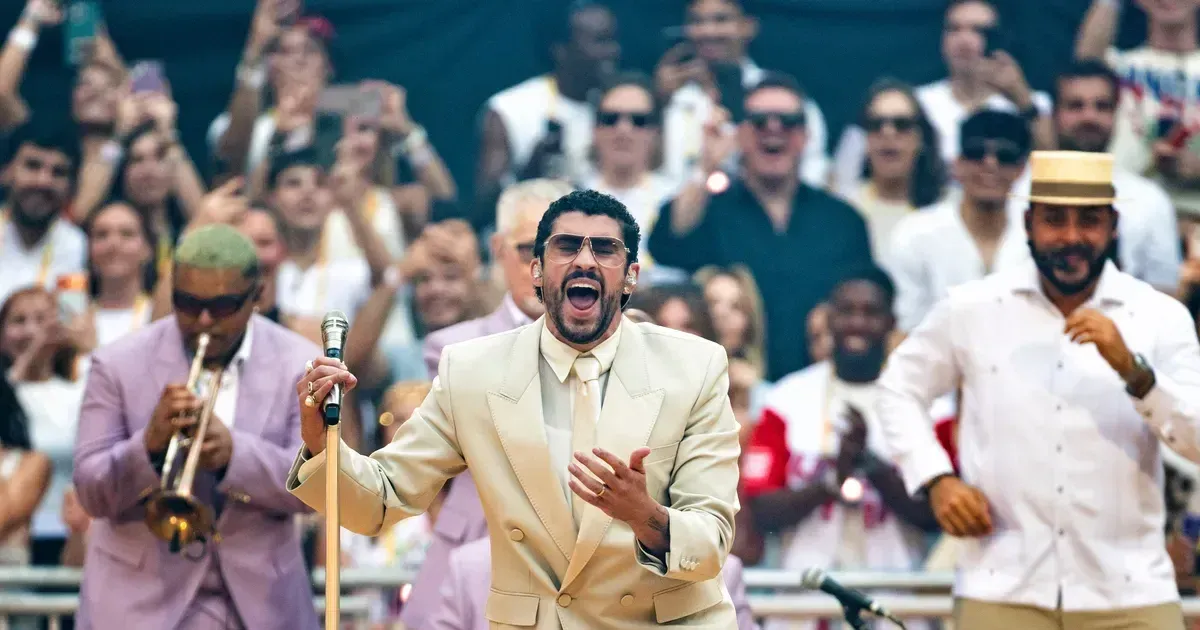
Bad Bunny opened his Madrid residency at the Riyadh Air Metropolitano with a stadium show that turned the first night into a large-scale celebration of Puerto Rican music. The Madrid residency turns Bad Bunny's European stop into a stadium-scale cultural event rather than a routine tour date. Its scale also shows how Latin music demand is reshaping venue planning across major European capitals. The residency also gives Madrid a tourism and nightlife boost beyond the concerts themselves. The May 30, 2026, concert drew about 64,000 people and began with Benito Antonio Martinez Ocasio rising from below the stage before staying silent for roughly two minutes. The pause gave the crowd time to take in the scale of the production before the music started.
The show marked the first of 10 scheduled Madrid concerts, a run that continues across late May and June. Bad Bunny appeared in a cream suit and sunglasses before calling for applause for his parents and moving into the opening section of the set. A large brass and percussion band gave the early songs a Caribbean feel, emphasizing salsa, mambo, plena, reggaeton, and other rhythms tied to Puerto Rico and the broader Latin music tradition.
The concert lasted about two hours and 50 minutes, according to local coverage, and moved between a main stage and La Casita, a smaller stage built as a replica of a traditional Puerto Rican home. That second space became one of the main visual and social features of the night, allowing celebrity guests and selected fans to appear close to the performer while the stadium watched.
Madrid Becomes a Residency Hub
The Metropolitano run is unusual because it treats Madrid as more than a standard tour stop. Instead of one show, the artist is using the Spanish capital as a temporary residency city, similar in strategy to the way major performers concentrate demand in Las Vegas, London, or other global hubs. The schedule gives fans multiple chances to attend while keeping the production in one place long enough to become part of the city's cultural calendar.
"La unica razon de este show es que ustedes la pasen bien," Bad Bunny told the crowd.
For Madrid, the concerts bring a wave of visitors into hotels, restaurants, transit systems, and nightlife districts. For Bad Bunny, the residency reinforces the idea that Spanish-language pop and urbano music no longer need to be framed as secondary to English-language touring circuits. The audience in the stadium reflected that shift, with fans carrying Puerto Rican flags and singing along across styles that moved from club tracks to live-band arrangements.
The production also leaned into memory and place. La Casita connected the stadium spectacle to domestic imagery from Puerto Rico, giving the show a more personal frame than a conventional arena stage. That contrast between intimate set design and stadium scale helped the concert feel less like a generic tour template and more like a traveling version of the world built around the artist's recent work.
La Casita Draws Stars and Fans
Celebrity attention added another layer to the opening night. El Pais reported that actors Ester Exposito, Ana de Armas, Maria Leon, and Martino Rivas were among the guests seen in La Casita. Footballers Kylian Mbappe, Alvaro Carreras, and Isi Palazon were also identified among the attendees, along with entrepreneur and influencer Chiara Ferragni. Their presence turned the stage area into a visible meeting point for music, sport, film, and social media culture.
The guest list mattered because La Casita was not simply a VIP box. It was part of the performance design, a place where famous attendees could dance and appear inside the visual language of the show. That made the concert feel like both a public performance and a staged house party, with cameras and phones amplifying every appearance for audiences beyond the stadium.
Bad Bunny also used the different stages to shift tone. The early live-band section leaned into Caribbean roots, while later passages moved through the reggaeton songs that helped build his global audience. The transitions kept the show from feeling like a simple greatest-hits run and made the residency opener work as a statement about range, identity, and audience control.
Latin Pop's European Reach Expands
The Madrid opening shows how far Latin pop's touring economy has moved. A 10-concert stadium residency in Spain is not only a measure of Bad Bunny's popularity; it is a sign that promoters see enough demand to concentrate major production costs in one European city. That model can be more efficient than moving the full show every night, and it can turn a concert series into a destination event.
The residency also strengthens Spain's role as a bridge between Latin American music and European audiences. Madrid offers language, media, and cultural proximity that make it a natural base for an artist whose appeal crosses national markets. If the remaining shows sustain the opening night's energy, the Metropolitano run will stand as one of the clearest examples of a Spanish-language artist using the residency model once reserved for legacy pop and rock acts. The run also matters commercially because a stadium residency can anchor travel, hospitality and local staffing for multiple nights rather than a single concert. Promoters will be watching whether Madrid becomes a template for other European capitals.