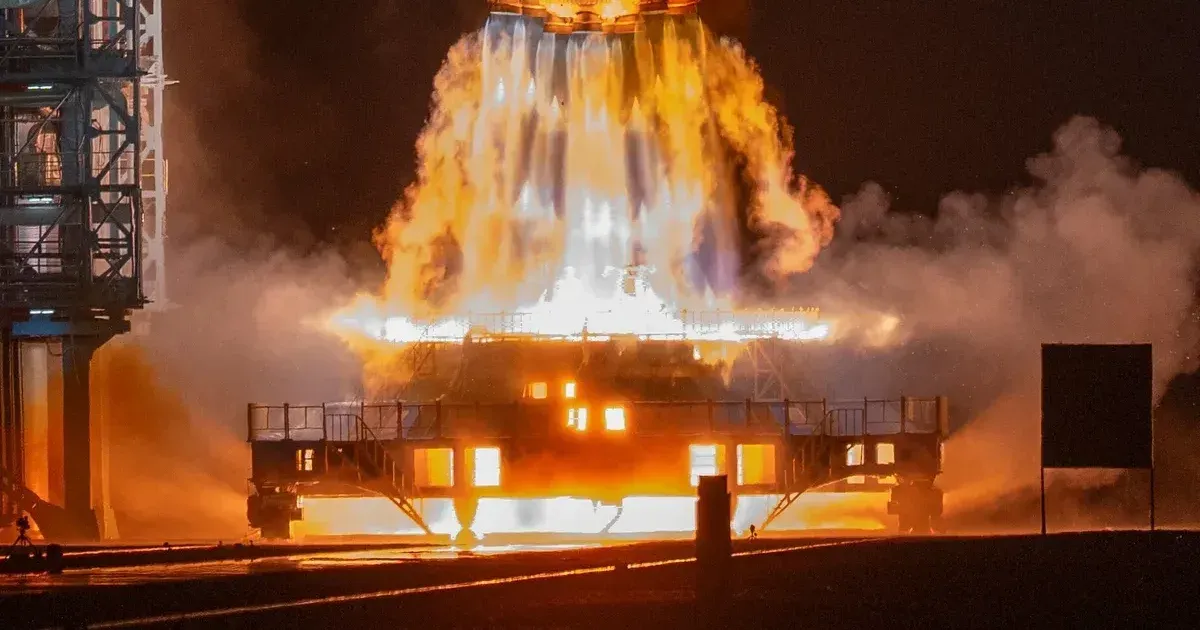
China launched the Shenzhou 23 spacecraft toward the Tiangong space station, extending its push for continuous human operations in orbit. The launch keeps China's orbital program on a steady rotation schedule. It also gives medical teams a longer test of how crews adapt inside Tiangong. On May 25, 2026, the mission lifted off from the Jiuquan Satellite Launch Center with a three-person crew aboard a Long March 2F rocket.
Mission controllers said the spacecraft reached its planned orbit after launch and began the process of rendezvous with the station. The flight continues a regular crew-rotation pattern, but one detail makes this mission different. China is using the rotation to test endurance while keeping the station staffed, which lets researchers study long exposure without interrupting normal Tiangong operations. One astronaut is scheduled to remain aboard Tiangong for a full year while the other two follow a shorter rotation.
The extended stay is designed to test how the human body adapts to long-duration microgravity. For mission planners, a year in orbit is not a symbolic milestone; it is a way to expose medical, psychological and equipment problems that may not appear during shorter rotations. Chinese crews have generally operated on shorter cycles, so the yearlong assignment will give medical teams a larger data set on bone loss, muscle decline, cardiovascular changes and psychological stress.
Tiangong Mission Plan
The Shenzhou spacecraft includes orbital, reentry and service modules built for crewed missions. Each section has a distinct role, from supporting the crew in orbit to protecting them during the high-risk return through the atmosphere. Engineers use the Long March 2F system because it includes human-rated safety features and escape systems for the ascent phase. Weather and upper-air conditions were monitored closely before launch teams gave final clearance.
Docking with Tiangong requires precise timing as the spacecraft approaches the Tianhe core module at orbital speed. Even small errors in speed, angle or pressure checks can delay entry into the station, so the approach remains one of the most sensitive phases after launch. Ground teams in Beijing track telemetry throughout the approach, checking propulsion, alignment and pressure systems before the crew can enter the station.
The yearlong stay will make the station a deeper medical laboratory rather than only a rotation platform. Chinese researchers can track how health markers change month by month, then compare that pattern with the performance of astronauts who return after the normal six-month period. The comparison should help identify which countermeasures are working and which systems need redesign. Daily exercise, biometric monitoring and environmental controls will be measured over a longer period than usual. Air and water recycling systems will also be tested under sustained demand.
Long-Duration Health Test
Medical researchers are expected to focus on fluid shifts, vision changes, bone density and muscle maintenance. They will also track sleep, mood, workload and immune responses because long missions test the crew as an integrated human system rather than a set of isolated organs. These issues become more important as mission planners look beyond near-Earth operations. A lunar base or Mars transit would require crews to remain healthy far from immediate evacuation options.
China is not the first space power to study yearlong missions, but Tiangong gives Beijing its own controlled environment for the research. Data from the station can be compared with previous six-month Chinese missions and with longer stays conducted by other space agencies.
The mission also supports China's stated goal of landing astronauts on the moon before 2030. Longer human endurance tests give planners confidence that crews can handle the physical and operational strain of missions beyond Earth orbit. Longer orbital stays help engineers refine life-support systems, exercise equipment, crew schedules and medical protocols. Those lessons are central to any plan for permanent or semi-permanent habitats beyond low Earth orbit. A crew living near the moon would face longer supply lines, delayed emergency options and greater dependence on station systems than astronauts working close to Earth. That is why the Shenzhou 23 endurance test matters beyond a single station rotation.
Yearlong Tiangong Mission Links Crew Health to Lunar Plans
The launch shows how quickly China's human spaceflight program has moved from assembly to sustained operations. Tiangong is now being used to answer harder questions about endurance, not just docking, launch reliability and station maintenance.
Other space agencies will watch the results because long-duration flight remains one of the major barriers to deeper exploration, particularly for missions where rescue or rapid return is impossible. The value of the mission will depend not only on whether the astronaut completes the year, but on how clearly the data shows which risks can be managed through training, hardware and medical support. If the yearlong resident returns without serious lasting harm, China's case for more ambitious lunar and deep-space missions becomes stronger. The technical launch problem is increasingly routine; the human biology problem is now the focus. For Beijing, solving that problem is essential to turning national space prestige into practical exploration capability for future crews. The mission will also help Beijing show that regular crew handovers can support a larger research program without turning every launch into a one-off demonstration.