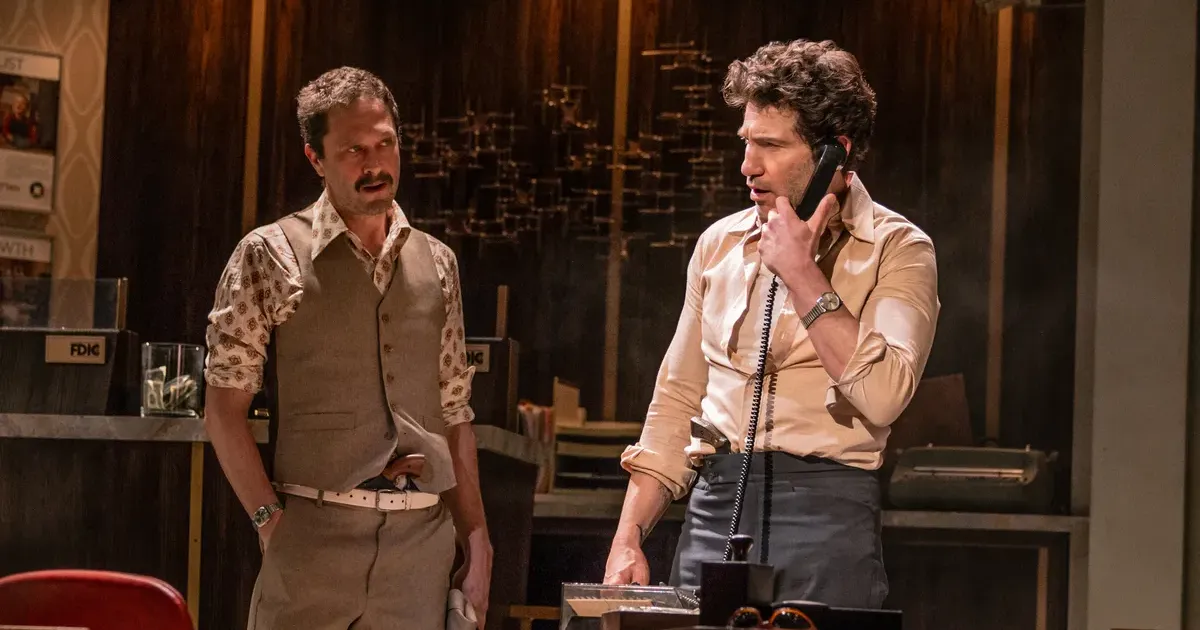
Dog Day Afternoon arrived on Broadway with enough pedigree to make the risk obvious. Stephen Adly Guirgis adapted the 1975 Sidney Lumet film, Rupert Goold directed, and Jon Bernthal and Ebon Moss-Bachrach put two prestige-TV actors inside one of American cinema's most combustible bank-robbery stories. The result has not produced a clean critical verdict. It has produced a fight over tone.
The production at the August Wilson Theatre leans louder, faster and funnier than a museum-piece adaptation would. Some notices have treated that as a strength, pointing to the show's New York grit, live-wire energy and crowd-friendly charge. Other critics have argued that the comedy thins out the danger that made the film endure. Tone is the central problem for any stage version of this story. Dog Day Afternoon needs absurdity, heat, desperation and moral discomfort at the same time. Push the laughs too hard and the bank stops feeling like a crisis.
Bernthal Gives Sonny a Different Voltage
Bernthal does not have to imitate Al Pacino to justify taking on Sonny. His advantage is physical pressure. The performance can feel less like nervous combustion and more like panic trapped inside a body built for impact. The choice gives the stage Sonny force even when the adaptation around him strains for pace.
Moss-Bachrach's Sal operates in a quieter register, which can be useful for a character who should make the room feel unstable without explaining himself. Jessica Hecht's Colleen has also drawn attention because she gives the bank interior a human texture beyond the robbers' chaos. The cast is not the weak link. The question is whether the production gives that cast enough danger to play against.
Guirgis Has the Right Ear and a Hard Assignment
Guirgis is a natural match for profanity, pressure and wounded people trying to talk their way through bad choices. His language can make a room feel crowded before another body enters it. The skill helps a heist story built on panic, negotiation and people performing for police, television cameras and one another.
The assignment is still punishing. Lumet's film already balanced comedy and dread with documentary precision. Its humor came from people behaving strangely under unbearable pressure, not from the story pausing to chase jokes. A stage adaptation has to earn every added laugh because each laugh changes the temperature of the hostage situation.
Theater Has to Build Confinement Differently
Film can trap an audience through close-ups, editing, sweat, sirens and the slow tightening of a frame. Theater has to create confinement with bodies, timing, set movement and the shared air of the room. The shared space can make a bank heist feel immediate. It can also expose the machinery if the staging calls too much attention to itself.
The mixed reviews converge there. The Broadway version is often alive, but not always dangerous. Banter can make characters vivid. Too much banter loosens the clock. A hostage crisis needs the sense that time is narrowing. If the audience begins waiting for the next comic beat, suspense starts leaking out of the room.
The Comedy Is the Risk, Not the Crime
The story has always had comedy in it. The real danger is not that people laugh. It is that the production sometimes appears too comfortable letting laughter become the dominant rhythm. Dog Day Afternoon is funny because panic makes everyone strange: the robbers, the tellers, the police, the crowd outside and the media turning crime into spectacle.
When that comedy lands with dread behind it, the adaptation has a reason to exist. It shows how public attention feeds a crisis and how performance can swallow sincerity. When the comedy floats free of dread, the same material begins to resemble a rowdy caper built from a darker wound. The resulting tonal split is what critics are arguing about.
The Adaptation Needs Dread Under the Noise
Broadway should not be barred from classic films. The stage can sharpen old material when it finds a new pressure point. This version of Dog Day Afternoon has star heat, muscular language and enough motion to hold an audience. What it cannot afford to lose is the feeling that every joke is happening inside a trap.
The strongest version of the play would make the audience laugh and then feel the cost of laughing. If it only entertains, it becomes a lively night out built from a story that should leave a bruise. Bernthal and Moss-Bachrach give the production weight. Guirgis gives it voice. Goold gives it momentum. The unresolved question is whether all that noise can still hear the desperation underneath.