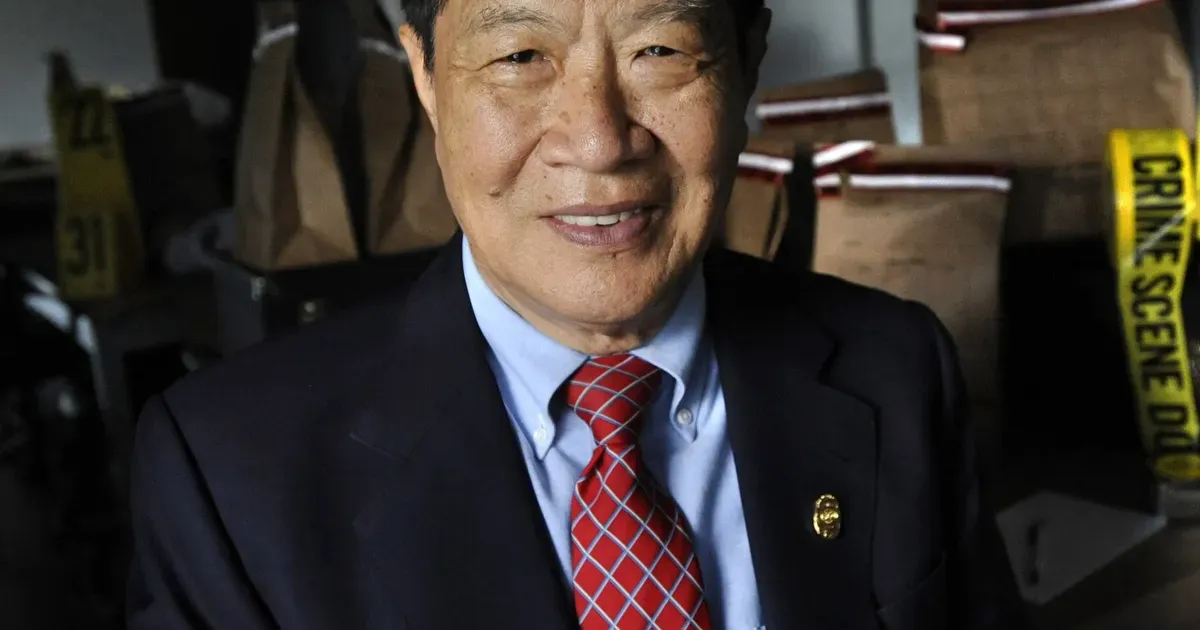
Henry C. Lee, the forensic scientist whose name became synonymous with courtroom crime-scene analysis, died at 87. His family and the University of New Haven said he died on March 27, 2026, at his home in Henderson, Nevada, after a brief illness.
Lee's public legacy is unusually divided. He helped make forensic science visible to American juries and television audiences, testified in some of the country's most famous criminal cases and trained generations of investigators. He also ended his career under the weight of a federal civil ruling that found he had fabricated evidence in a Connecticut wrongful-conviction case, an allegation he denied.
That tension makes a simple tribute impossible. Lee's death closes a major chapter in the popular rise of forensic science, but it also forces the field to confront the danger of expert authority when courtroom confidence outruns verifiable method.
From State Lab To Televised Trials
Lee built his reputation in Connecticut, where he served as chief criminalist, led the state police forensic laboratory and later became commissioner of public safety. At the University of New Haven, he spent more than 50 years as a professor and helped build the forensic science program and institute that carried his name.
His national fame grew through high-profile cases. The O.J. Simpson murder trial made him recognizable far beyond scientific circles after he testified for the defense about blood evidence and crime-scene handling. He was also connected to cases involving JonBenet Ramsey, Phil Spector, Scott Peterson and the Helle Crafts wood-chipper murder.
Those cases made Lee a symbol of forensic expertise at a moment when the public was learning to watch trials as media events. His courtroom presence helped turn the forensic expert into a central figure in legal storytelling.
Celebrity Expertise Came With A Cost
Forensic science carries special power in court because it sounds objective. Jurors hear laboratory language, diagrams, bloodstain patterns and technical confidence. That can be useful when the methods are sound and the limits are clear. It becomes dangerous when an expert's prestige substitutes for proof.
Lee's defenders point to the scale of his career, the students he trained and the investigations he influenced. Critics point to the cases where forensic certainty was later challenged and to the broader reckoning over pattern evidence, bloodstain interpretation and older crime-lab practices.
Both views belong in the record. Lee helped professionalize and popularize crime-scene work. He also became part of the warning that forensic science must be auditable, replicable and transparent rather than dependent on a famous witness.
The Birch And Henning Case Changed The Legacy
The most damaging controversy involved Ralph Birch and Shawn Henning, who were convicted in the 1985 killing of Everett Carr and spent decades in prison before their convictions were overturned. Lee had testified about what he described as blood evidence on a towel.
In 2023, a federal judge found Lee liable in a civil case for fabricating evidence tied to that testimony. The ruling said the claimed blood evidence did not exist as described. Connecticut later agreed to a $25.2 million settlement in the wrongful-conviction litigation. Lee denied fabricating evidence and maintained that he had done nothing wrong.
The case matters because it shows how one expert's statement can travel through a justice system. Prosecutors, defense lawyers, judges, laboratories and investigators all share responsibility for testing evidence, preserving records and challenging weak claims. But a famous forensic witness can give a questionable fact a weight it does not deserve.
Forensic Science Has To Survive The Expert
Lee's death leaves institutions with a difficult inheritance. They can acknowledge the immigrant scientist who built programs, trained investigators and brought public attention to crime-scene work. They also have to teach the evidence-fabrication ruling as a serious boundary marker for the field.
The best response is not erasure or hero worship. It is a full account: the scholar, the expert witness, the media figure and the controversial forensic authority whose later record showed why science in court needs independent verification.
That is the harder lesson. Forensic science earns trust when it admits uncertainty, documents its methods and lets evidence stand without theatrical authority. Lee helped make the field famous. His legacy now has to be used to make the field more accountable.