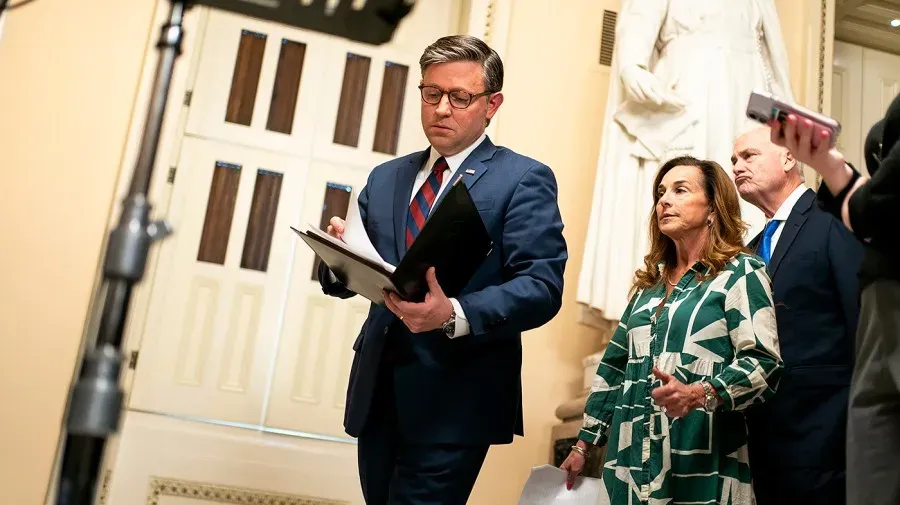
House Speaker Mike Johnson rejected a Senate-backed plan to fund most of the Department of Homeland Security, extending a shutdown fight that had already reached its forty-third day. The move exposed a sharp split between House Republicans and Senate leaders over whether ICE and Customs and Border Protection should be handled separately from the rest of the department.
The dispute is not only procedural. It is a test of whether Republicans can govern across their own factions while holding power in both chambers. Senate Majority Leader John Thune moved behind a compromise that could reopen most DHS operations. Johnson refused to bring that path to the House floor.
The result was another round of stalemate for federal workers, travelers and border operations. A party that says national security is its central priority is now arguing over funding mechanics while parts of the security workforce remain caught in the middle.
Johnson Blocks Senate DHS Path
The Senate plan would have funded most DHS accounts while leaving the most contested immigration-enforcement pieces to a separate process. Johnson rejected that structure and said House Republicans would not split off major enforcement agencies from the broader department.
His argument was simple: ICE and CBP could not be left outside the immediate funding package. The political problem is that the Senate compromise had been designed to pass through a chamber where sixty votes still matter. What satisfied Senate negotiators did not satisfy the House majority.
House Republicans instead moved a short-term plan to fund all of DHS for sixty days. That approach let Johnson present a unified enforcement message, but it did not create a clear path through the Senate. Senate Democrats quickly treated the House bill as a nonstarter, and Senate Republicans were left between their own chamber's deal and the House's harder line.
Shutdown Pressure Hits DHS Workers
The operational damage is no longer theoretical. TSA officers and other DHS employees have been working under shutdown conditions, and the longer the lapse continues, the more staffing, morale and retention become real security problems rather than talking points.
Airport delays and checkpoint pressure are the most visible symptoms because travelers feel them immediately. Border and port operations carry a quieter strain. Officers can keep essential functions running for a time, but agencies cannot treat unpaid work and political uncertainty as a stable workforce model.
That is the contradiction at the center of the fight. Lawmakers are using border-security language while leaving parts of the security apparatus under fiscal stress. The policy message and the governing behavior are moving in opposite directions.
Senate Recess Freezes The Fight
The timing made the deadlock worse. Senators left Washington for recess after the chamber advanced its approach, while House Republicans demanded action on their alternative. Each side could then accuse the other of walking away from the solution.
That kind of positioning may work for press conferences. It does little for agencies that need appropriations, managers who need staffing plans and workers who need paychecks. The shutdown becomes easier to prolong once every faction can claim it already offered the responsible answer.
Thune and Johnson later announced a path toward fully funding DHS, but the March fight showed how narrow the Republican governing lane had become. The party could agree that DHS should be funded. It could not agree quickly on the route.
Governance Failure Is The Real Story
The shutdown fight is often described as a border-policy dispute, but it is also a basic governing-capacity test. A majority that cannot fund the department it calls essential is not simply negotiating hard. It is advertising its own weakness.
Johnson's refusal to accept the Senate route gave House conservatives the confrontation they wanted. It also prolonged uncertainty for the same agencies Republicans say must be strengthened. That is the absurdity: the politics of enforcement became more important than the functioning of enforcement.
The Senate deserves no clean exit either. Passing a plan and leaving town during an active shutdown made the institution look detached from the consequences of its own sequencing. The public sees the practical result, not the floor strategy. Workers wait, travelers wait and the border-security argument becomes less credible with every failed vote.