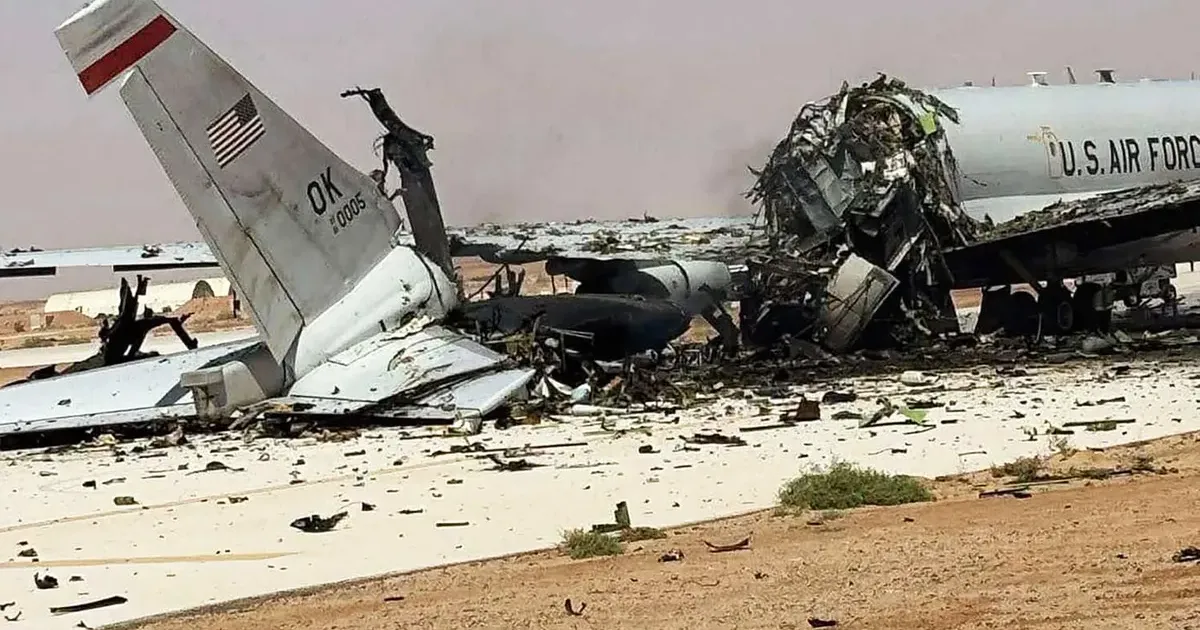
The reported damage to a U.S. E-3 Sentry at Prince Sultan Air Base matters because airborne surveillance is not a background asset in the Gulf. It is part of the command system that lets forces see threats, organize responses and keep a regional air picture together.
The War Zone reported that imagery appeared to show an E-3 badly damaged after an Iranian attack, while noting limits around independent confirmation. The Wall Street Journal separately reported that an E-3 surveillance aircraft and several refueling tankers were damaged at the Saudi base. The safest reading is serious damage to a high-value platform, not an unsupported certainty about total destruction.
The E-3 Is A Scarce Command Asset
The E-3 Sentry is not just a radar plane. It is an airborne warning and control platform built around a modified Boeing 707 airframe, a large radar dome, specialized crews and systems designed to coordinate aircraft and track threats across a wide area.
The specialized platform is hard to replace quickly. The United States is moving toward the E-7 Wedgetail as the future replacement, but the transition is not instant. If an E-3 is out of service, commanders cannot simply substitute a normal aircraft and recreate the same function.
Airborne Radar Matters In The Gulf
Ground radar has limits. Terrain, distance, curvature and low-flying threats complicate detection. An aircraft at altitude sees the battlespace differently and can connect fighters, air-defense systems, tankers and command centers.
The role becomes critical in a theater shaped by drones, cruise missiles, ballistic missiles and fast-moving escalation. Warning time is the currency. Losing or degrading an airborne radar node can narrow coverage exactly when U.S. forces and Gulf partners need more of it.
Iran Hit The Support System, Not Just The Spear
Tehran has a clear reason to target aircraft like the E-3. Modern air campaigns do not depend only on fighters, bombers and missiles. They depend on tankers, radar aircraft, electronic warfare, maintenance crews, data links and airfields.
Hitting support systems can reduce effectiveness without defeating every combat aircraft directly. A damaged surveillance plane forces scheduling changes, risk reassessments and possible coverage gaps. Damaged tankers can also affect sortie generation and reach.
The Base Message Was Aimed At Partners Too
Prince Sultan Air Base is not only a U.S. logistics point. It is part of the wider Gulf security architecture. A visible strike there tells Gulf partners that American assets on regional bases are exposed during escalation.
The message carries political weight. It pressures Washington, but it also speaks to host governments. If U.S. surveillance and refueling assets can be hit, regional states have to ask what support they are providing, what risks they absorb and how much escalation their territory can bear.
The case is serious enough without overclaiming. Reports and imagery indicate a damaging strike on high-value U.S. aviation assets. They do not require the article to assert more than the public record supports.
Caution is especially important with wartime imagery. Satellite photos, social-media posts and anonymous claims can be useful, but they can also outrun official confirmation. The more precise statement is also the stronger one: a scarce surveillance platform appears to have been damaged, and that alone is strategically important.
The Vulnerability Is Structural
Expensive surveillance assets are powerful because they make the force more efficient, and vulnerable because they must sit somewhere, refuel somewhere and be maintained somewhere. Iran does not need to defeat the entire U.S. military to create pressure. It can attack the nodes that make that military work.
If the Prince Sultan damage is confirmed in fuller detail, it will stand as a warning that the Gulf air war is not only about missiles in flight. It is about the fragile infrastructure that lets commanders see those missiles coming and coordinate the response in time.