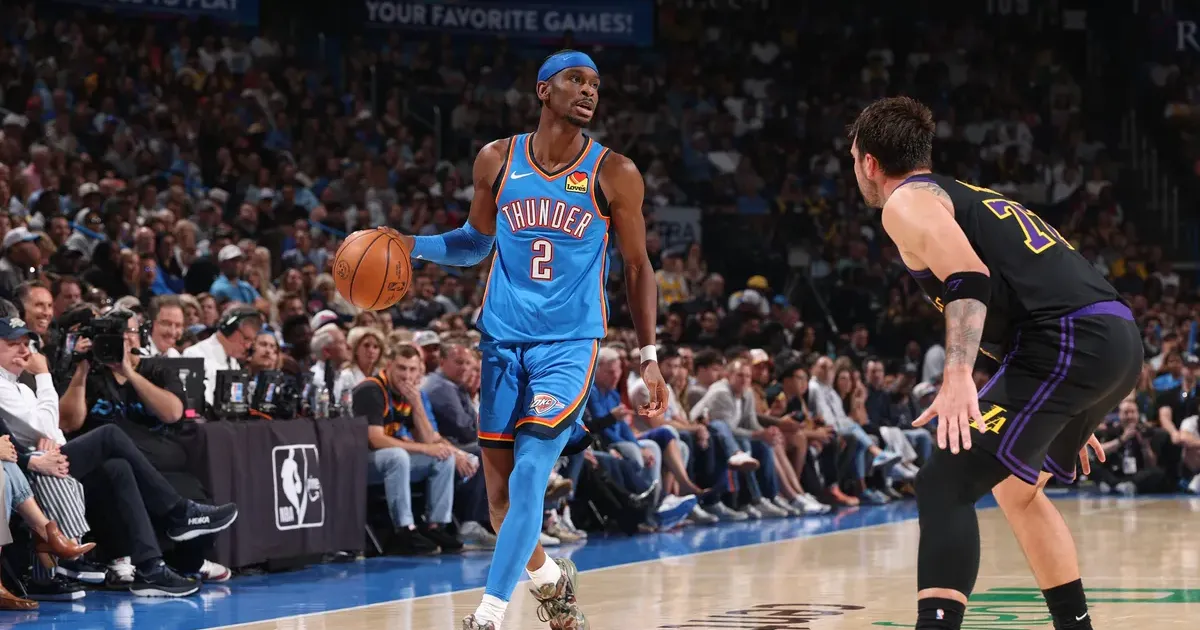
April 3, 2026, finds Luka Dončić under intense medical evaluation after a left hamstring injury during a 139-96 loss against the Oklahoma City Thunder. Los Angeles fans watched in silence as their franchise centerpiece departed the court during the third quarter, a move that effectively ended any hope of a comeback in a game that had already spiraled out of control. Medical staff confirmed the injury shortly after the buzzer, noting that the star guard would not return to the contest. The immediate concern now shifts to the long-term health of a player who has carried the offensive burden for the Lakers throughout a grueling season.

Oklahoma City dominated every facet of the game from the opening tip. A relentless offensive barrage from the home team left the Lakers trailing by 23 points after only twelve minutes of play. Shooting percentages told a grim story for the visiting side, as the Thunder connected on 53.1% of their field goal attempts while the Lakers struggled to find any rhythm. By halftime, the lead had swelled to 31 points, making the second half a mere formality before the catastrophic injury to Dončić added a layer of crisis to the defeat.

Dončić Hamstring Reinjury Mechanics and Medical History

Luka Dončić originally felt discomfort during the first half of Thursday’s game but received clearance from trainers to continue playing. This decision proved costly when he aggravated the site of the strain in the third quarter. Lakers coach JJ Redick told reporters after the game that the medical team had monitored the situation closely before allowing the star to return to the floor. The left hamstring has been a recurring issue for the Slovenian guard, who previously missed four games in February due to a similar strain.

Hamstring injuries often require extended rest to prevent a full tear, a reality that now threatens the remainder of the Lakers’ campaign. Recovery timelines for Grade 1 strains typically range from seven to fourteen days, while Grade 2 tears can sideline an athlete for over a month. Friday's scheduled MRI will provide the definitive diagnosis required to set a return schedule. Redick confirmed the necessity of the imaging during his post-game press conference.

Dončić will undergo an MRI on Friday to determine the severity of the injury.

Lakers personnel must now prepare for a schedule without their primary playmaker. Statistics from the current season show a serious drop in offensive efficiency when Dončić sits, particularly in three-point shooting and half-court sets. The team converted only 22.7% of their long-range shots against the Thunder, a figure that highlights their reliance on the gravity Dončić creates for his teammates. Depth players will need to fill a large statistical void if the MRI reveals a multi-week injury.

Lakers Tactical Collapse Against Oklahoma City Thunder

Thunder shooters exploited every defensive lapse from a weary Lakers squad that appeared overmatched from the first quarter. Oklahoma City finished the night shooting 50% from beyond the arc, a mark that the Lakers could not match. Deflections and transition points fueled the blowout, as the Thunder capitalized on 15 turnovers to generate easy scoring opportunities at the rim. Los Angeles failed to establish a presence in the paint, allowing the Thunder to dictate the tempo of the game at will. The Oklahoma City Thunder have now proven their defensive dominance by forcing early injury exits for multiple stars.

Redick expressed frustration with the lack of defensive resistance throughout the night. Efforts to contain the perimeter were inconsistent, and the Thunder's ball movement consistently found the open man. Lakers defenders frequently arrived late on closeouts, a symptom of the physical and mental fatigue currently plaguing the roster. Oklahoma City led 112-67 by the end of the third quarter, a margin that reflected the total lack of competitive balance in the matchup.

Rotation players struggled to find their footing after the blowout. Bench contributions were minimal, and the starting unit lacked the cohesion seen earlier in the spring. Los Angeles ended the game shooting 41.8% from the field, a number boosted slightly by late-game production against the Thunder's reserve units. The loss serves as one of the most lopsided results in the recent history of the rivalry.

NBA Award Eligibility Rules Spark National Basketball Players Association Tensions

Eligibility for postseason honors is now a secondary casualty of the injury sustained by Dončić. Thursday marked the 64th appearance for the Lakers guard, placing him exactly one game shy of the 65-game threshold mandated by the latest Collective Bargaining Agreement. League rules require players to meet this minimum to qualify for MVP, All-NBA, and other prestigious year-end accolades. If Dončić cannot return to the lineup before the regular season concludes, he will forfeit his chance at these honors regardless of his statistical dominance.

This specific mandate has already removed several elite names from award consideration. LeBron James, Anthony Edwards, and Cade Cunningham have all fallen short of the requirement due to various health setbacks earlier in the year. The National Basketball Players Association has repeatedly criticized the rule, arguing that it penalizes players for legitimate medical issues and devalues the history of the awards. Owners, by contrast, pushed for the rule to ensure that the league's top stars participate in the maximum number of games for television partners and ticket holders.

Financial implications of these rules are meaningful for the players involved. Many top-tier contracts include escalators tied to All-NBA selections, meaning a missed eligibility window can cost an athlete millions of dollars in future earnings. Dončić is currently a frontrunner for multiple honors, but the hamstring strain has placed his candidacy in immediate jeopardy. Fans and analysts have questioned the fairness of a system that excludes a player of his caliber based on a single game of availability.

Western Conference Playoff Seeding and Redick Rotation Shifts

Playoff positioning in the Western Conference remains volatile as the regular season enters its final week. The Lakers now face the prospect of a play-in tournament appearance if they cannot maintain their current standing without their leading scorer. Oklahoma City, meanwhile, solidified their grip on a top seed with the victory, demonstrating the depth and resilience of a young roster built for a deep postseason run. Every game carries immense weight in a conference separated by only a few games from the fourth through the ninth seeds.

Redick must now navigate a rotation that lacks its focal point. Playmaking duties will likely fall to secondary ball handlers who have spent most of the season in supporting roles. Adjusting the offensive scheme mid-week is a difficult task for any coaching staff, especially when the injuries involve soft tissue that can be easily re-injured. Lakers fans are bracing for a period of transition that could define the legacy of this roster.

MRI results will dictate the strategic direction of the front office for the coming month. A clean scan would allow for a cautious return, perhaps just in time for the opening round of the playoffs. A more serious tear would force the Lakers to consider their options for next season while managing the current roster's morale. The outcome of the imaging remains the most important variable in the Los Angeles sports landscape.

The Elite Tribune Strategic Analysis

Professional basketball enters a dangerous phase when administrative quotas outweigh athletic performance. The 65-game rule is a bureaucratic hammer designed to appease broadcast networks, yet it consistently strikes the very stars who drive the league's value. Luka Dončić missing a historic MVP-caliber season because of a 64th-game injury is not a victory for league integrity. It is a failure of common sense that prioritizes attendance sheets over the reality of human physiology.

Lakers management deserves scrutiny for clearing Dončić to play the second half after he tweaked the hamstring in the first. Risking the franchise foundation in a game where the team trailed by 31 points at halftime is an indefensible gamble that may have cost them their postseason. Load management is often ridiculed by the old guard, but this scenario provides the perfect counter-argument. Had Redick protected his star during a blowout, the Lakers might still have a functional path to a title.

The Thunder are a terrifying machine of efficiency. While the Lakers drama takes the headlines, Oklahoma City is quietly proving that their system is superior to the superstar-centric models of the past. Their 50% three-point shooting was not a fluke but the result of superior spacing and unselfish ball movement. If this was a preview of the Western Conference Finals, the rest of the league should be deeply concerned. Reality is a harsh teacher.