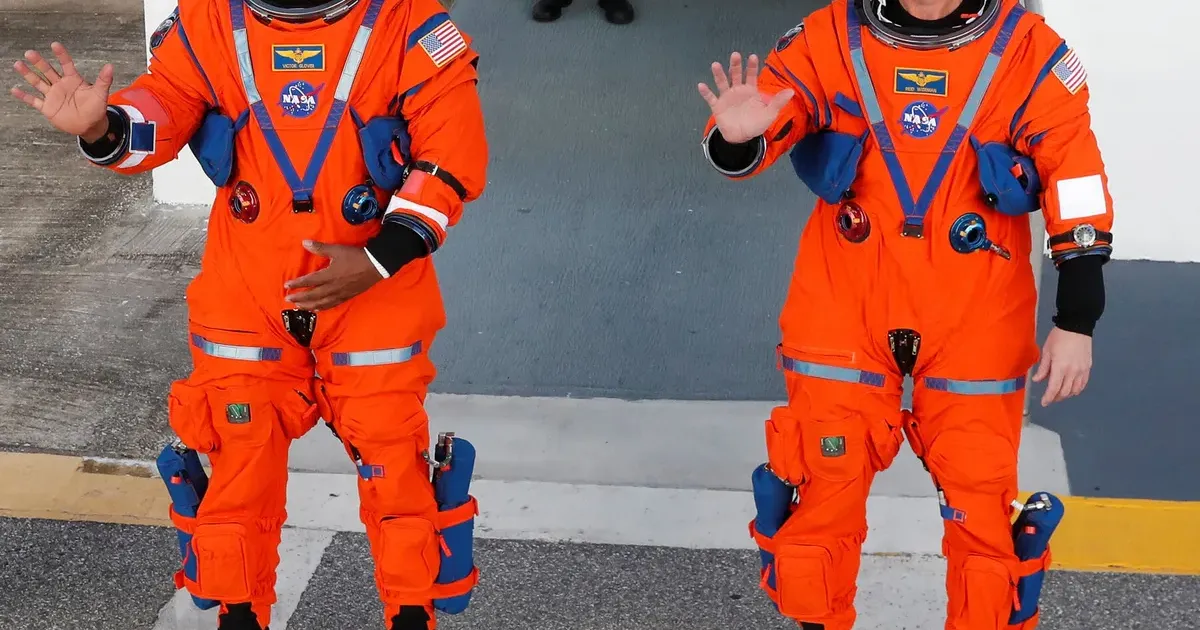
Artemis II made NASA's orange Orion Crew Survival System suits visible to a new generation, but the color was never about style. Reid Wiseman, Victor Glover, Christina Koch and Jeremy Hansen wore the bright launch-and-entry suits for the highest-risk phases of the mission because deep-space exploration still ends with ordinary rescue questions: can the crew breathe, communicate, move and be found?
The mission sent humans around the Moon for the first time since Apollo and returned Orion to the Pacific off California after lunar-speed reentry. The spacecraft, parachutes, Navy recovery teams and post-splashdown procedures drew attention for good reason. The orange suits belonged in that same safety chain. They were not moonwalking suits. They were survival equipment for launch, cabin emergencies, reentry and the ocean.
International Orange Is a Rescue System
The color solves a practical problem. A white suit makes sense for thermal control on the lunar surface. It is much less useful if a crew member is floating in open water, surrounded by glare, waves, foam, capsule hardware and recovery craft. International Orange gives pilots, divers and deck crews a visual target that does not need a battery.
Radios, beacons and tracking systems are essential, but rescue design still respects failure. Salt water can damage electronics. Weather can reduce visibility. Distance and impact can complicate recovery. A high-visibility outer layer is a simple redundant system, and redundancy is the language of crew safety.
OCSS Is Built for Orion, Not the Moon
The Orion Crew Survival System is an intra-vehicular suit. It is designed for the capsule, not for walking on the lunar surface. The job is pressure protection, communications, mobility and survival support inside Orion during the moments when the spacecraft is most unforgiving.
NASA's suit design includes custom fit, pressure capability, gloves, boots, communications, ventilation and survival gear. The system can support crew survival during a cabin-pressure emergency, with NASA descriptions noting a survival window of up to six days in contingency conditions. The survival window is not a comfort feature. It is time bought for the spacecraft and ground teams to get the crew home.
Function Still Has to Include Movement
A survival suit fails if it protects the body but prevents the astronaut from doing the work. Artemis II's crew still needed to operate controls, read displays, communicate, move through checklists and tolerate hours inside the cabin. Better gloves, helmets, boots and fit matter because launch and entry are not passive experiences.
Custom fitting also matters in a way earlier programs did not always solve well. A suit built around a narrower body template can create risk when crew sizes and shapes vary. Artemis sells itself as a more inclusive return to deep space. The suit program has to make that inclusion practical, not just symbolic.
The Shuttle Lesson Carried Forward
The orange silhouette recalls the Space Shuttle era, especially the post-Challenger focus on ascent and entry survival. Artemis uses different hardware and a different mission profile, but the old lesson still applies. Spaceflight can become a rescue operation quickly, and rescue operations reward visible, redundant, low-drama equipment.
The Shuttle continuity is important because Artemis is often presented through moon images, SLS liftoff shots and historic firsts. The suit points to a less glamorous truth. The mission is only successful if the crew comes through the riskiest transitions: launch, deep-space contingency, high-speed return and recovery at sea.
Splashdown Proved the Full Chain Matters
The final hours of Artemis II made the suit's purpose concrete. Reentry from lunar velocity placed the capsule under stress far beyond routine low Earth orbit returns. After parachute descent, the crew still had to wait through ocean recovery, spacecraft safing and extraction steps. The suit was part of that last phase, not just the first one.
The full safety chain matters for future missions. Artemis III and later flights will add more complexity, including landers, surface suits, docking events and longer operational timelines. The launch-and-entry suit is the baseline layer underneath all of that ambition. Before anyone walks on the Moon again, NASA still has to prove it can protect astronauts in the capsule.
The Real Message Was Survival Discipline
The rescue logic is simple: orange does not look futuristic because it is not trying to. It looks findable. That is the point. Exploration depends on rockets and trajectories, but it also depends on breathing gas, pressure seals, glove dexterity, radio clarity, flotation and rescue visibility.
Artemis II's suits reminded viewers that crew safety is built from unglamorous choices. A moon mission that cannot recover its people safely has failed no matter how clean the launch looked. The orange suit is NASA admitting that history, risk and ocean recovery still have a vote.