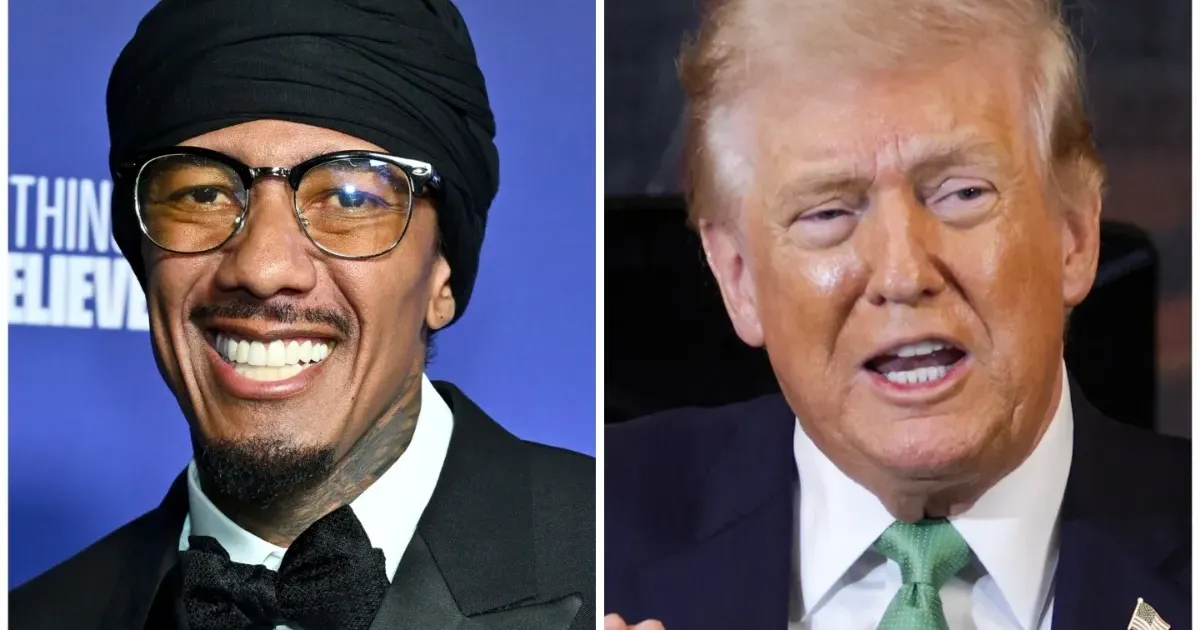
Nick Cannon's Trump comments with Amber Rose turned a celebrity car interview into a political flashpoint. The March 2026 episode of Nick Cannon's Big Drive spread because Cannon voiced support for Donald Trump, criticized Democrats and repeated a familiar argument about the party's historical ties to the Ku Klux Klan.
The careful version of the story is narrower than the viral version. Cannon was not announced as a campaign surrogate, and the clip did not prove a broad voter shift. It showed something more specific: a celebrity with a large audience saying, in a casual entertainment format, that he was comfortable praising Trump while rejecting Democratic loyalty.
That distinction matters. A loose statement in a web interview can travel like an endorsement even when it is not an organized campaign act. The political value sits in the signal, not in any formal role.
Amber Rose Gives the Conversation Its Political Frame
Rose entered the exchange as a public Trump supporter who had already made her shift from liberal politics part of her public image. In the interview, she argued that Democrats take voters of color for granted. Cannon agreed with parts of that critique and pushed it into a broader complaint about party history.
His strongest line was also the most contested one. Cannon said Democrats were tied to the KKK and contrasted that with the nineteenth-century Republican Party's role in emancipation. The historical origin is real, but the claim becomes misleading if it stops there. The modern party system was reshaped by the civil-rights era, Southern political realignment and decades of Black voter coalition-building.
The clip worked politically because it turned partial history into a blunt identity argument.
That is why the backlash moved so quickly. Supporters treated Cannon's words as proof that entertainers are breaking from Democratic expectations. Critics saw a celebrity platform turning a compressed version of history into ammunition for contemporary politics.
Celebrity Politics Now Moves Through Short Clips
Big Drive is built for the short-video ecosystem. A conversation in a car can produce a line that spreads faster than a formal interview, and that format rewards certainty. It leaves little room for the context needed around party realignment, civil-rights history or racial voting patterns.
That does not make the episode meaningless. Celebrity politics often works by making a position feel socially permissible. When Cannon and Rose talk about Trump as an ordinary topic inside an entertainment show, they are not drafting a platform. They are lowering the social cost of saying the same thing in public.
For Trump allies, that kind of clip is useful because it suggests cultural movement among audiences campaigns want to reach. For Democrats, it is a warning that cultural loyalty cannot be assumed just because voting patterns have been stable in the past.
Cannon Clip Shows the Limits of Viral Realignment
The mistake would be to treat one interview as proof of mass political movement. It is not. A fan can share a provocative clip because it is surprising, not because it changed a vote. Online reach is not the same as durable persuasion.
The opposite mistake is to dismiss it as celebrity noise. Political identity is increasingly negotiated through podcasts, web shows, short video and personality-led media. Those spaces can normalize a position before a campaign ever turns it into a message.
Cannon's comments matter because they exposed that gap. The clip gave Republicans a cultural talking point and gave Democrats a reminder that grievance about party neglect can travel through entertainment media with little friction.
The hard read is that both parties can overlearn the moment. Republicans cannot build an electorate out of celebrity praise. Democrats cannot protect a coalition by assuming irritation will never become defection. Cannon did not move a voting bloc in one interview, but he showed how a casual line can become political permission when the media environment is ready to carry it.