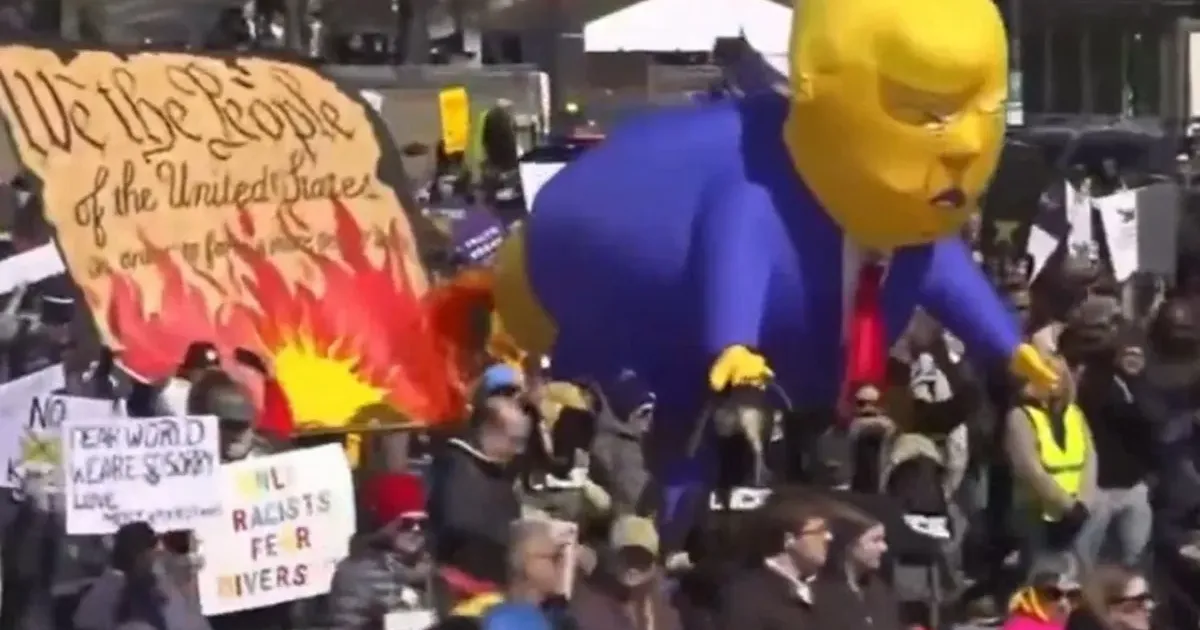
No Kings protests returned across the United States on March 28, 2026, with Minnesota becoming the movement's clearest stage. Organizers built the third major wave around a simple anti-authoritarian slogan: the United States has presidents, not monarchs. The message let local rallies connect national criticism of Donald Trump's administration to immigration enforcement, war policy, courts, civil service and democratic checks.
The visual language was blunt. In Washington, a Reuters photograph showed a Trump effigy at a No Kings protest, giving the rallies an image that traveled faster than most speeches. But the movement's larger story was not one prop. It was the scale and geographic spread of a protest network that tried to show opposition beyond the usual coastal map.
Minnesota mattered because St. Paul hosted the flagship rally at the State Capitol, with a crowd large enough to make the state a national reference point for the day. The location was not accidental. Earlier immigration operations and local confrontations over federal power had already made Minnesota a focal point for organizers who wanted the slogan to feel connected to lived events rather than only national branding.
Minnesota Gave The Movement A Local Anchor
A national protest can look hollow if every city repeats the same script. Minnesota gave No Kings a more specific emotional center. The St. Paul event drew labor, civil-rights, progressive and anti-war voices into one frame, while organizers connected the national slogan to local anger over enforcement tactics and federal overreach.
That grounding matters politically. A movement visible only in New York, Los Angeles or Washington is easier for the White House to dismiss as predictable opposition. A large Midwestern flagship rally complicates that argument and gives organizers a stronger claim that the protest map reaches into places the administration cannot ignore.
The coalition was broad by design. No Kings events could be organized under shared national branding while allowing local speakers to emphasize different grievances. That flexibility helped the day feel national without forcing every rally into one message box.
Effigy Images Carried Power And Risk
The Trump effigy gave the protests sharper visual identity, but it also created a tradeoff. Images like that energize supporters and make the story easy to share. They also give critics a way to describe the movement as theatrical, disrespectful or extreme.
That is a familiar problem in mass protest. Attention rarely arrives cleanly. The tactics that make a demonstration visible can also narrow how opponents describe it. For No Kings, the question is whether the imagery amplifies the anti-authoritarian message or lets the administration focus on spectacle while ignoring turnout.
The strongest version of the movement is not the photograph alone. It is the photograph tied to organizing infrastructure: local partners, livestreams, speakers, legal support, voter work and repeatable pressure after the weekend ends.
The White House Legitimacy Fight Was Predictable
The administration and allies framed the rallies as organized left-wing resistance rather than spontaneous public will. Protest leaders argued that coalitions are normal in national mobilizations and that organizational help does not erase the agency of people who choose to show up.
That argument over legitimacy is now part of the protest cycle. One side calls the rallies democratic participation. The other calls them manufactured outrage. Neither framing is likely to persuade the other. The practical question is whether the protests reach people who are not already committed to opposing Trump.
Dismissing turnout entirely carries risk for any administration. Even a highly organized rally can reveal real dissatisfaction if people are willing to spend a weekend in the streets. The harder test comes after the signs come down.
No Kings Has To Become More Than A Protest Day
Marches can show scale. They do not automatically create power. Durable pressure has to move into city councils, courtrooms, school boards, state legislatures, voter registration drives and local mutual-aid networks. If No Kings builds those channels, March 28 becomes part of a longer campaign. If it does not, the rallies risk becoming another symbolic day in a crowded political calendar.
The movement also has to decide what it is building: a protest brand, an electoral machine, a civil-liberties coalition or a litigation-support network. Each path requires different skills. A rally can be assembled through social media and partner groups. A durable operation needs local leadership, funding transparency and ways to measure wins beyond crowd size.
That is the hard edge behind the spectacle. The administration can dismiss one day of protest. It is harder to dismiss a movement that keeps appearing at hearings, court steps and local meetings for months. No Kings proved it can create images and turnout. Its next test is whether it can turn both into pressure that lasts longer than the news cycle.