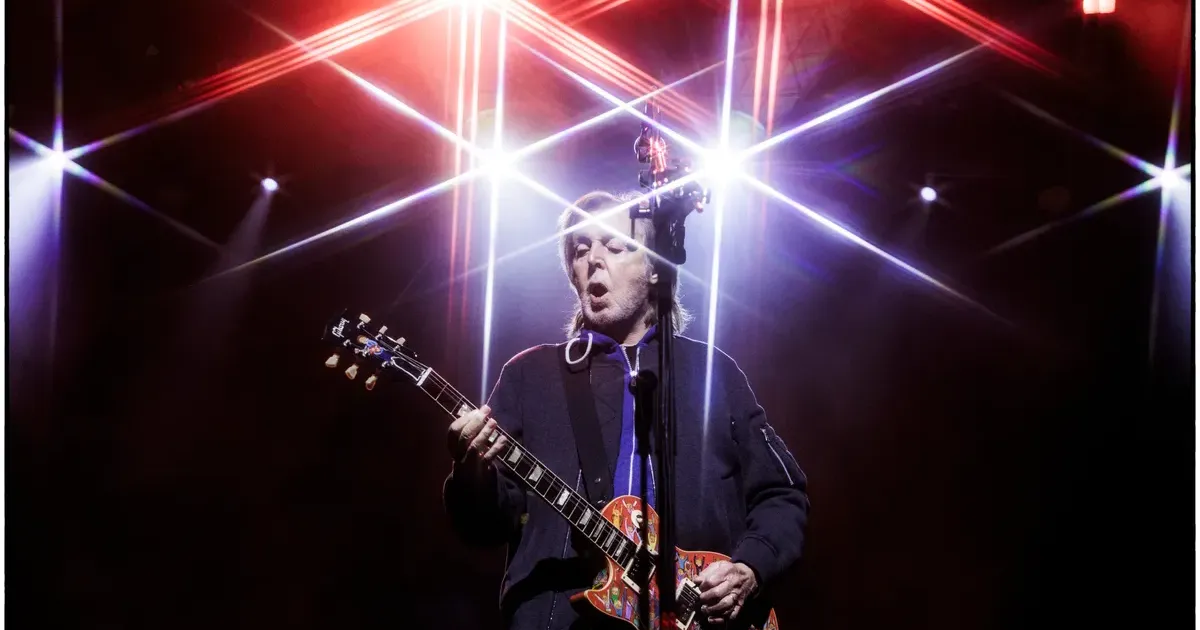
Paul McCartney's two-night Fonda Theatre run turned a Hollywood club into the kind of room that usually exists only in rock mythology. On March 27 and 28, 2026, he brought Beatles, Wings and solo material into a 1,200-capacity venue, shrinking songs built for stadiums into a space where fans could see faces instead of screens.
The result was not simply a smaller version of a stadium concert. It was a reminder that McCartney's catalog changes when the distance between performer and audience collapses. Familiar songs that often function as public monuments became direct exchanges inside a theater.
The Fonda Changes the Scale
The shows were billed as Paul McCartney Rocks the Fonda, but the industry word underplay captures the strategy more precisely: a stadium artist choosing a room far below his usual scale. That choice changes the emotional value of every song. Scarcity becomes part of the ticket, and proximity becomes part of the performance.
The Fonda's old-theater shape helped. Balcony, floor and compact stage made the night feel shared rather than managed. McCartney could joke with the room, acknowledge the closeness and let small gestures carry in a way they cannot across a stadium bowl.
Sound mattered too. A Hofner bass line, a harmony, a slightly loose transition and the audience's immediate response become more legible in a theater. McCartney has spent decades mastering large-scale delivery. The Fonda asked him to make that precision feel spontaneous.
Setlist Turns History Into Live Material
The set moved through the expected territories: Beatles landmarks, Wings staples and solo-era songs. Reports described a classic-heavy show rather than a showcase for new material, even though the concerts came as McCartney was discussing new work. That choice made sense. In a room this small, the catalog itself was the event.
Beatles songs inevitably carried the loudest recognition, but the Wings material gained from the room's compression. Songs that can be swallowed by festival-scale spectacle sounded more like band performances, with bass lines, melodic turns and arrangements pushed forward by the theater's size.
The show also made clear why McCartney's catalog remains unusually flexible. It can carry nostalgia without depending entirely on nostalgia. Fans came for memory, but the songs worked because they still functioned as live material with structure, hooks and muscle.
Hollywood Makes Scarcity Louder
A McCartney underplay in Hollywood naturally became a status event. The room drew longtime fans, industry figures and celebrity attendees, turning a small concert into a cultural signal. That could have made the night self-conscious, but a compact venue limits detachment. Everyone is in the same small container, waiting for the same first chord.
The event also shows why intimate shows by legacy artists still matter in the streaming era. The songs are endlessly available. The room is not. A small show by a global artist creates a premium that cannot be copied by an algorithm or a deluxe reissue.
That scarcity is not only marketing. It tests whether the songs can survive without massive production. For an artist like McCartney, whose work is already monumental, the smaller room provides friction: imperfect sightlines, direct address and the risk of being judged at close range.
Small-Room Verdict
The Fonda run worked because it stripped away the assumption that scale equals importance. McCartney did not need a larger screen, a bigger runway or a lecture on his own history. The small room did the explaining by contrast.
Six decades of pop history were forced into a venue built for a fraction of his usual audience. Instead of shrinking the music, that compression clarified it. For two nights in Hollywood, McCartney sounded less like an institution and more like what he has always been at the core: a bandleader with songs strong enough to survive any room.