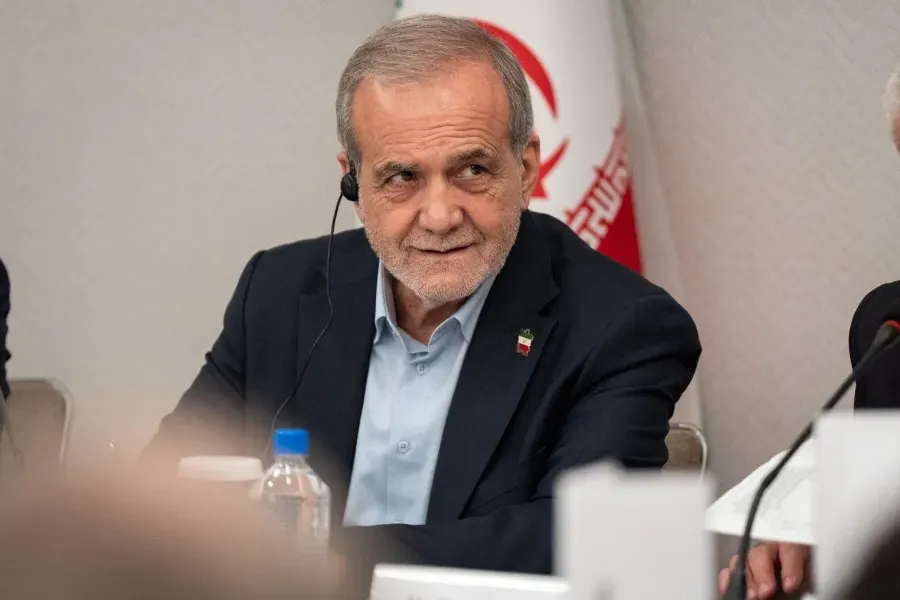
Masoud Pezeshkian's open letter to the American people was not a detached peace note. It was an early fight over the audience for the Iran war. Released on April 1, 2026, hours before President Donald Trump's national address, the letter tried to speak around official channels and challenge the U.S. government's framing before Washington could define the night's message alone.
Pezeshkian wrote that Iranians held no enmity toward ordinary Americans and argued that Iran had not chosen aggression, colonialism or domination in its modern history. He also questioned whether U.S. policy was truly serving Americans or serving Israeli aims. The mix of reassurance and accusation made the letter more than a soft appeal. It was public diplomacy used as wartime pressure.
April Timing Turned the Letter Into a Countermessage
The letter's timing mattered as much as the text. Trump was preparing to address the country about U.S. action against Iran, and the conflict had already become a war of claims: who started the escalation, who wanted a ceasefire, who was protecting civilians and who was manipulating public opinion.
By addressing Americans directly, Pezeshkian tried to create a second frame before the White House speech. The intended audience was not only U.S. voters. It included European governments, regional actors, Iranian factions and media outlets deciding how to describe the conflict. A public letter can travel faster than a diplomatic cable because it is built for quotation, argument and replay.
A Softer Voice Still Carried an Accusation
Pezeshkian's register was deliberately different from the hardest language often associated with Iranian security institutions. He presented Iran as defensive, historically wronged and open to peaceful understanding. The softer register helped him address Americans without sounding like a military communique.
But the letter was not simply conciliatory. By asking whether U.S. policy served another country's agenda, he aimed directly at domestic American doubts about foreign wars. Questioning U.S. motives is sharper than saying Iran wants peace. It asks Americans to suspect their own leaders' motives.
Broken Channels Made the Public the Route
Iran and the United States do not have normal diplomatic relations, and wartime contact often moves through intermediaries, public statements and denials. In that environment, a letter to citizens becomes a substitute channel. It lets Tehran put its version of events into the U.S. information space without waiting for formal talks.
The public channel has limits. American officials judge Tehran by nuclear steps, regional activity, shipping security, proxy behavior and the treatment of U.S. forces and allies. A letter may slow the rhetorical tempo for a news cycle, but it cannot verify enrichment limits, secure the Strait of Hormuz or stop attacks by itself.
Trump's Address Made the Split Screen Clear
Trump's April address, as carried and transcribed by AP, framed U.S. operations as major military success and presented Iran as a long-standing threat. Pezeshkian's letter should be read against that speech. One side sought to demonstrate force and inevitability. The other tried to undermine the moral and political basis for that force before the address reached Americans in prime time.
The letter did not need to persuade everyone to matter. Its function was to leave language in circulation: ordinary Americans are not Iran's enemy, the war serves other interests, Iran sees itself as defensive, and escalation is a political choice. Those claims gave Tehran a script for the next rounds of international messaging.
Hormuz Later Showed Words Were Not Enough
The months after the letter made its limits clearer. By July, U.S.-Iran tensions had moved through ceasefire claims, renewed strikes, Hormuz shipping pressure and U.S. demands that Iran publicly state the strait would remain open. AP reported the U.S. pushing for that assurance as Washington warned of further options and mediators urged restraint.
The later escalation matters when evaluating the April letter. It may have been a useful narrative move, but it did not create enough trust to stabilize the crisis. Public diplomacy can prepare audiences for negotiation. It cannot substitute for operational commitments that both sides can observe.
Verifiable De-Escalation Was the Missing Piece
The letter's main value was diagnostic. It showed that Tehran understood the American public mattered and that the war narrative was contested terrain. It also showed Pezeshkian trying to keep a diplomatic identity while operating inside a system shaped by the Supreme Leader's authority, the Revolutionary Guard and hardline pressure.
The unanswered question was whether either government would pair words with moves: fewer strikes, clearer maritime assurances, credible negotiation channels and verifiable nuclear steps. Without observable moves, the letter remained a polished argument in a worsening crisis.
Seen from July, Pezeshkian's message looks less like a bridge than an early marker in the information war. It tried to reach Americans before Washington locked in its version of events. The failure was not that the letter was meaningless. The failure was that the conflict required more than a better sentence.