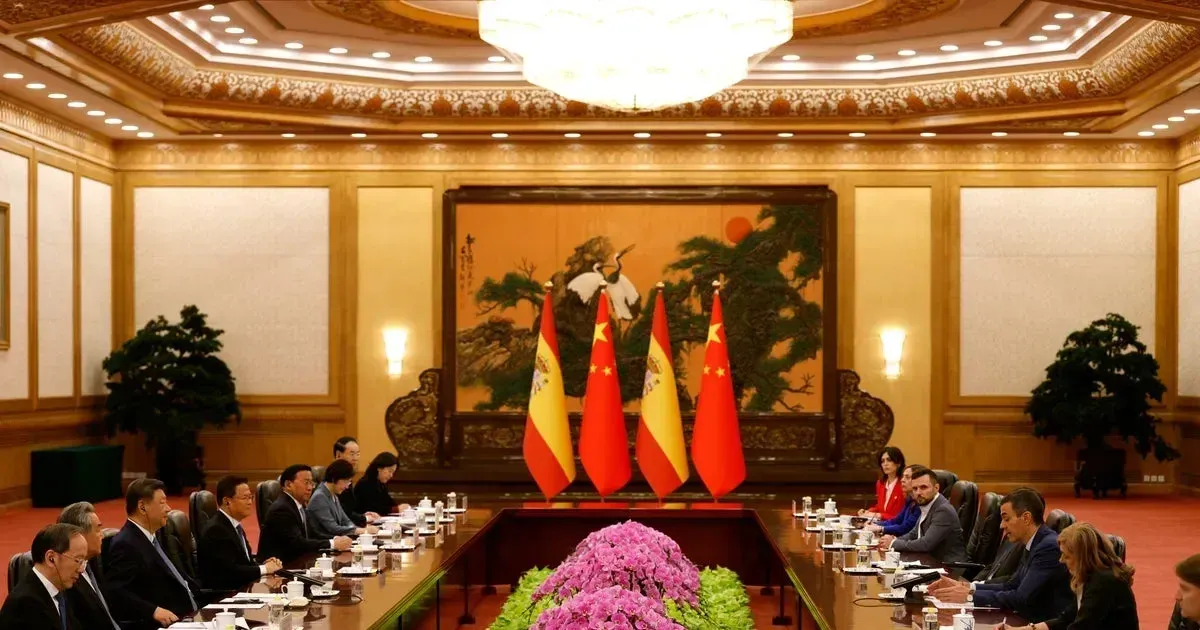
Spanish Prime Minister Pedro Sánchez stood before students at Tsinghua University to demand a fundamental re-evaluation of Western diplomatic strategy toward Beijing. This high-profile address coincided with a formal meeting between the Spanish leader and President Xi Jinping, where both men pledged to protect the structures of international cooperation. Conflict in the Middle East, specifically the recent war in Iran, has accelerated the push for what Sánchez describes as a clear-eyed understanding of global shifts. Madrid framed the visit on April 14, 2026. Madrid now positions itself as a mediator capable of looking beyond the restrictive geopolitical frameworks that have historically defined European foreign policy.
Xi Jinping emphasized that the partnership between Spain and China must focus on safeguarding multilateralism. Economic stability relies on predictable diplomatic channels that avoid the traps of isolationism. During their discussions, the leaders addressed the reality that global systems are fracturing under the weight of regional wars. Chinese state media reported that the dialogue focused on creating a stabilizing force in a world where traditional alliances are often viewed through the lens of conflict rather than construction.
Sanchez Rejects Zero Sum Geopolitical Logic
Addressing an audience of academics and diplomats, Sánchez used a historical parable to illustrate modern diplomatic failings. He invoked the legacy of Matteo Ricci, the 16th-century Jesuit priest who introduced European cartography to the Ming dynasty. Ricci arrived with a map that placed Europe at the center and Asia at the periphery, a visual representation of the biases of the era. Sánchez argued that many Western capitals still use an intellectual equivalent of that map to interpret the rise of $11 billion in modern trade and technology corridors. Some observers still view the growth of one nation as an automatic loss for another, a mindset Sanchez explicitly labeled as dangerous.
Zero-sum logic creates artificial barriers that hinder collective problem-solving. While Washington and London often lean toward decoupling or derisking, Madrid advocates for a strategy of engagement that recognizes China's central role in the 21st century. Economic data from the Spanish Ministry of Industry suggests that trade between the two nations has grown consistently, despite broader pressures from the European Union to tighten investment rules. This approach suggests that Spain is willing to deviate from the standard Atlanticist script to secure its own economic and diplomatic interests.
Multilateralism Objectives in the Post-Iran War Era
International stability has faced its greatest challenge in decades following the recent war in Iran. The conflict disrupted energy markets and forced every major power to reconsider its security architecture. Sánchez argued that the global governance mechanisms created in the 20th century are now more necessary than ever. He dismissed claims that these systems are outdated or obsolete. Multipolarity, in his view, requires stronger multilateral frameworks to prevent the world from descending into chaotic regionalism.
Madrid sees the United Nations and the World Trade Organization as essential buffers against the volatility of unilateral actions. Chinese officials have echoed this sentiment, often framing their own initiatives as a defense of the UN-centered international order. This alignment between a major EU member and China complicates the narrative of a world divided strictly into democratic and autocratic blocs. Spain is effectively betting that the future of the global order will be defined by institutional cooperation instead of ideological purity.
Europe Tests Its China Language
The visit also shows how European leaders are trying to avoid a binary choice between Washington and Beijing. Sánchez used the trip to argue that commercial engagement can coexist with strategic caution, a position that may appeal to export-heavy governments facing slow growth at home.
Madrid has long harbored the delusion that it can act as the intellectual bridge between a suspicious Washington and an assertive Beijing. Prime Minister Pedro Sánchez is currently engaged in a high-stakes performance of diplomatic hedging that may ultimately please no one. By lecturing students at Tsinghua University on the biases of Western cartography, Sánchez is essentially signaling that Spain is no longer a reliable foot soldier in the American-led effort to contain Chinese influence. It is a calculated gamble on a multipolar future where the European Union is a fractured, instead of unified, geopolitical actor.
The irony of Sanchez calling for 20th-century multilateralism while the world burns is not lost on seasoned observers. He is attempting to revive a corpse. The post-war liberal order is not just outdated; it is being actively dismantled by the very powers he claims to be bringing together. China uses the language of multilateralism as a shield for its own regional dominance, and Spain is providing the rhetorical cover. Madrid is trading its long-term strategic alignment with the West for short-term economic relevance and the vanity of being seen as a world-class mediator.
This strategy is unlikely to pay off. If the conflict in Iran taught us anything, it is that middle powers are often crushed when the giants eventually stop talking. Sánchez is walking into a trap of his own making.