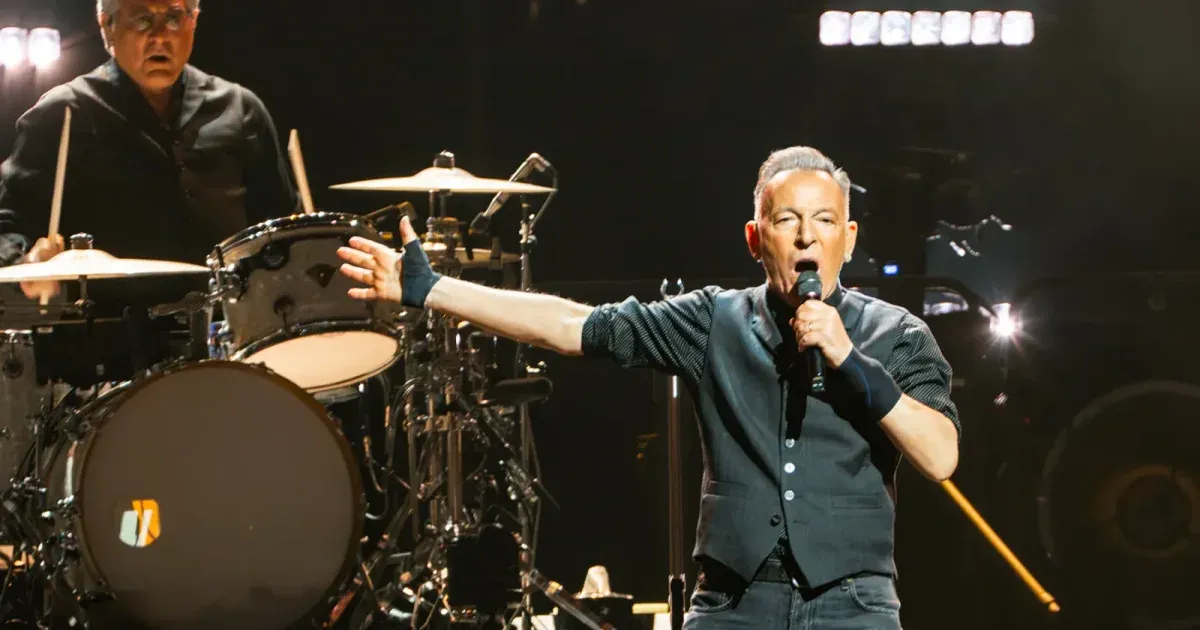
Bruce Springsteen's Land of Hope and Dreams American Tour was never designed as a neutral nostalgia run. From the Minneapolis opener on March 31, the show treated protest as the frame, not the intermission. Springsteen opened with War, brought Tom Morello into a set built around anger and civic warning, and placed his catalog inside a direct argument with Donald Trump's second administration.
The structural protest made the tour different from ordinary stage politics. Springsteen was not pausing between songs to make a stray comment. He built the night around the claim that democracy, immigration, citizenship and dissent were now part of the same fight. By the time the tour reached Washington in late May, the message had hardened rather than faded. The concerts had become a running public rebuke.
Minneapolis Was the Opening Statement
The first night mattered because Springsteen tied national politics to a local wound. Streets of Minneapolis, his protest song connected to federal immigration enforcement and deaths in the city, gave the concert a specific target before it became a broader anti-Trump set. The crowd was not simply asked to agree with a slogan. It was asked to sit inside a story of state power, fear and loss.
Opening with War sharpened that mood. It was a blunt way to tell the audience that the show would not hide inside greatest-hits comfort. Born in the U.S.A., Death to My Hometown, American Skin and Chimes of Freedom all carried extra weight in that sequence. Springsteen has spent decades writing about veterans, workers, immigrants and broken promises. In 2026, he used that vocabulary as a direct accusation.
Trump Turned the Fight Personal
The White House and Trump world did not treat the tour as background entertainment. Trump attacked Springsteen on Truth Social after the Minneapolis show, mocked his appearance and urged supporters to boycott him. That response helped prove the point Springsteen was making: the conflict was no longer only about policy. It was about who gets to claim patriotism in public.
Springsteen's criticism was harsh, but it was not out of character. He has long resisted the use of American symbolism as decoration for power. The difference in 2026 was the directness. He was not leaving much for listeners to decode. The administration, in his telling, had crossed from normal political disagreement into authoritarian conduct, corruption and cruelty.
Birthright Citizenship Gave the Music Legal Weight
The ACLU's birthright citizenship fight gave Springsteen's political language a constitutional anchor. He allowed Born in the U.S.A. to be used in an ACLU campaign defending birthright citizenship as Trump's order moved through the courts. That was not a small symbolic choice. The song is often mistaken for flag-waving simplicity, but its force has always come from betrayal and exclusion.
After the Supreme Court later rejected Trump's attempt to limit birthright citizenship, the issue did not disappear. Trump and his allies kept pushing for another fight over the 14th Amendment. That made Springsteen's intervention look less like celebrity commentary and more like part of a larger struggle over whether citizenship is a stable constitutional guarantee or a prize politicians can narrow when immigration panic is useful.
The Washington Show Raised the Stakes
By the Washington concert near the end of the tour, Springsteen's indictment had become even more explicit. He denounced the administration as reckless, racist, incompetent and treasonous, and framed the United States' democratic image as damaged by its own government. That kind of language is not calibrated for bipartisan comfort. It is designed to force a choice.
The setting mattered. A political artist attacking a president from a stage in Washington is not the same as making a safe protest speech far from power. It turned a rock show into a civic confrontation. For some fans, that was exactly what they came to hear. For others, it was too much politics in a concert ticket. Springsteen appeared willing to lose the second group if silence meant treating the moment as normal.
Patriotism Was the Real Battlefield
The tour's argument was not that America is beyond repair. It was that patriotic language becomes empty when it is separated from rights, restraint and equal belonging. The shared question is why immigration enforcement, birthright citizenship, protest songs and old Springsteen characters could sit inside the same set. They were all versions of the same question: who is protected when the country says it believes in freedom?
The rough edge of the tour was its refusal to soothe. Springsteen did not offer unity as a mood. He offered dissent as a duty and treated the stage as a place where American myth had to answer for American conduct. The refusal to soothe is why the shows landed harder than celebrity politics usually does. He was not borrowing politics to sell a tour. He was using the tour to say the country's story was being rewritten, and that artists who know the old language of labor, exile and promise have no excuse to whisper.