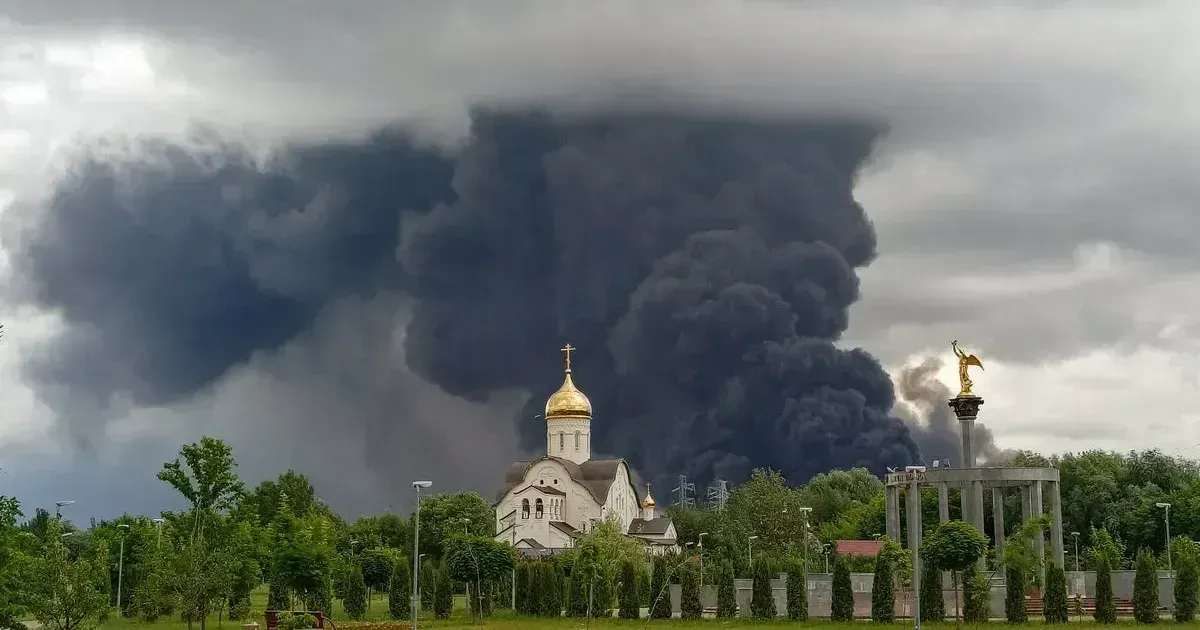
Ukrainian forces launched nearly 200 drones at the Russian capital, striking a major oil refinery and a shopping center in a major escalation of cross-border hostilities. The barrage forced officials to suspend operations at major airports on June 18, 2026, as air defense systems attempted to intercept waves of incoming fire. Clouds of thick black smoke rose from the Kapotnya district, where the refinery is a critical fuel source for the metropolitan region. Emergency crews spent hours battling blazes at both the industrial site and a nearby retail complex. Local witnesses recorded multiple explosions echoing across the south-eastern suburbs, marking the most intense aerial bombardment directed at the center of Russian power since the full-scale invasion of Ukraine began. Russian state media confirmed the refinery fire but restricted details regarding the full extent of the damage to energy production. Flights across the capital remained grounded for several hours as the scale of the drone wave became apparent. This disruption affected thousands of travelers and highlighted the vulnerability of commercial aviation corridors to sustained low-cost drone warfare. Authorities eventually diverted incoming planes to regional hubs further from the conflict zone. Energy infrastructure has become a primary target in the recent shift of Ukrainian military strategy. Ukrainian officials framed the operation as a direct retaliation for ongoing Russian missile strikes on civilian population centers. President Volodymyr Zelensky described the mission as a necessary component of the defense of his nation. His administration has increasingly relied on long-range domestic drone technology to bypass border defenses and strike high-value assets deep inside the Russian Federation.
Fully justified response to Russian strikes on our cities and communities.
Volodymyr Zelensky confirmed the strategic intent behind the morning strikes during a brief address. Targeting fuel supplies aims to degrade the logistics of the Russian military machine while bringing the reality of the war closer to the Russian public. Although Moscow has reported numerous drone incidents over the past two years, the volume of aircraft involved in this specific operation set a new precedent for the conflict.
Damage at the refinery could have immediate consequences for regional fuel prices and military transport. This strike marks the second time in a single week that the facility has been successfully targeted by Ukrainian forces. Repeated hits on the same infrastructure suggest that previous repairs were either incomplete or that defense batteries around the capital are struggling to manage saturation attacks.
Beyond the industrial impact, the fire at the shopping center indicated the potential for collateral damage in densely populated urban areas. Expanding the theater of operations to include the capital's commercial zones places additional pressure on the Kremlin to divert air defense resources from the front lines to protect its political and economic core.
Military analysts note that the use of approximately 200 drones requires sophisticated coordination and a sound manufacturing pipeline. By launching such a large number of units simultaneously, Ukraine appears to be testing the limits of Russia’s electronic warfare and physical interception capabilities. The cost of the defensive missiles used to stop these drones far outweighs the cost of the drones themselves.
Disruption of Capital Infrastructure and Transport
Airport closures across the Moscow region have become a common, yet increasingly expensive, side effect of these incursions. On this occasion, the duration of the grounding lasted considerably longer than previous incidents, suggesting that the threat remained active well into the afternoon. International carriers that still operate in the region face rising insurance premiums and logistical instability as the risk of mid-air incidents persists.
Public transport in the vicinity of the refinery was also rerouted as emergency vehicles took over major arteries. The refinery in question is one of the most important energy assets in the city, providing a broad portion of the kerosene used by the very airports that were forced to shut down. If the facility remains offline for an extended period, the capital could face a localized energy crunch.
Recent data indicates that nearly 15 percent of Russia's refining capacity has been impacted by drone strikes over the first half of 2026. While some facilities return to service quickly, others require specialized Western components that are difficult to obtain under current sanction regimes. Moscow has largely downplayed these shortages, though the frequency of attacks suggests a cumulative effect on the national economy.
The Logic of Reciprocal Strikes
Kyiv has maintained a policy of strategic ambiguity regarding many of its operations inside Russian territory, yet the scale of this morning’s event required a public acknowledgment. President Volodymyr Zelensky has often argued that restricting the war to Ukrainian soil gives the aggressor an unfair advantage. By hitting the refinery, Ukraine is asserting its ability to reach any target within 500 miles of the border.
Military planners in Ukraine are likely observing the response times and success rates of various Russian air defense units. These strikes provide valuable intelligence on where the gaps in the capital's protective dome are located. Success in hitting a target for the second time in seven days implies a specific weakness in the local defense grid that has yet to be addressed.
Retaliation from the Russian side usually involves cruise missile barrages on Ukrainian power stations. The cycle of kinetic exchange shows no signs of slowing, as both nations prioritize the destruction of the other’s energy security. The refinery fire in south-east Moscow continued to burn late into the evening.
Moscow's Air Defenses Face an Attritional Choice
The saturation of metropolitan airspace with low-cost loitering munitions could fundamentally alter the cost-benefit analysis for urban defense. Russia faces a dilemma: it can either leave front-line assets exposed by pulling air defense systems back to protect the capital, or it can accept the continued destruction of its critical energy infrastructure. The deployment of almost 200 drones in a single wave suggests that the production of these systems in Ukraine has reached an industrial scale that allows for frequent, high-volume operations.
For the residents of Moscow, the war is no longer a distant television broadcast. The sight of black smoke over a refinery and the shuttering of international transport hubs bring a real sense of instability to the heart of the state. The psychological impact is a deliberate byproduct of the Ukrainian strategy, aimed at eroding the sense of normalcy that the Kremlin has worked hard to maintain. Security experts will be watching to see if this prompts a shift in Russian offensive tactics or if the cycle of attrition simply accelerates. The technical success of the strike on a protected site in the capital indicates that the defensive perimeter remains porous.