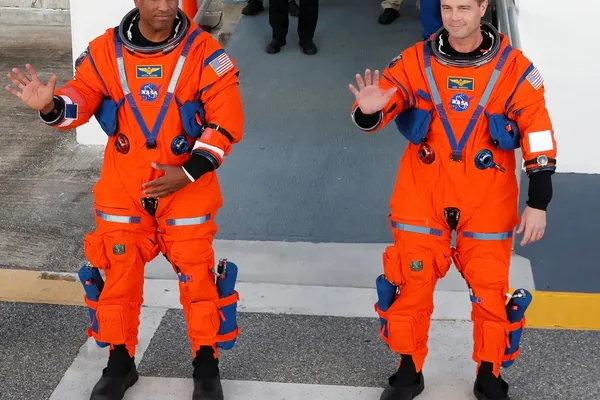
Artemis II's Orange Suits Made Rescue Engineering Visible
Artemis II's orange Orion survival suits showed why launch, reentry, pressure protection and ocean recovery still decide crew safety.
Showing 61-72 of 177 articles
Artemis II's orange Orion survival suits showed why launch, reentry, pressure protection and ocean recovery still decide crew safety.

Artemis II proved Orion, SLS, life support, radiation planning and crew procedures in deep space, but NASA still has to turn one flyby into a repeatable program.
Artemis II turned NASA's lunar countdown into flight evidence after Orion carried four astronauts around the Moon and returned safely.
Artemis II returned Orion and its crew from a record lunar flyby, giving NASA heat-shield, life-support and deep-space operations data.
A Barnard's star model suggests Mars-like planets around red dwarfs may lose air fast enough to weaken easy habitability claims.
University of Michigan nanoparticle studies point to safer nonviral gene delivery and targeted copper release against bacterial biofilms, but both remain research-stage tools.
A silicon quantum processor demonstrated universal logical operations, a step that strengthens the spin-qubit case but leaves scaling and error rates unresolved.

Artemis II turned NASA's lunar program into crewed proof, carrying four astronauts around the moon and forcing harder questions for Artemis III and IV.

Alex Bellos's missing-letter puzzle shows how readers use word shape, color, context and familiar phrases to recover meaning from partial text.

NASA's next lunar step depends less on Apollo nostalgia than on Artemis III docking tests, commercial landers and a credible path to Artemis IV.

UC Davis researchers found Suisun Marsh managed wetlands can produce 11 to 22 times more zooplankton than tidal habitats, but fish need access.

NASA's Artemis strategy treats the Moon as the bridge to Mars, but lander delays, China competition and repeatable lunar operations now define the program.