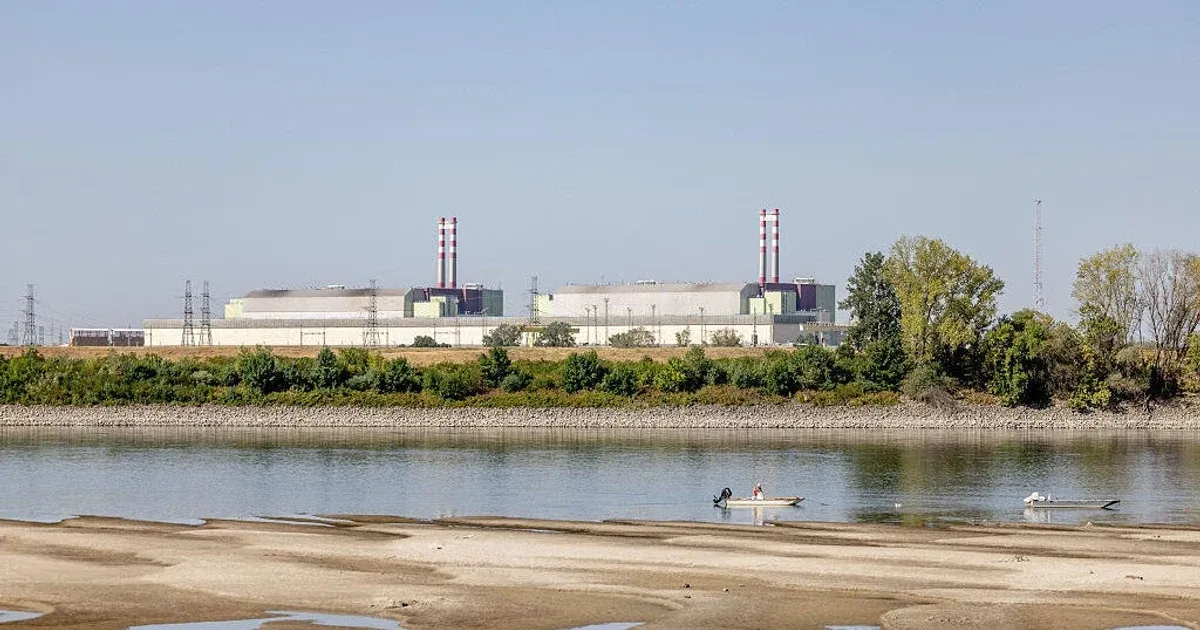
Record-low water in the Danube has pushed Hungary's only nuclear power station close to a complete shutdown, turning a regional drought into an immediate test for the national grid. Three of the four reactors at Paks were out of operation by Wednesday morning, while the remaining unit was running at about half power. In normal conditions, the 44-year-old Soviet-designed station supplies roughly half of Hungary's electricity.
On August 5, 2026, the government was trying to hold that loss inside the power system rather than pass it directly to households. Hungary had nearly doubled electricity imports through its connections with neighboring countries, and officials said the state was absorbing the additional cost for the time being. The response also reached public buildings and daily routines as Budapest endured temperatures above 100 degrees Fahrenheit.
Danube Cooling Turns River Depth Into a Reactor Limit
The station is roughly 60 miles downstream of Budapest, and its reactors take cooling water from the Danube without the intermediary of recirculating towers. Plants in the United States, Britain, Germany and France often use those large structures to reuse water, while Paks depends on adequate river flow at the site. More than three months of drought has reduced that margin, showing how the record-low river crisis can move from navigation and agriculture into power generation. The Danube was once assumed too large to run dry, but the immediate operating constraint is now the water available to remove heat safely.
The weather window is narrow. CBS News reported that meaningful rainfall was not expected for at least 10 days and that river levels were forecast to fall further. Prime Minister Peter Magyar said a cold front expected Friday offered some relief, but he described Wednesday and Thursday as critical days for the plant. The uncertainty therefore rests on two linked thresholds: whether cooler weather eases demand and whether Danube conditions remain sufficient for the final operating reactor.
“There are a few critical days left. Today and tomorrow are certainly that.”
Authorities have already reduced demand in visible ways. Budapest's nighttime landmarks went dark under an order covering over 300 state-linked properties, among them Buda Castle and the Chain Bridge. Residents were told to move clothes-washing and dryer use outside the 5 p.m. to 10 p.m. period, when evening demand puts more pressure on the network. Those steps do not replace lost generation, but they lower the peak that imports and the remaining Paks output must cover. They also make conservation part of the government's short-term supply plan.
The government maintained that supply was stable and problem-free, even as it asked residents to conserve electricity. That claim describes the grid's current balance, not the return of the plant's unavailable units. Nearly doubled electricity imports are carrying more of the load through one of Europe's more interconnected national networks, while the state shields consumers from the higher purchase cost. Interconnection provides immediate buying options, but it does not create replacement generation inside Hungary. If low water persists, officials must judge how long public funds and cross-border capacity can support the gap.
Ten Dry Days Separate Grid Management From a Deeper Shortfall
The Paks disruption gives Magyar's new government its first infrastructure emergency after his Tisza party ended Viktor Orban's 16-year rule. Its options are measurable: conserve during peak hours, buy more power abroad and preserve enough cooling capacity for any reactor that can operate safely. A further shutdown would remove the station's remaining output at the same time extreme heat raises demand, narrowing the room for error across all three measures. Friday's cold front could reduce heat pressure, but the longer rainfall outlook still governs the plant's cooling supply.
The episode also exposes a design assumption that reaches beyond one plant. Paks was built beside a river once treated as too large to run dry, yet southeast Europe's prolonged drought has turned that water source into the station's binding limit. Copernicus measurements cited by CBS News place Europe's rate of warming at over double the worldwide pace. For Hungary, the operational lesson is already visible: generation security now depends on river conditions, imported electricity and conservation working together until the weather changes. The duration of that arrangement will show how resilient the grid is under a deeper low-water event.